In “Two Sisters and a Piano” written by Nilo Cruz and directed by Lisa Portes, we soon learn these two women have been trapped for years under house arrest in an aging manor in Cuba. One is a writer, the other a musician —and that’s her baby grand piano on stage. Maria, the writer (Andrea San Miguel in a darkly rich performance), awaits news of her husband who escaped to freedom in Sweden five years before, yet his letters never arrive. The musician, Sofia (Neysha Mendoza Castro is a delight) is a free spirit, chafing under the constraints of always being at home.
It is 1991. The sisters home is a decaying Spanish Colonial manor house, with colonnades and columns. A spiral staircase leads to the bedrooms above, and the Caribbean Ocean beyond is visible through the windows (Brian Sidney Bembridge is Scenic Designer.)
The Russian policies of perestroika and increased market openness that led to the collapse of the Soviet Union, causes Russia to withdraw from its Cuban client state. Though this sounds timely given current events, playwright Nilo Cruz (who won a Pulitzer for “Anna in the Tropics”) uses the circumstances only as backdrop for something deeper. The political shift dispenses a sense of tumult and change.
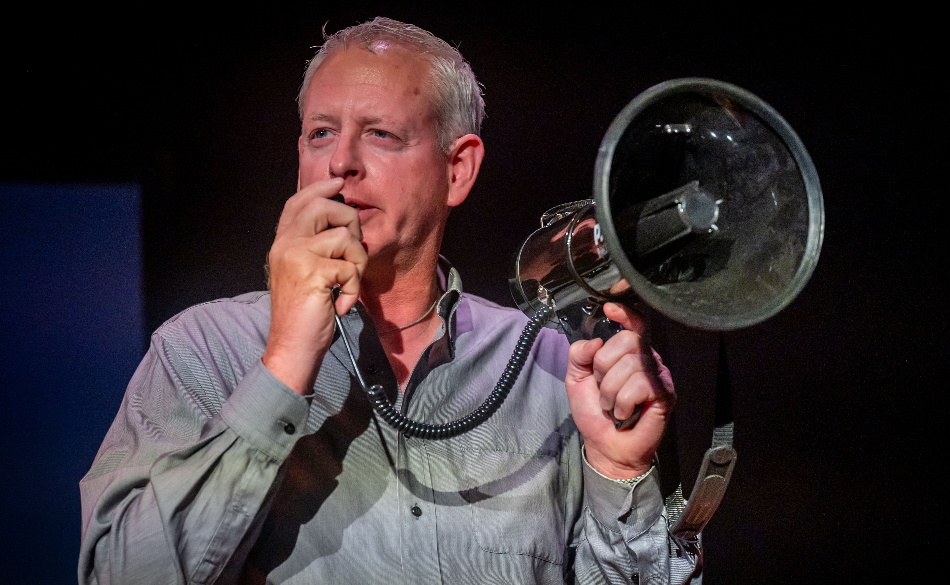
A military officer, Lieutenant Portuondo (Adam Poss), arrives on the scene carrying satchels of correspondence from Maria’s husband from his safe harbor in Sweden. Portuondo appears sinister at first, and we gather that he thinks the letters may be masking plans for Maria’s escape. But we soon learn that is not his game, as he taunts Maria, then whittles away at her strong resistance, exposing her vulnerabilities by reading selections from the pile of sometimes ardent letters.
Her sister Sofia plays that piano at times, mostly reluctantly, but her soul is suffering as she feels cut-off from humanity. Even their radio dies, silencing their only source of news. We learn that neighbors loyal to the government monitor their activities, and no one visits.
Eventually a permissible opportunity allows a piano tuner to be summoned: Victor Emmanuel (Arash Fakhrabadi), an open-hearted and warm fellow whom Sofia charms into returning to visit her again.
Thus we have two parallel relationships which the playwright explores, but to my mind, not effectively. At times we have to do too much work to gather the motivations of the characters. The playwright may think them self-evident. We can see that Lieutenant Portuondo has fallen in love—perhaps because he has read so many of the letters from Maria’s husband? We get rather melodramatic expressions of aspirational longing.
“There is something about you and your sister that’s different,” says Lieutenant Portuondo. “You’re pure.” And yet he keeps these pure beings under arrest. There is much talking about, reminiscing, but not enough action. In one such conversation, Lieutenant Portuondo says “I think people die there from looking at the cows.” To which Sofia replies, “Moo!” Which earns a laugh, but to me it also sounded like an actress trying to save a play.
In fact the most engaging moments are those comic antics that Neysha Mendoza Castro’s Sofia drums up, along with her accomplice Fakhrabadi’s Victor Emmanuel. Nilo Cruz is a skillful playright, the sert-up is intriguing, and the turning points and rising action and resolution show up. But the most interesting parts are the relief provided by the scenes with Victor the piano tuner and Sofia, who finally cracks under the oppressive weight of her seclusion. That piano is not played enough to warrant its billing in the title. And the repetitive arrivals of Lieutenant Portuondo and the continuous voice of alarm in Maria’s complaints offer drama more on the order of soap opera—going not very far, ultimately.
Somewhat recommended, if only for the excellence of the overall production, “Two Sisters and a Piano” runs at Writers Theatre through March 29 in Glencoe, IL.
This review is proudly shared with our friends at www.TheatreInChicago.com.