
Displaying items by tag: Tyrone Phillips
Definition's How We Got On: A Mixtape for the Stage
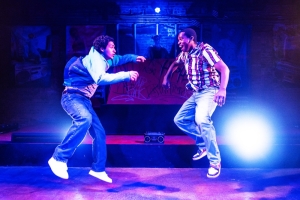
What happens when three young people discover hip-hop and realize they might have something to say? Idris Goodwin’s How We Got On, directed by Definition Theatre Artistic Director Tyrone Phillips, answers that question with rhythm, humor, attitude and plenty of heart. Think of it as a mixtape for the stage - a collection of voices, beats, dreams and memories that takes us back to the 1980s, when hip-hop was still growing and figuring out what it could become.
Jamal Turner’s Hank is ambitious, curious and hungry to find his place. He’s a young guy who discovers that writing rhymes gives him a voice and a way to express what he may not always be able to say out loud. Turner makes Hank likable, funny and real. You can see the excitement in him as he begins to realize that maybe he has something special.
Tony Garcia’s Julian brings a completely different flavor. He is confident, competitive and determined to prove himself. Garcia gives Julian plenty of swagger, but there is vulnerability underneath it. His chemistry with Turner makes their friendship and competition fun to watch.
And then there’s Luann, played by Anuoluwa T. Awolola. Luann is a talented rapper who has almost everything under control. She has the confidence, the skills and the flow. Her one problem is that she’s a girl trying to make it in a male-dominated hip-hop world. Awolola gives Luann the confidence of someone who knows exactly what she can do - and isn’t waiting for anyone’s permission to do it.
Maya Vinice Prentiss is a standout as the Selector, shifting effortlessly between narrator, DJ and several different characters. She is our guide through this musical journey, constantly reminding us that this isn’t just a story being told - it’s a story being spun.
Sydney Lynn Thomas’s set design gets the vibe right from the start. A wall filled with different beatboxes immediately transports us into the world of early hip-hop. It feels like walking into someone’s bedroom, record shop or neighborhood hangout where the next great track might be created.
Adding another visual dimension is Chicago artist John Vergara’s art installation. His colorful work, influenced by graffiti, portraiture and Chicago’s street culture, fits naturally alongside the production’s celebration of hip-hop and self-expression.
The show does have some pacing issues. There are moments when the energy drops, but once the rhythm kicks back in, How We Got On is hard not to enjoy.
This is a mixtape for the stage - a lively blend of music, memories, friendship and youthful ambition. It reminds us that before hip-hop became a worldwide cultural force, it was young people with something to say, a beat to work with and the courage to get on the mic.
RECOMMENDED
When: through September 27th
Where: Definition Theatre@55th, 1160 E. 55th Street., Chicago, Il.
Running time: 90 minutes no intermission
Tickets: Start at $25
312-469-0390
How We Got On - Definition Theatre - Through September 27th
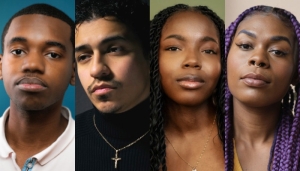
Definition Theatre is proud to present How We Got On, a mix-tape for the stage by playwright Idris Goodwin and directed by Tyrone Phillips. How We Got On will play a limited run from September 11– 27, 2026 at Definition Theatre (1160 E. 55th St, Chicago, IL) with previews September 11–12, 2026 and an opening on September 13 at 7:30pm. Tickets are $35 and are on sale now at definitiontheatre.org.
How We Got On tells the story of three suburban teenagers who discovered something that would change their lives forever. It's the 1980’s, and Hank, Julian, and Luann are determined to make their mark on the explosive new world of rap music. Armed with turntables, notebooks, and raw talent, they’ll navigate cultural isolation, family struggles, and fierce competition as they chase their dreams of becoming the next big thing.
But in the suburbs, far from hip-hop's birthplace, they'll have to fight twice as hard to prove they belong. Guided by a sultry DJ, the selector, who spins their stories with wit and wisdom, this electrifying production celebrates the passion, creativity, and determination of the generation that helped build hip-hop from the ground up—one beat, one rhyme, one battle at a time.
The cast features Jamal Turner, Tony Garcia, Anuoluwa T. Awolola, and Definition Ensemble Member Maya Vinice Prentiss.
The production team includes Director Tyrone Phillips, Assistant Director Lucy Whitehead, Production Manager Julie Jachym, Stage Manager Carissa Greene, Scenic Designer Sydney Lynn Thomas, Costume Designer Janelle Smith, Lighting Designer Garrett Bell, Lighting Design Intern Bria Hall, Sound Designer Kyle Cortes, and Movement Designer Breon Arzell.
Running in tandem with the production is The Sound Barriers Vol. 4, an installation of vintage boomboxes, paintings, and photography by Chicago muralist John Vergara. The exhibit is open Monday–Thursday from 5pm–9pm from Monday, September 14 – Thursday, Sept 24, 2026.
Chicago-based artist John Vergara time travels via boomboxes, the ultimate muse, in The Sound Barriers Vol. 4. Immersed in 1980’s Chicago hip-hop, funk, and house music, Vergara's vibrant brushstrokes, paint splatters, and graffiti work embody the movement of sound, while his cityscape photographs and portraits present music as a life form accompanying each person. Vergara has created more than 200 public murals, curated Chicago art shows for over 20 years, and is an advocate for the preservation of historical public art—work that helped lead to the founding of the City of Chicago Mural Registry.
PERFORMANCE DETAILS
How We Got On
Dates: September 11 – 27, 2026
Previews: September 11 – 12, 2026
Location: Definition @ 55th | 1160 E. 55th Street, Chicago, IL
Tickets: On sale now at definitiontheatre.org
EXHIBIT DETAILS
The Sound Barriers Vol. 4 by John Vergara
On View: September 14 – 24, 2026 (concurrent with How We Got On)
Hours: Monday – Thursday, 5pm – 9pm.
Location: Definition @ 55th | 1160 E. 55th Street, Chicago, IL
Admission: Free for How We Got On ticket holders, $15 for General Admission
ABOUT DEFINITION THEATRE
Definition Theatre has been a vibrant force for over a decade, celebrating stories created with, inspired by, and intended for people and communities of color. Through the act of making, Definition expands perspectives, stewards resources, and bridges the possibilities found at the intersection of art, innovation, and education. Known for bold and impactful productions, we’ve brought to life plays by Oscar-winner Tarell Alvin McCraney, Pulitzer Prize-winners James Ijames and Jackie Sibblies Drury, and Tony Award-winner Branden Jacobs-Jenkins. We strive to promote equity, foster empathy, and enhance the quality of life for our community members by offering opportunities for creative, entrepreneurial, and cultural expression. Our work emphasizes collaboration in theater-making and raises awareness of career paths in the arts. In 2024, Definition leased and equipped a storefront space in Hyde Park, enabling us to engage artists and expand programs as we prepare for our permanent home in Woodlawn on the southside of Chicago. This new theater, community center, and business incubator will amplify and preserve BIPOC voices, promote social justice, and empower the next generation of artists, entrepreneurs, and changemakers to drive positive progress through the transformative power of the arts.
Definition Ensemble members include: Adia Alli, Owais Ahmed, Ariel Beller, Jared Bellot, Carley Cornelius, Ari Craven, Julie Jachym, Willow James, Martasia Jones, Slick Jorgensen, Yeaji Kim, Kristy Hall, James Ijames, Julie Jachym, Willow James, Kiki Layne, Kelson Michael McAuliffe, Victor Musoni, Neel McNeill, Sophiyaa Nayar, Karyn Oates, Alexandra Oparka, Julian Parker, Maya Vinice Prentiss, Tyrone Phillips, Ireon Roach, Jacqueline Rosas, Christopher Sheard, and Dujon Smith.
Definition Artistic Advisory Board members include: director May Adrales, Steppenwolf ensemble member Alana Arenas, actress Shannon Cochran, actor Brandon Dirden, actor Jason Dirden, actor Jon Michael Hill, director Pam Mackinnon, Equity Quotient CEO Keryl McCord, professor JW Morrissette, director Ron OJ Parson, professor/lighting designer Kathy Perkins, media producer and host Troy Osborne Pryor, Tony Award-winning actress and stage director Phylicia Rashad, and Goodman Theatre director in residence Chuck Smith. Tyrone Phillips is the Artistic Director, Neel McNeill is the Executive Director, Willow James is the Civic Engagement Director. For additional information, visit definitiontheatre.org and @definitiontheatre on Facebook and Instagram #stayinit
Fat Ham at Goodman Theatre: Bold, Hilarious, and Heartfelt

James Ijames' Pulitzer Prize-winning play, Fat Ham, bursts onto the Goodman Theatre stage in a vibrant, deeply resonant co-production with Definition Theatre. Directed with an expert hand by Definition Theatre's Artistic Director Tyrone Phillips, this contemporary reinvention of Hamlet dazzles with humor, heart, and a profound exploration of identity, toxic masculinity, and generational burdens.
Set in a Southern backyard during a family barbecue, Fat Ham transforms Shakespeare's dark tragedy into a poignant yet hilarious meditation on living one's truth. At the center of this narrative is Juicy, played with remarkable nuance and emotional depth by Trumane Alston. Juicy's journey of self-discovery unfolds amid the ghosts—both literal and figurative—of his family's past, grappling with expectations of masculinity and the weight of inherited trauma.
Alston's performance is layered and compelling; his Juicy is introspective and tender yet brimming with an undercurrent of resilience, given time he will lean more into the character arc. His comedic timing is impeccable, delivering Ijames' sharp and incisive dialogue with a natural ease that invites the audience into his emotional world. Juicy's interactions with his spirited best friend Tio, brought to life by the dynamic Victor Musoni, provide some of the play's most humorous and thought-provoking moments. Musoni's portrayal of Tio is electric, offering a counterpoint to Juicy's introspection with boundless energy and unfiltered wisdom.
Ronald Connor impresses in the dual role of Rev and Pap, seamlessly shifting between the domineering ghost of Juicy's father and the charismatic over-sexed preacher presiding over family affairs. His presence looms large, embodying the toxic masculinity that haunts Juicy's world with an intensity that is both chilling and oddly comedic. Opposite him, Anji White as Tedra, Juicy's vivacious mother, delivers a powerhouse performance—balancing maternal warmth with an underlying desperation to escape her own past.
Ireon Roach’s Opal is a revelation, with her confidence simmering to the surface, while Sheldon Brown’s Larry, a stoic Marine grappling with his own identity, offers a poignant reflection of the play’s central themes. And no production would be complete without the powerhouse that is E. Faye Butler, whose presence on stage is nothing short of magical.
The technical elements of the production elevate the storytelling to new heights. Arnel Sancianco’s set design captures the essence of a Southern backyard with rich, lived-in detail, creating a tangible sense of place that enhances the play’s themes of home and heritage. Jos N. Banks’ costume designs are vibrant and character-driven, reflecting each individual's inner conflicts and outward personas. Jason Lynch’s lighting design cleverly shifts from naturalistic warmth to eerie supernatural hues, underscoring the play’s tonal shifts. Meanwhile, Willow James’ sound design punctuates the emotional beats with a careful blend of music and ambient sounds that ground the play’s heightened moments.
Phillips’ direction is both deft and sensitive. He embraces the play's comedic elements without undercutting its emotional weight. He crafts a production that honors Ijames’ bold vision while allowing the cast to fully explore the complexities of their characters.
Fat Ham is a triumph—an innovative, riotously funny, and ultimately moving exploration of what it means to break free from the ghosts of the past and forge an authentic future. Whether you're a Shakespeare purist or someone looking for a fresh, contemporary take on a classic story, this production offers something truly special.
With an outstanding ensemble, sharp direction, and a creative team firing on all cylinders, Fat Ham at Goodman Theatre is a must-see theatrical event that redefines what it means to inherit, to resist, and to thine own self be true.
Highly Recommended
When: Through March 2
Where: Goodman Theatre, 170 N. Dearborn St.
Tickets: $25 - $85
Info: Goodmantheatre.org/Ham
Review: Chicago Shakespeare Theater's 'Twelfth Night'

From Twelfth Night’s well-known opening lines “If music be the food of love, play on …,” the stage is set for Shakespeare’s madcap comedy of misplaced love and mixed-up identities. Woven throughout this production are the colors, culture, and Caribbean-inspired music that play almost as important a role as the actors on stage.
There are those who prefer their Shakespeare straight up and true to the Bard’s written word and intended setting. I, however, am not one of them. I enjoy seeing Shakespeare’s plays reimagined and reset into different settings and time periods, and I was thoroughly enchanted and entertained by director Tyrone Phillips’ interpretation of Twelfth Night.
In his debut as a director at Chicago Shakespeare Theatre, Phillips brings his personal background to the stage as a first-generation Jamaican America. The island kingdom of Shakespeare’s Illyria comes to life under Phillips’ direction as a Caribbean paradise, complete with swaying palm trees, a sandy shore, and a reggae-inspired beat that pulses throughout the show.
There’s no way you can leave the theatre without a smile on your face, as if you’ve just been on a mini-vacation.
We first meet the Duke Orsino, played by Yao Dogbe, a talented veteran of Chicago Shakespeare, lamenting his unrequited love for Countess Olivia, who has declared a seven-year period of mourning for her brother. The duke’s emissaries have all been rejected, and he is at wit’s end.
That is, until a spectacular storm at sea deposits the young Viola, aptly played by Jaeda LaVoone in her debut at Chicago Shakes, on the beach of Illyria. Believing that her twin brother, Sebastian, has drowned in the storm, she disguises herself as a young lad, Cesario, and seeks employment with the duke. There’s something about the well-spoken Cesario that prompts the duke to send him to Olivia to proclaim the duke’s love to her.
Viola is immediately smitten by the duke, but vows to serve her master, and so as Cesario, goes off to see Olivia, wonderfully played by Christiana Clark. Craziness ensues as Olivia becomes love-struck with Cesario, and comically, Viola finds herself trying to extract herself from this awkward love triangle.
Throw into the mix the subplot of characters, led by Olivia’s uncle, Sir Toby Belch, (Ronald L. Conner), and his sidekick, Sir Andrew (Alex Goodrich), who plot to prank the uptight Malvolio, Olivia’s stalwart steward, by leading him to believe that his mistress is deeply in love with him. Add the surprise appearance of Olivia’s twin, Sebastian, who in actuality also survived the shipwreck, and the series of mistaken identities that result add to the chaotic comedy.
But, as with all Shakespeare’s comedies, all is resolved in the final scenes. Brother and sister are reunited. The Duke and Olivia, at last, find their true loves (and not with each other!), and even the mistreated Malvolio realizes that “everyone is fragile,” and makes his peace with his adversaries.
The production is a homecoming of sorts for Phillips, who first visited Chicago Shakespeare as a teen and later performed on its stage in A Midsummer’s Night Dream. He has assembled a talented group of predominantly African-American actors who bring an energy and authenticity to the show. For me, the performances by Clark’s Olivia and Paul Oakley Stovall’s Malvolio stood out. Clark’s Olivia is bold, beautiful, and determined to win Cesario’s love. I was captivated by her larger-than-life presence whenever she was on stage. And Stovall shines as the puritanical prude, Malvolio, who underscores his performance with a subtle gesture or a raised eyebrow.
From the opening scene where Olivia’s jester Feste (Israel Erron Ford) invites islanders to stroll with him to a reggae-inspired beat to the curtain-call where the entire cast dances to that same exuberant rhythm, Twelfth Night is an energetic, joyous, laugh-out loud romp that is sure to entertain – a perfect escape for a couple hours from the holiday stress.
You can still get in on the fun as Chicago Shakespeare extended its run through Dec. 3.
Mind blowing 'FAIRVIEW' By Definition Theatre at The Revival

I’m going to do my best to not provide any spoilers in my review of “Fairview” the 2019 Pulitzer Prize winning play by Jackie Sibblies Drury. It’s going to be hard. Definition Theatre’s production under the direction of Tyrone Phillips will certainly challenge its audience. This production starts in heightened realism, flows into surrealism, runs head on into the absurd before landing a moralistic gut punch. It would be unfair of me to describe the twist, turns and surprises. Everyone should be given a fair view of this excellent production for themselves.
Director Tyrone Phillips has staged “Fairview” as a play within a play. We are introduced to the home of The Frasier Family. It is a nice, if somewhat simple home. The type of home you may find in so many television sit-coms. It becomes obvious the Frasers are middle class African Americans once we meet high anxiety Beverly (Kandice Robins) and her hen-pecked, doting husband Dayton (David Goodloe). They are straight out of central casting, Perfect. If you closed your eyes and just listened to them, you would be hard pressed to guess their race. Yeah…those Black people.
Beverly is preparing a birthday dinner for her mother, the family matriarch, and everything must be perfect because, well, what would people think. As Beverly sits cutting carrots listening to Stevie Wonder’s “Happy Birthday” the channel on the radio changes and starts to play the traditional “Happy Birthday Song. It rattles Beverly for a minute, but the music quickly changes back, and she continues her preparation of the dinner as if nothing happened. Her sister, Jasmine (Martasia Jones) arrives with a bottle of rose wine to kick the party off. It is obvious Jasmine is a little more spirited (o.k. she’s ghetto)
than her proper sister. She’s opinionated, gossipy, loud and (well, ghetto.) We next meet Keisha, (Jada Jackson) the teenage daughter any family would want. She has the usual teenage problems but it’s clear she’s very smart and focused.
The family has the usual conversations any middle-class family would have. Beverly is hoping her lawyer brother, Tyrone makes the party. Keisha wants her Aunt Jasmine to ask her mother to allow her to take a gap year after graduation. Dayton is helping his wife as much as he can. Jasmine and Beverly have an on-going rivalry. Beverly gets more anxious as things aren’t going perfectly. When she realizes the cake has burnt she faints, chopped carrots fly everywhere. Lights down!
The lights come halfway up on stage. And for the next five to ten minutes stagehands reset the set. This happens right before our eyes. The genius of Phillips is giving the audience the opportunity to have a conversation while this is going on. Nothing truly remarkable happened in the first act. Its unremarkable nature was, in fact, was quite remarkable. There are going to be some interesting conversations going on during this non-intermission.
The actors start the show from the top, except this time they are doing it in silence. There are two new audience members seated arguably in the best seats in the house. As everyone’s conversation has subsided, these new audience members conversation is just starting. We’ll call the more aggressive White male, Jimbo (Max Stewart) and the more liberal leaning White women, Suze (Barbara Figgins). The topic of Jimbo’s conversation: If you can be any race, what race would you be? Poor guilt-ridden, bleeding-heart Suze is verbally abused by Jimbo. She refuses to answer, she doesn’t want to be wrong for one thing. Next to walk into this conversation is a white man we’ll call Mack (Collin Quinn Rice). He clearly knows what race he wants to be, Latinx, not Latino, Latinx. He practically fetishizes the Latinx. Rounding out this coterie, is European born Bets (Carly Cornelius). Asked the same question, Bets answer is probably the weirdest or rather the most interesting. She eventually comes around.
Initially, this conversation seems to have no bearing on the Frasier family’s affairs, with their prying questions and uneasy answers. I was tempted to disregard the actions on stage for the action happening in the audience. However, as Act ll progresses, the two plotlines converge and interact, creating some of the most hilarious comedy I’ve seen on stage in a very long time.
“Fairview” is an exploration on the white gaze. Writer Jackie Sibblies Drury has let us in on the private thoughts of white people. We get an idea of how people create whole scenarios based solely on race, especially the Black race. They weren’t even listening to The Frasiers. They made up the story to suit their individual biases. Director Phillips has made the “white gaze” an actual gaze done by actual white audience members. We see how matter of factly racist tropes are spewed especially when it’s “just amongst us”. This play is also an exploration in the art of the mindfuck. The Urban Dictionary describes a mindfuck as something to confuse or reshape your thought the way the "mind-fucker" wants you to think. making you question, doubt, or acquire a new set of ideas based on what the perpetrator has told you. Susan Lori Parks did a mindfuck with Topdog/Underdog. By naming her characters Lincoln and Booth, she tells us what is going to happen. Yet we act like we don’t know what will happen. Jackie Sibbles Drury is a bit more sly but equally effective.
This production is excellent. The ensemble was perfect. The Choreography by Jyreika Guest, who was magic in “How Blood Goes” another excellent production, was engaging and fun. Special recognition must go to Props Designer Mariah Bennett (you’ll understand when you see the show). The costumes by Alexandria Richardson ran the gamut from plain to unforgettable.
Theater should challenge and inspire. Theater should beg you to question and dare you to act. Theatre should teach and enlighten. “Fairview” does all these things and if you have a heart it will move you, and don’t we deserved to be moved…….. ain’t it time!
HIGHLY RECCOMMENDED
When: Through May 28
Where: The Revival, 1160 E. 55th Street Chicago
Running time: 120 minutes
Tickets: $35
Contact: definitiontheatre.org
Review: "Stick Fly" at Windy City Playhouse

"Stick Fly" is about the Levays, a wealthy African American family, who go to their beach house for a weekend getaway. What started off as two brothers bringing their significant others to meet their parents ends with revelations of deception, racial issues, and relationship woes.
The older brother, played by Michael Pogue, does an excellent job in his role as an arrogant plastic surgeon. He brings home his Italian girlfriend, Kimber, who is strong, independent, and aware of her own privilege. Tyrone Phillips plays the younger brother, Kent, who has definitely gone through a journey to find himself but finally settled into writing to which he shows some talent. His girlfriend, Taylor, is neurotic and comes from a lower class background although her father is a well-liked and respected anthropologist who has written several books. We later learn that he left her at a very young age and created his own family that didn't include her.
The family invites their longtime housekeeper to the beach house for the weekend but she asks her daughter Cheryl, played by Paige Collins, to fill in for her due to her illness. What we soon find out is that Cheryl went to a top tiered high school on scholarship and she is ready to attend college soon. It is apparent that she is out of place and clearly does not fit in.
I couldn't help but to be impressed with Phillip Edward Van Lear’s performance as Dr. Levay. He is the matriarch and does a great job at commanding the stage when he walks in.
I appreciate the playwright's attempt at bringing a very complex storyline to the theater. I was impressed with the fact that I was able to connect to a couple of characters as they all seemed to have some sort of problem. However, I felt at the end some of the characters were not fully developed and seemed a bit disjointed. Emotions were running high and it appeared that Cheryl just gave up at the end which was a bit of a disappointment.
"Stick Fly" is the play to see if you like dramas with some comedy. Not only does it touch on many things such as family abandonment as well as racial issues; it leaves you reflecting on some of the things you may have encountered in your own life, especially if you are African American. This play is worth checking out at Windy City Playhouse, a non-profit theater that supports local actors. To be honest, any play that opens with Stevie Wonder is good in my book.



Latest Articles
-
 Detroit ’67: A Basement Becomes a City on the Brink
Written by Wesley DavidDetroit was burning in the summer of 1967, inside one basement, life was still going on. That contrast is at the heart of Dominique Morisseau’s Detroit ’67, now being produced by Pulse Theatre Company in residence at eta Creative Arts…
Detroit ’67: A Basement Becomes a City on the Brink
Written by Wesley DavidDetroit was burning in the summer of 1967, inside one basement, life was still going on. That contrast is at the heart of Dominique Morisseau’s Detroit ’67, now being produced by Pulse Theatre Company in residence at eta Creative Arts… -
 Now Boarding: Bonnie’s Last Flight, a Sky‑High Comedy with Real Heart
Written by Ken PayneRivendell Theatre Ensemble closes its milestone 30th season with Bonnie’s Last Flight, a sly, sky‑high comedy set during a flight attendant’s final day on the job - a blend of sharp satire and warm, traditional character comedy that’s genuinely, disarmingly…
Now Boarding: Bonnie’s Last Flight, a Sky‑High Comedy with Real Heart
Written by Ken PayneRivendell Theatre Ensemble closes its milestone 30th season with Bonnie’s Last Flight, a sly, sky‑high comedy set during a flight attendant’s final day on the job - a blend of sharp satire and warm, traditional character comedy that’s genuinely, disarmingly… -
Chicago Shakes' Play On!: With a Syncopated Harlem Beat
Written by Wesley DavidThere are some productions you watch, and then there are productions that make your heart swoon and your toe tap. Sheldon Epps’ Play On! is definitely the latter. Now playing at Chicago Shakespeare Theater, this exuberant musical takes Shakespeare’s Twelfth…
-
 Step Right Up and Ride the Cyclone (The Musical) at Metropolis Arlington Heights
Written by Anne RakowieckiIf anyone has ever told you to buckle up and enjoy the ride, they were talking about life—and even if they didn’t know it, they were talking about Ride the Cyclone, the musical. When six teenagers die in a rollercoaster…
Step Right Up and Ride the Cyclone (The Musical) at Metropolis Arlington Heights
Written by Anne RakowieckiIf anyone has ever told you to buckle up and enjoy the ride, they were talking about life—and even if they didn’t know it, they were talking about Ride the Cyclone, the musical. When six teenagers die in a rollercoaster…
Does your theatre company want to connect with Buzz Center Stage or would you like to reach out and say "hello"? Message us through facebook or shoot us an email at This email address is being protected from spambots. You need JavaScript enabled to view it..
*This disclaimer informs readers that the views, thoughts, and opinions expressed in the text belong solely to the author, and not necessarily to Buzz Center Stage. Buzz Center Stage is a non-profit, volunteer-based platform that enables, and encourages, staff members to post their own honest thoughts on a particular production.