Chicago Shakespeare Theater celebrates its 40th Anniversary season with the second production of its ambitious repertory. A Midsummer Night’s Dream is directed by Artistic Director Edward Hall with all the magic, spectacle, and visual amazement of a circus extravaganza. Presented in repertory with Shakespeare’s The Winter’s Tale, these productions offer audiences two very different journeys into Shakespeare’s imagination, where love, jealousy, power, and transformation take center stage.
In A Midsummer Night’s Dream, four young lovers find themselves entangled in a romantic mess when they venture into an enchanted forest ruled by mischievous fairies. Shakespeare’s familiar comedy of mistaken identities, misplaced affections, and magical interference becomes an opportunity for theatrical invention. Here, the forest is less a woodland retreat and more of a fantastical playground where anything can happen.
The mortals include Sean Fortunato as Theseus, Jessica Dean Turner as Hippolyta, Felicia Oduh as Hermia, Kevin Gudahl as Hermia’s father, Esteban Ortiz-Villacorta as Demetrius, Dan Haller as Lysander, and Grace Steckler as Helena. The craftsmen - amateur actors rehearsing a play for the upcoming wedding - include Erick Hellman as Peter Quince, a carpenter; Chiké Johnson as Nick Bottom, a weaver; Kieran McCabe as Francis Flute, a bellows-mender; Issy Van Randwyck as Robin Starveling, a tailor; Ronald L. Connor as Tom Snout, a tinker; and Demetrios Troy as Snug, a joiner.
Among the evening's comic highlights is Chiké Johnson as Nick Bottom. His transformation into a creature with the head of an ass is wonderfully realized, both visually and physically. Johnson embraces the absurdity of the transformation with such comic confidence that Bottom becomes impossible to resist. His bewilderment, self-importance, and complete obliviousness to his altered appearance make his encounters with Titania, who has fallen under a love spell, all the more hilarious. It is a delightful reminder of Shakespeare's genius for finding comedy in human vanity and the ridiculous ways love can make fools of us all.
Completing the ensemble are the inhabitants of the fairy kingdom. Fortunato doubles as Oberon, King of the Fairies, while Turner transforms into Titania, Queen of the Fairies. Patty Roache takes on Robin Goodfellow, delivering one of the most delightfully puckish interpretations of Puck I've encountered. Roache seems to relish every opportunity to stir up trouble, and their physicality brings an added dimension to the character's mischief.
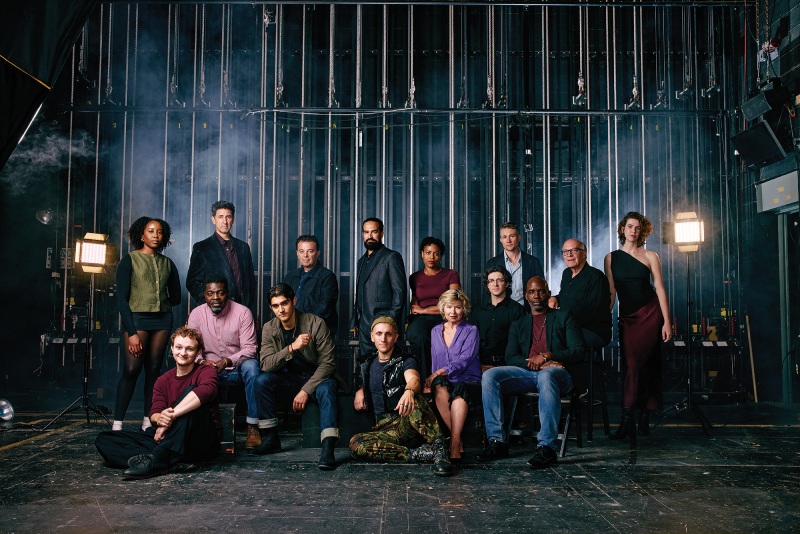
The cast of Chicago Shakespeare Theater's A Midsummer Night’s Dream. Photo by Kyle Flubacker.
One of the production's most striking achievements is Michael Pavelka's costume design, which is visually stunning, imaginative, and remarkably cohesive. The mortals inhabit a sophisticated palette of winter white and camel. The men wear tailored suits and coats with fur collars, while the younger men sport varsity jackets, cuffed trousers, sweater vests, and crisp white shirts. The women's dresses evoke 1940s silhouettes, creating an elegant period-inspired aesthetic.
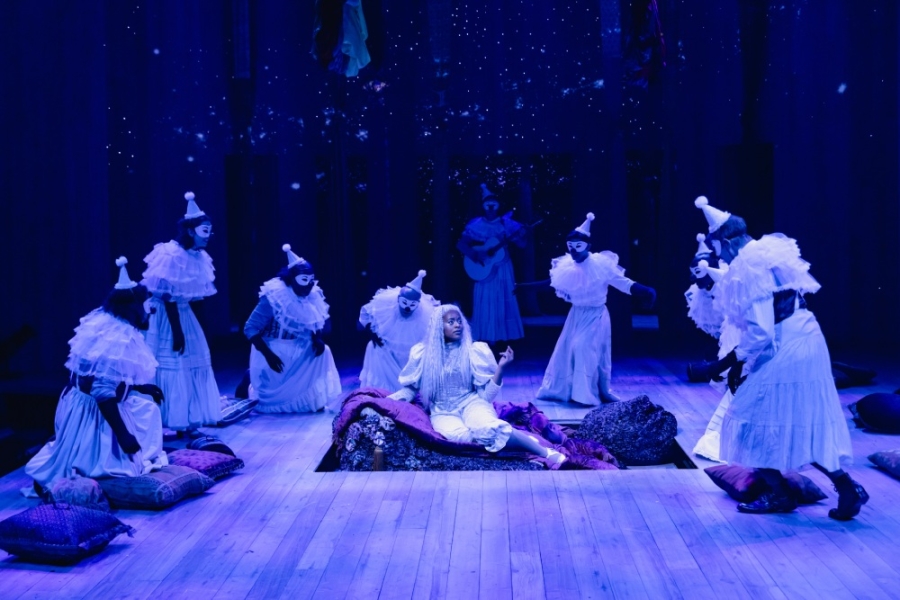
The craftsmen are dressed in costumes that identify their respective trades, while the fairies appear as Pierrot pixies, dressed entirely in white, complete with half-masks and delicate lace collars. Oberon and Titania make a dramatic visual statement: the Queen wears a lush white brocade gown, while the King is dressed in stark black. Their contrasting costumes reinforce the tension between these two powerful personalities. Robin Goodfellow, meanwhile, is outfitted as a striped mime with hints of leather, perfectly suited to the character's playful and unpredictable nature.
The set is deliberately stark, giving the performers room to move and allowing the physical spectacle to take precedence. One particularly memorable visual is Robin Goodfellow's entrance. Rising from the floor, twirling onto the stage, and observing the action from suspended silks like an aerialist, Roache turns Puck's entrances into miniature circus performances. It is an imaginative theatrical touch that reinforces the production's magical atmosphere.
Yet beneath all the spectacle is Shakespeare's enduring exploration of human foolishness. The lovers are tossed about by their own desires, Oberon and Titania engage in a battle of wills, and Bottom's transformation into an ass provides an absurd reminder that love doesn't always recognize what it sees. Shakespeare understands that love can be irrational, jealousy can be destructive, and human beings are often their own worst enemies.
That is part of the pleasure of this comedy. We laugh at the lovers' confusion while recognizing something familiar in their inability to control their emotions. The fairy world may be magical, but its inhabitants are hardly immune to the pettiness and power struggles of the human world.
The pairing with The Winter's Tale makes this repertory season particularly intriguing. Both plays explore jealousy, love, and transformation, but arrive at very different destinations. Where A Midsummer Night's Dream resolves its romantic entanglements through enchantment and comedy, The Winter's Tale confronts the devastating consequences of jealousy and the difficult possibility of forgiveness.
For its 40th Anniversary season, Chicago Shakespeare Theater reminds us why Shakespeare continues to captivate audiences. His characters may be centuries old, but their desires, insecurities, foolishness, and capacity for love remain remarkably recognizable. This A Midsummer Night's Dream embraces the theatrical possibilities of the play, inviting us into a world where imagination takes flight and the unexpected is always just around the corner.
Highly Recommended
When: Through January 3
Where: Chicago Shakespeare Theater 800 East Grand Avenue in Chicago
Runtime: 2 hours 30 minutes with a 15-minute intermission
Box Office: 312-595-5600
Info: www.chicagoshakes.com