
Displaying items by tag: Black theatre
ETA’s for colored girls Honors the Enduring Power of Ntozake Shange
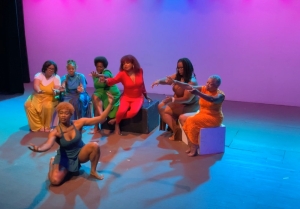
Nearly fifty years after its groundbreaking premiere, Ntozake Shange's for colored girls who have considered suicide / when the rainbow is enuf remains one of the most important works ever written for the American stage. Neither conventional play nor musical, Shange called her work a "choreopoem," a seamless fusion of poetry, dance, music, and theatrical ritual that forever changed the landscape of Black theatre.
When the work premiered in 1976 it shattered theatrical conventions. The original production gave Black women something rarely afforded on the American stage: the authority to tell their own stories without apology, through language that was lyrical, raw, sensual, political, and deeply personal. At a time when Black women were often relegated to supporting roles in theatre, Shange centered their voices, their pain, their joy, and ultimately, their survival. The production earned multiple Tony Award nominations and cemented itself as a cornerstone of the American theatrical canon.
Its relevance today is perhaps even more striking. In an era shaped by conversations surrounding gender-based violence, mental health, reproductive autonomy, identity, and the ongoing struggle for Black women to be fully seen and heard, Shange's words continue to resonate with astonishing clarity. The emotional truths embedded in her poetry refuse to age.
ETA Creative Arts Foundation's production, directed by Donn Carl Harper, wisely understands that the strength of for colored girls lies in trusting Shange's language. Harper resists the temptation to over-direct or impose unnecessary concepts upon the material. His direction is careful, respectful, and largely unobtrusive, allowing the poetry to remain the undeniable centerpiece.
The production, however, begins on an unfortunate note. Opening night started approximately thirty minutes late, a delay that inevitably affected the audience's energy. Compounding that issue was the decision to open with Nina Simone's haunting "Four Women." While Simone's anthem is unquestionably a masterpiece and shares thematic kinship with Shange's work, its placement here felt somewhat gratuitous. After already waiting half an hour, the audience was asked to spend another five minutes listening to a recorded song while nothing occurred onstage. Rather than heightening anticipation, the extended prelude tested the audience's patience before the choreopoem had the opportunity to speak for itself.
Once the production settles into Shange's text, however, it finds its rhythm.
Levi Wilkins' abstract scenic design provides an uncluttered visual landscape that allows the performers to inhabit both literal and emotional spaces. His lighting effectively supports the shifting moods of the evening, although both scenic and lighting concepts occasionally seem content to complement the material rather than challenge it. Given the limitless theatrical possibilities inherent in a choreopoem, I wish he would have made bolder visual choices that embrace the work's dreamlike qualities.
Markene Peavy's costume designs honor the play's iconic color symbolism, a safe choice, but it doesn't distinguish each woman as individuals, a missed opportunity. Peavy's choreography becomes the production's most compelling storytelling device. Rather than serving as decorative movement between monologues, the choreography extends Shange's language into the body, allowing emotion to continue flowing.
Among the ensemble, Madison Savannah (Lady in Purple) emerges as an exceptional physical storyteller. Her dancing possesses remarkable precision, grace, and emotional transparency, making every movement feel deeply connected to the poetry. She consistently commands attention without disrupting the ensemble's collective balance.
The performances throughout demonstrate a clear understanding that these women are not individual characters so much as facets of a shared experience.
Tina Marie (Lady in Red) delivers her poetry with commanding authority and emotional maturity. Margo Harper (Lady in Blue) brings quiet dignity and introspection, while Deborah Ross (Lady in Green) grounds her moments with warmth and humanity. Tracey Renee (Lady in Orange) finds welcome humor amid the heartbreak, providing necessary moments of emotional release. L.A. Holts (Lady in Yellow) infuses her work with youthful vitality and infectious spirit. Kennedi Coleman (Lady in Brown) offers moments of thoughtful restraint that contribute beautifully to the ensemble's collective voice.
Opening night also presented an increasingly familiar frustration that falls outside the production itself but nonetheless affected the theatrical experience. The persistent glow of cell phones and repeated audience distractions proved difficult to ignore. Theatre remains one of the few art forms built upon a shared agreement between artists and audience to be fully present in the moment. When that agreement is repeatedly broken, everyone in the room loses something.
Even with its uneven opening and a few missed opportunities for greater theatrical imagination,
ETA's production succeeds where it matters most: it trusts Shange.
That trust is ultimately enough.
Nearly fifty years after its premiere, for colored girls who have considered suicide / when the rainbow Is enuf continues to remind audiences that Black women's stories are not peripheral to the American experience - they are central to it. Their pain, laughter, sensuality, vulnerability, resilience, and joy remain as urgent today as they were in 1976.
Shange did more than write a play. She created a language for survival.
ETA Creative Arts Foundation honors that legacy with sincerity, sensitivity, and respect, reminding us that some masterpieces require no reinvention- only artists willing to listen deeply enough to let them speak.
Recommended
When: thru August 31
Where: 7558 South Chicago Ave Chicago
Tickets: $30 - $50 general admission



Latest Articles
-
 Detroit ’67: A Basement Becomes a City on the Brink
Written by Wesley DavidDetroit was burning in the summer of 1967, inside one basement, life was still going on. That contrast is at the heart of Dominique Morisseau’s Detroit ’67, now being produced by Pulse Theatre Company in residence at eta Creative Arts…
Detroit ’67: A Basement Becomes a City on the Brink
Written by Wesley DavidDetroit was burning in the summer of 1967, inside one basement, life was still going on. That contrast is at the heart of Dominique Morisseau’s Detroit ’67, now being produced by Pulse Theatre Company in residence at eta Creative Arts… -
 Now Boarding: Bonnie’s Last Flight, a Sky‑High Comedy with Real Heart
Written by Ken PayneRivendell Theatre Ensemble closes its milestone 30th season with Bonnie’s Last Flight, a sly, sky‑high comedy set during a flight attendant’s final day on the job - a blend of sharp satire and warm, traditional character comedy that’s genuinely, disarmingly…
Now Boarding: Bonnie’s Last Flight, a Sky‑High Comedy with Real Heart
Written by Ken PayneRivendell Theatre Ensemble closes its milestone 30th season with Bonnie’s Last Flight, a sly, sky‑high comedy set during a flight attendant’s final day on the job - a blend of sharp satire and warm, traditional character comedy that’s genuinely, disarmingly… -
Chicago Shakes' Play On!: With a Syncopated Harlem Beat
Written by Wesley DavidThere are some productions you watch, and then there are productions that make your heart swoon and your toe tap. Sheldon Epps’ Play On! is definitely the latter. Now playing at Chicago Shakespeare Theater, this exuberant musical takes Shakespeare’s Twelfth…
-
 Step Right Up and Ride the Cyclone (The Musical) at Metropolis Arlington Heights
Written by Anne RakowieckiIf anyone has ever told you to buckle up and enjoy the ride, they were talking about life—and even if they didn’t know it, they were talking about Ride the Cyclone, the musical. When six teenagers die in a rollercoaster…
Step Right Up and Ride the Cyclone (The Musical) at Metropolis Arlington Heights
Written by Anne RakowieckiIf anyone has ever told you to buckle up and enjoy the ride, they were talking about life—and even if they didn’t know it, they were talking about Ride the Cyclone, the musical. When six teenagers die in a rollercoaster…
Does your theatre company want to connect with Buzz Center Stage or would you like to reach out and say "hello"? Message us through facebook or shoot us an email at This email address is being protected from spambots. You need JavaScript enabled to view it..
*This disclaimer informs readers that the views, thoughts, and opinions expressed in the text belong solely to the author, and not necessarily to Buzz Center Stage. Buzz Center Stage is a non-profit, volunteer-based platform that enables, and encourages, staff members to post their own honest thoughts on a particular production.