
Displaying items by tag: Dairyon Bolden
Detroit ’67: A Basement Becomes a City on the Brink
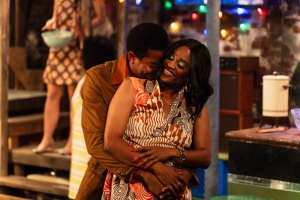
Detroit was burning in the summer of 1967, inside one basement, life was still going on.
That contrast is at the heart of Dominique Morisseau’s Detroit ’67, now being produced by Pulse Theatre Company in residence at eta Creative Arts Foundation. Directed by Pulse Executive Artistic Director Aaron Reese Boseman, with assistance from the wonderful AnJi White, the production takes us into the lives of people trying to maintain some sense of normalcy as their city moves toward upheaval.
The summer of 1967 was a year of enormous social and political upheaval. Detroit’s Black community was confronting racial discrimination, police brutality and economic inequality while the city was experiencing major changes in population, industry and employment.
Then came July 23.
A police raid on an after-hours establishment on Detroit’s 12th Street ignited five days of unrest. The uprising reflected longstanding tensions involving racial discrimination, police-community relations, economic inequality and the changing landscape of the city. Forty-three people died, hundreds were injured, thousands were arrested, and buildings throughout Detroit were destroyed or damaged.
Yet Morisseau doesn't put the uprising on display for us.
Instead, she puts us in a basement and allows us to listen to the people who have something to lose.
And what a basement it is.
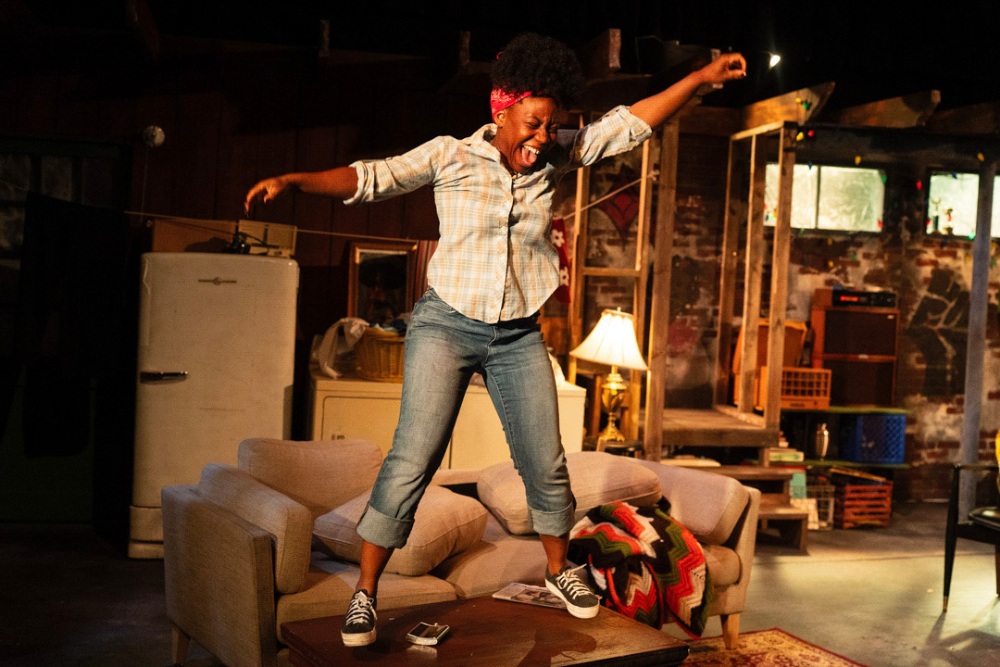
Photo Credit: Aaron Reese Boseman
Kevin M. Rolfs has created a remarkably realistic environment for this after-hours joint. An old washer and dryer, a well-used sofa, a period bar, scraps of wood and exposed beams make the space feel genuinely lived in rather than simply designed. Look around and you will find virtually everything you would expect in a 1960s Detroit basement.
Rolfs has proven himself a master designer, and this is among his best work.
Levi J. Wilkins’ lighting design is equally impressive. The basement does not exist in isolation. Light from outside constantly reminds us that another world is happening beyond those walls. The working fixtures inside, combined with changing light through the windows, establish the passage of time with remarkable precision.
Together with Warren Levon’s sound design, Terri Devine’s period-perfect costumes, and Rueben Echoles’ hair and makeup, the production creates an immersive portrait of 1967 Detroit. The design team doesn’t simply tell us we are in Detroit in 1967—they make us feel that we are there.
To say the ensemble is outstanding would be an understatement.
Shenise Danyel, whom I vividly remember as the maid in Invictus Theatre’s The House That Will Not Stand, is exceptional as Chelle, the level-headed sister whose strength anchors the household.
Tamarus Harvell another exceptional actor, plays Lank, a recent Vietnam veteran carrying dreams and the complicated weight of returning home from war. His presence reflects another reality of 1967: America was deeply immersed in Vietnam, with young men—including many Black and working-class men—being drafted into military service.
Jimiece Gilbert brings confidence and energy to Bunny, the best friend who knows exactly who she is.
Emma Jean Eastlund plays Caroline, a woman carrying secrets beneath the surface.
And then there is Dairyon Bolden as Sly.
Bolden was the biggest surprise for me. He is a genuine scene stealer, commanding every moment he occupies. That is no small accomplishment with a cast of this caliber. Bolden understands that commanding a scene does not necessarily mean being the loudest person in it. His choices are specific, confident and compelling.
Boseman’s direction brings the emotional life of Morisseau’s play to the surface without forcing it. The pacing is deliberate, and his decision to avoid blackouts between scenes works particularly well. The scenes roll smoothly into one another, creating the sense that life in this basement simply continues. There is no interruption between one emotional moment and the next. The outside world may be changing dramatically, but inside this basement, people still have to live, love, argue, dream and make decisions.
That contrast becomes one of the production’s greatest strengths.
The audience knows what is happening outside. The characters know what is happening outside. Yet the basement remains a place of refuge, business, friendship and possibility.
And that makes the history feel personal.
Detroit ’67 is ultimately about much more than an uprising. Through Morisseau’s writing, it becomes a story about people trying to hold onto one another while the world around them changes. The historical events give the play its pressure, but the characters give it its heart.
Pulse Theatre Company’s 2026–27 season is dedicated to examining Black life, family, memory and mental health across generations. Beginning with Detroit ’67, the company has established a compelling foundation for that exploration.
For Pulse Theatre Company, Detroit ’67 is not simply a production about 1967.
It is a reminder that history lives in rooms, in families, in memories—and sometimes, in a basement where the outside world is beginning to burn.
Highly Recommended
When: Through Nov. 1
Monday, Friday & Saturday 7:30pm
Saturday & Sunday 3:00pm
Where: eta Creative Arts Foundation 7558 S. Chicago Ave. Chicago, Ill.
Running time: 2 hours, 30 mins.
Tickets: $25-$40
(872)306-5734
A Compelling Vision of Desperation and Injustice: Lifeline Theatre's 'Native Son'

Lifeline Theatre’s production of "Native Son," directed by Ilesa Duncan and adapted by Nambi E. Kelley from Richard Wright’s seminal novel, is a masterful exploration of urban naturalism. With powerful performances and an incisive adaptation, the play captures the harrowing tale of Bigger Thomas, a young Black man whose life spirals out of control in 1930s Chicago.
The adaptation stays true to the novel’s brutal honesty, portraying a world where characters are shaped and ultimately doomed by forces beyond their control. Much like Upton Sinclair's "The Jungle," the narrative of "Native Son" is driven by the crushing weight of systemic racism and economic oppression. Duncan's direction ensures that every moment of this production is charged with a sense of inevitability, creating a haunting and immersive experience.
Nambi E. Kelley’s adaptation of "Native Son" powerfully employs W.E.B. DuBois's concept of "double consciousness" by dramatizing Bigger Thomas's internal conflict and the way he is perceived by the larger society. This duality is embodied in the character of The Black Rat, who represents Bigger's internal voice, and his awareness of the limitations imposed on him by a racially prejudiced society. Through dialogues and interactions with The Black Rat, Bigger’s consciousness is split between his self-perception and the identity forced upon him by systemic racism. This dramatization underscores the psychological toll of navigating a world where Bigger must constantly reconcile his personal identity with the dehumanizing stereotypes projected onto him by the white society, highlighting the perpetual struggle and fragmentation described by DuBois.
Tamarus Harvell delivers a riveting performance as Bigger Thomas, embodying the character's internal turmoil and external pressures with raw intensity. Harvell's portrayal captures the complexity of Bigger’s emotions—from his initial bravado and suppressed rage to his ultimate desperation and fear. His interactions with other characters reveal layers of vulnerability and frustration, making Bigger a deeply sympathetic figure despite his tragic actions.
Kamille Dawkins as Hannah, Bigger's mother, brings a poignant depth to her role. Her portrayal of a woman struggling to hold her family together amid relentless poverty and systemic racism is heart-wrenching. Dawkins' performance highlights the generational despair that permeates the Thomas family, adding a layer of emotional gravity to the narrative.
Mandy Walsh’s Mrs. Dalton is a study in benevolent racism. Blind and wealthy, Mrs. Dalton represents the liberal white America that believes in charity but remains blind to the systemic injustices it perpetuates. Walsh’s nuanced performance underscores the dissonance between Mrs. Dalton’s intentions and the impact of her actions on Bigger's life.
Laura Nelson as Mary Dalton and Nick Trengove as her boyfriend Jan play their roles with a blend of naivety and rebellious idealism. Their interactions with Bigger are uncomfortable, filled with well-meaning condescension that reflects their ignorance of the harsh realities faced by Black Americans. Nelson and Trengove adeptly capture the obliviousness of privileged youth, making their characters' tragic fates feel both inevitable and avoidable.
James Lewis, portraying The Black Rat, Bigger’s alter ego, adds a layer of psychological complexity to the production. This character, representing Bigger’s internal struggle and dual consciousness, is a haunting presence on stage. Lewis’ performance is both eerie and empathetic, providing insight into Bigger’s fragmented psyche and the pervasive influence of fear and anger.
Ashli Funches excels in her multiple roles as Bessie, Vera, and Leslie, showcasing her versatility and depth as an actress. Her portrayal of Bessie, in particular, is both tender and tragic, illustrating the collateral damage of Bigger’s actions and the broader societal constraints on Black women.
Gabe Fries as Detective Britten embodies the oppressive force of the law, delivering a performance that is both menacing and emblematic of institutional racism. His interactions with Bigger are charged with tension and prejudice, making the audience viscerally aware of the systemic barriers faced by the protagonist.
Dairyon Bolden’s Buddy, Bigger’s younger brother, brings a touch of innocence and hope to the bleak narrative. Bolden’s performance contrasts sharply with the despair surrounding him, emphasizing the devastating impact of systemic injustice on the younger generation.
The set design by Regina Garcia is both functional and symbolic, creating an oppressive urban environment that reflects the entrapment of the characters. The use of confined spaces and stark lighting enhances the sense of claustrophobia and inevitability that pervades the production. The minimalistic yet evocative set serves as a constant reminder of the harsh realities of Bigger's world. I wish the pre-show had featured music from the late 1930s to better immerse the audience in the play's historical setting.
Duncan’s direction ensures that every element of the production works in harmony to deliver a powerful message about race, poverty, and the human condition. The pacing is relentless, reflecting the constant pressure on Bigger as he navigates a world stacked against him. The use of sound and lighting to heighten tension and underscore critical moments is particularly effective, drawing the audience deeper into Bigger’s harrowing journey.
Lifeline Theatre’s "Native Son" is an important piece of theater, offering a poignant and unflinching look at a society riddled with racial and economic injustices. The stellar performances and Duncan’s incisive direction make this adaptation a must-see, offering a powerful reminder of the enduring relevance of Wright’s work. In capturing the essence of urban naturalism, this production not only honors the original novel but also provokes crucial reflections on contemporary issues of race and justice.
Highly Recommended
When: Through June 30
Where: Lifeline Theatre, 6912 N. Glenwood
Running time: 90 minutes
Tickets: $45 at
773-761-4477 and www.lifelinetheatre.com



Latest Articles
-
 Detroit ’67: A Basement Becomes a City on the Brink
Written by Wesley DavidDetroit was burning in the summer of 1967, inside one basement, life was still going on. That contrast is at the heart of Dominique Morisseau’s Detroit ’67, now being produced by Pulse Theatre Company in residence at eta Creative Arts…
Detroit ’67: A Basement Becomes a City on the Brink
Written by Wesley DavidDetroit was burning in the summer of 1967, inside one basement, life was still going on. That contrast is at the heart of Dominique Morisseau’s Detroit ’67, now being produced by Pulse Theatre Company in residence at eta Creative Arts… -
 Now Boarding: Bonnie’s Last Flight, a Sky‑High Comedy with Real Heart
Written by Ken PayneRivendell Theatre Ensemble closes its milestone 30th season with Bonnie’s Last Flight, a sly, sky‑high comedy set during a flight attendant’s final day on the job - a blend of sharp satire and warm, traditional character comedy that’s genuinely, disarmingly…
Now Boarding: Bonnie’s Last Flight, a Sky‑High Comedy with Real Heart
Written by Ken PayneRivendell Theatre Ensemble closes its milestone 30th season with Bonnie’s Last Flight, a sly, sky‑high comedy set during a flight attendant’s final day on the job - a blend of sharp satire and warm, traditional character comedy that’s genuinely, disarmingly… -
Chicago Shakes' Play On!: With a Syncopated Harlem Beat
Written by Wesley DavidThere are some productions you watch, and then there are productions that make your heart swoon and your toe tap. Sheldon Epps’ Play On! is definitely the latter. Now playing at Chicago Shakespeare Theater, this exuberant musical takes Shakespeare’s Twelfth…
-
 Step Right Up and Ride the Cyclone (The Musical) at Metropolis Arlington Heights
Written by Anne RakowieckiIf anyone has ever told you to buckle up and enjoy the ride, they were talking about life—and even if they didn’t know it, they were talking about Ride the Cyclone, the musical. When six teenagers die in a rollercoaster…
Step Right Up and Ride the Cyclone (The Musical) at Metropolis Arlington Heights
Written by Anne RakowieckiIf anyone has ever told you to buckle up and enjoy the ride, they were talking about life—and even if they didn’t know it, they were talking about Ride the Cyclone, the musical. When six teenagers die in a rollercoaster…
Does your theatre company want to connect with Buzz Center Stage or would you like to reach out and say "hello"? Message us through facebook or shoot us an email at This email address is being protected from spambots. You need JavaScript enabled to view it..
*This disclaimer informs readers that the views, thoughts, and opinions expressed in the text belong solely to the author, and not necessarily to Buzz Center Stage. Buzz Center Stage is a non-profit, volunteer-based platform that enables, and encourages, staff members to post their own honest thoughts on a particular production.