
Displaying items by tag: LaKecia Harris
Now Boarding: Bonnie’s Last Flight, a Sky‑High Comedy with Real Heart
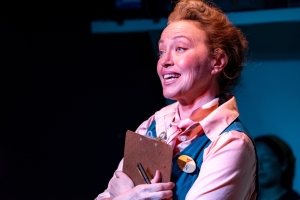
Rivendell Theatre Ensemble closes its milestone 30th season with Bonnie’s Last Flight, a sly, sky‑high comedy set during a flight attendant’s final day on the job - a blend of sharp satire and warm, traditional character comedy that’s genuinely, disarmingly funny. Jan has always carried a quiet love for writing, and now she’s earned a spot in an elite program - a dream she’s never fully allowed herself to chase. Handing over her wings means more than leaving the airline; it means finally giving herself permission to focus, to create, and to figure out who she is when she’s no longer defined by the job that shaped her life. But instead of treating her retirement as a tidy celebration, the play leans into the strange limbo that comes when a long‑held identity is about to disappear. Jan isn’t just stepping off a plane - she’s stepping out of the role that has shaped her routines, her friendships, and the way she moves through the world. That kind of transition can feel exhilarating, but it can also feel like freefall: What happens when the structure you’ve relied on for decades suddenly dissolves? Who are you when the uniform comes off?
Around her, the cabin is filled with a wonderfully mismatched crew navigating their own turbulence. Greig, her closest colleague - and one of the few people Jan truly considers family - is somehow the only person on board who doesn’t realize this is her final flight. While Jan quietly braces for the unknown, Greig clings to nostalgia – reminiscing about the 70s and 80s when people flew with style and grace, which in turn translated to proper behavior as passengers. LeeAnne, the rookie attendant, is still wobbling her way through the basics and is convinced the rest of the crew resents her simply for being young. Meanwhile, the Captain - who relies a little too heavily on mid‑air “comforts” - and the Co‑Pilot form an offbeat duo doing their best to keep the ride smooth and the mood light, even as everything around them threatens to veer off course. And then there’s Mark Twain – Jan’s guiding light and inspiration - drifting through the cabin like a sardonic travel spirit, adding an off‑kilter, almost dreamlike layer to the already unpredictable atmosphere. At any given moment, he might toss out a Twain‑ish zinger like, “Don’t argue with stupid people - they’ll drag you down to their level and beat you with experience.”
And yes - the title Bonnie’s Last Flight does mean something specific. The play waits to share it, and it’s worth letting that moment land on its own.
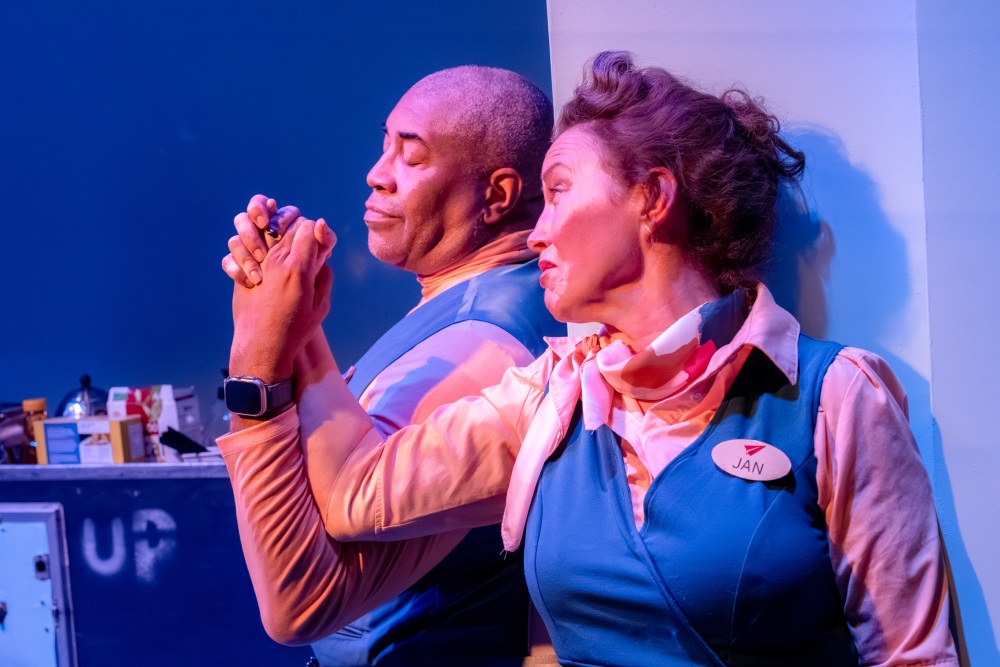
Paul Oakley Stovall as Greig and Rebecca Spence as Jan. Photos by Jenn Udoni.
Rivendell’s latest offering finds sharp, playful humor in every recognizable quirk of air travel - from the ritual of cramming bags into overhead bins to the exaggerated seatbelt pantomime, from the sad little routines of in‑flight food service to the collective sigh of a delayed takeoff, and even the inevitable moment when the Boingo internet keeps going down. Playwright Eliza Bent (The Regulars, Karen, I Said) threads these details together with wit and oddball charm - comic gold, really - especially in the way she captures the crew’s half‑coded, half‑conspiratorial communication style. Director Devon de Mayo amplifies that energy by staging the entire piece as an 85‑minute real‑time passage through the air on the gloriously scrappy Smelta Airlines, traveling from “use your imagination” to Chicago. Audience members are assigned boarding groups before entering, and once inside, the immersion never breaks - we are the passengers, and the cast treats us as such. In Rivendell’s intimate 40–50 seat house, the action unfolds close enough to feel immediate, with scenes playing out just a few feet away and often surrounding you entirely. Surprise song‑and‑dance numbers erupt out of nowhere and are executed with precision that feels almost impossible in such close quarters. As someone who now dreads flying, I thoroughly enjoyed being on this airborne adventure.
On top of the cleverly crafted script and fine‑tuned direction, the cast’s blend of Rivendell regulars with notable newcomers is the last flourish that makes the whole thing take off. Rebecca Spence, a longtime Rivendell ensemble member fresh off her appearance in Chicago Shakespeare Theater’s Fault directed by Jason Alexander and her screen work on Taylor Sheridan’s The Madison, returns with a commanding presence as Jan, grounding the production with a performance that moves effortlessly between wry humor and quiet emotional depth. Up close, we see what a truly talented actor she is - we feel every beat of her internal calculus, the uncertainty, the flickers of excitement, the moments of reflection, and even the disappointments, all delivered with a subtlety that makes her journey resonate long after the plane arrives in Chicago.

Eric Slater (left) as Pilot and Glenn Obrero as Co-Pilot in Bonnie's Last Flight.
Spence is joined by fellow Rivendell ensemble members Jessica Ervin, Eric Slater, and Glenn Obrero, each bringing sharp timing, confident comic instincts, and just the right touch of vulnerability when the moment calls for it, with Paul Oakley Stovall and LaKecia Harris rounding out the cast as fantastic additions who elevate the ensemble’s already cohesive dynamic.
Eric Slater’s dry‑witted Captain/Pilot lands every beat with understated precision, while Jessica Ervin’s off‑balance LeeAnne provides a wonderfully unpredictable charge that never feels forced. Glenn Obrero’s earnest Co‑Pilot (“Jesus,” as the Captain likes to refer to him), brings a lovable silliness along with genuine warmth, a combination that gives the show extra bounce. Paul Oakley Stovall, a standout as Greig, draws on his wide‑ranging stage experience to deliver a performance full of nuance, comic assurance, and centered emotional presence that adds unexpected depth to the production. The ensemble’s cohesion is further strengthened by LaKecia Harris, whose turn as Mark Twain brings a sly, confident rhythm that meshes seamlessly with the group’s comic fabric. Together, they’re dynamite - fully in tune with one another and performing with the cohesion of a team that’s been flying together for years.
At its core, Bonnie’s Last Flight is less about airline chaos and more about the uneasy moment when a person realizes the next chapter of life doesn’t come with a boarding pass. Jan is standing at the edge of retirement, a place where excitement and dread blur together. Leaving a long‑standing job can feel like stepping off a moving walkway: suddenly the rhythm that shaped your days disappears, and you’re left wondering who you are without the role that once defined you. While Jan wrestles with that quiet panic, the rest of the cabin spirals in their own directions - LeeAnne dodging emotional landmines, the Captain leaning too hard on liquid courage, and Erik trying to squeeze a thought into the noise. Beneath the jokes and mishaps, the play nudges at something more human: the fear of losing purpose, the hope of reinvention, and the strange freedom that comes when life forces you to start over.
This design team gives us the feel of being inside an airplane, creating an environment that gently echoes the experience of settling into a cabin. Scenic designer Regina García shapes Rivendell’s intimate space into a compact aircraft interior, complete with a cockpit, a small lavatory, a food‑and‑drink station, and lighted walkways that recall the soft glow of aisle markers guiding passengers to their seats. Saawan Tiwari’s costumes reinforce the world with grounded, character‑specific details that nod to real airline crews without slipping into caricature. Garnett Bell’s lighting adds subtle shifts that mirror the ambience of a cruising cabin or the quick changes that accompany an announcement. And Satya Chavez’s sound design supplies the familiar chimes, the pressurized hush of doors, and the clipped rhythm of airline instructions, creating an auditory landscape that instantly situates us in the sky.
In short: Bonnie’s Last Flight promises a strange, playful, and slightly chaotic airborne adventure - a character‑driven comedy about people stuck in the sky and stuck in their lives, trying to figure out what comes next. The humor lands repeatedly with precision, but what ultimately gives the show its staying power is the heart that surfaces beneath and during the laughs - those small, sincere moments of connection and longing that linger long after the final descent.
Already extended to October 25th at Rivendell’s home on Ridge Avenue, this production is a sure‑fire good time that’s sure to send you back to the friendly skies with a smile. For tickets and more show info, visit https://www.rivendelltheatre.org/bonnieslastflight.
Highly recommended.
Improvising Joy: Rabbits In Their Pockets at Lifeline

Kimberly Dixon-Mays’ debut play Rabbits In Their Pockets, developed in the Lifeline BIPOC 2024 Workshop and now receiving a world premiere under the direction of Christopher Wayland, is a bold but uneven first effort. The play aspires to braid together family drama, Black folklore, and speculative Afrofuturism, but its script often buckles under its own ambition. Fortunately, Wayland’s staging and the committed, charismatic performances of his cast keep the production afloat, offering the audience enough vitality and resonance to stay engaged.
At the heart of the play are two sisters facing grief and legacy. Ash (Lakecia Harris), the elder, is a methodical aerospace engineer who believes joy can be engineered, even embedded into the walls of their late father’s home. Harley (Simmery Branch), younger, mercurial, and endlessly playful, sees improv as a distinctly Black technology—an art of survival through adaptability and wit. Together they clash over what to do with the family house: sell it, reinvent it, or transform it into something larger than themselves. Along the way, they are joined by Jasper (Marcus D. Moore), a friend and aspiring performer, and Inola (Felisha McNeal), an enigmatic elder who oscillates between investor, trickster, and perhaps even ancestor.
The script brims with ideas—sometimes too many for its own good. Dixon-Mays clearly has a fertile imagination and a keen sense of cultural inheritance. Br’er Rabbit folktales and the language of improvisation surface as recurring motifs, meant to show how Black families survive through cunning, resilience, and creativity. But rather than letting these motifs emerge organically, the dialogue often pauses to explain them at length. Ash’s “joy technology” speeches are dense with jargon, and Harley repeats her philosophy of improv as survival until the point is belabored. What should be vibrant metaphors instead risk feeling like lectures.
The dramatic stakes are also uneven. The decision to sell or keep the house is meant to stand in for deeper questions of legacy, cultural continuity, and grief. Yet too often the debate feels abstract, more a clash of ideas than a struggle rooted in palpable necessity. What happens if they don’t sell? If Ash’s joy system fails? If Harley’s dream fizzles? The play gestures toward these consequences without fully realizing them, softening the urgency.
Some characters suffer from this imbalance. Jasper, despite Marcus D. Moore’s affable performance, fades into the background as the sisters’ conflict escalates. Inola, wonderfully embodied by Felisha McNeal, is fascinating but underdefined: sometimes elder, sometimes ancestor, sometimes entrepreneur. This ambiguity could be powerful if sharpened, but as written, it feels more inconsistent than intentional.
Where Dixon-Mays overreaches, Christopher Wayland’s direction provides clarity. He keeps the pacing brisk, shapes the tonal shifts with care, and leans into the play’s improvisational spirit without letting it sprawl.
The performances are this production’s saving grace. Lakecia Harris gives Ash a flinty discipline that gradually reveals a woman undone by grief. Simmery Branch lights up the stage as Harley, balancing mischievous humor with aching vulnerability. Marcus D. Moore mines Jasper for humor and pathos, especially in his monologue about being both celebrated and consumed as a “rabbit.” And McNeal, magnetic and sly, grounds the play’s slipperiest role with commanding presence.
Rabbits In Their Pockets is not yet a fully realized play—it is a workshop bursting with possibility, weighed down by over-explanation and underdeveloped stakes. Yet as a debut, it reveals Dixon-Mays as a writer unafraid to ask large questions about joy, memory, and cultural survival. Thanks to Wayland’s sharp direction and the cast’s deeply felt performances, audiences can glimpse the vibrant play struggling to emerge.
Recommended
When: Through October 5
Where: Lifeline Theatre, 6912 N. Glenwood
Running time: 90 minutes
Tickets: $25 - $45 at
773-761-4477 and www.lifelinetheatre.com
Review: 'From the Mississippi Delta' at Lifeline Theatre

As we drove away from Lifeline Theatre I asked my companion what she thought of From the Mississippi Delta. “I have no words yet,” she said. “I’m still just reveling in delight.”
This play is indeed delightful. Even when eleven-year-old Phelia is raped; even when she and Aunt Baby are squashing cockroaches; even when her own town shuns her – even these scenes manage to delight without ever compromising the gravity of the story.
And the best part is it’s all true! Dr Endesha Ida Mae Holland (1944-2006) wrote the play From the Mississippi Delta based on her memoir/autobiography of the same name (which you can purchase in the lobby). As author and as playwright, Dr. Holland, professor emeritus of theatre at University of Southern California, chronicles her journey from dirt-farm poverty and the brutality of 1950’s Jim Crow, enduring rape and prostitution before finding herself in civil rights activism. It took twenty years, but Dr Holland completed her bachelors, masters, and doctoral degrees at the University of Minnesota. From the Mississippi Delta is a testament to Holland’s perseverance, and to the myriad sheroes who encouraged and sustained her.
The play, brilliantly directed by Lifeline Theatre’s Artistic Director ILesa Duncan, includes dozens of characters, all played by the cast of three actors: LaKecia Harris, Arielle Leverett, and Jenise Sheppard, billed in the program as Woman 1, Woman 2, and Woman 3. Harris and Sheppard alternate playing Phelia while Leverett primarily represents her mother, Aunt Baby. Aunt Baby’s artistry as a midwife leads a local (white, male – of course) doctor to call her ‘the second doctor’. The scene in which she rotates and delivers a breech baby left me stunned.
The play begins with the women relating hideous vignettes, beginning with Emmett Till, and each account ends with the words ‘This is the Mississippi Delta. This is where I was born and grew up’. After a handful of stories, they begin singing “Trouble in Mind”; that’s when I fell under their spell. Throughout the play they brilliantly perform at least a dozen iconic selections from blues and spirituals. Music Director Ricky Harris and Sound Director Deon Custard collaborate to meld the music perfectly with the action and with external and peripheral sound effects. Harris’ decision to forego accompaniment or instrumentation is inspired, as the three magnificent voices are enriched by a capella performance.
FunFact of the Day: the a capella genre originated with African Americans singing in African American barbershops: the original barbershop quartets.

(Top to Bottom) Arielle Leverett as Woman 2, Jenise Sheppard as Woman 3, and LaKecia Harris as Woman 1; in Lifeline Theatre and Pegasus Theatre’s “From the Mississippi Delta.”
Scenic Designer Angela Weber Miller’s amazing multi-level set has several doors and other options for egress, which choreographer Tanji Harper makes adroit use of to allow the three actors to instill a phenomenal amount of detail into each scene. Props Designer Wendy Ann caches props and bits of costumery (designed by Gregory Graham) all about the set, allowing the actors to change character by simply donning an apron or shucking a hat. The sparse furniture onstage is just as versatile: an ironing board converts to a birthing bed and later becomes grandstand seats for Phelia’s debut as a stripper. The transformations are skillfully abetted by Lighting Designer Levi J Wilkins. Stage Manager Roxie Kooi stitches it all together into an amazing package for Production Manager Adi Davis.
Everything lately seems to need an Intimacy consultant – even the American Ballet Theatre recently used one for a pas de deux – and Gregory Geffrard keeps the actors on the good side of the fine line separating stimulating from stodgy.
An African American deep-south accent is tough to pull off without sounding like Amos & Andy, so my hat’s off to Dialect Coach Shadana Patterson. Her job was made even tougher by the fact that white folks are notoriously challenged by African American dialects and accents. In fact, though I was encouraged to see the theatre more than 2/3-full, it was almost totally lacking Black faces, which I find both surprising and concerning.,
My melanin deficiency invalidates my opinion, but I’m going to give it anyway: I think African Americans, particularly Black women, would very much enjoy From the Mississippi Delta. It exposes the singular brutality lurking at the intersection of bigotry and misogyny. It is a testimonial to the strength and resilience of Black women, a hymn to the human spirit.
Look -- if for no other reason, go for the music. See From the Mississippi Delta and be transported by these three magnificent voices.
HIGHLY RECOMMENDED





Latest Articles
-
 Detroit ’67: A Basement Becomes a City on the Brink
Written by Wesley DavidDetroit was burning in the summer of 1967, inside one basement, life was still going on. That contrast is at the heart of Dominique Morisseau’s Detroit ’67, now being produced by Pulse Theatre Company in residence at eta Creative Arts…
Detroit ’67: A Basement Becomes a City on the Brink
Written by Wesley DavidDetroit was burning in the summer of 1967, inside one basement, life was still going on. That contrast is at the heart of Dominique Morisseau’s Detroit ’67, now being produced by Pulse Theatre Company in residence at eta Creative Arts… -
 Now Boarding: Bonnie’s Last Flight, a Sky‑High Comedy with Real Heart
Written by Ken PayneRivendell Theatre Ensemble closes its milestone 30th season with Bonnie’s Last Flight, a sly, sky‑high comedy set during a flight attendant’s final day on the job - a blend of sharp satire and warm, traditional character comedy that’s genuinely, disarmingly…
Now Boarding: Bonnie’s Last Flight, a Sky‑High Comedy with Real Heart
Written by Ken PayneRivendell Theatre Ensemble closes its milestone 30th season with Bonnie’s Last Flight, a sly, sky‑high comedy set during a flight attendant’s final day on the job - a blend of sharp satire and warm, traditional character comedy that’s genuinely, disarmingly… -
Chicago Shakes' Play On!: With a Syncopated Harlem Beat
Written by Wesley DavidThere are some productions you watch, and then there are productions that make your heart swoon and your toe tap. Sheldon Epps’ Play On! is definitely the latter. Now playing at Chicago Shakespeare Theater, this exuberant musical takes Shakespeare’s Twelfth…
-
 Step Right Up and Ride the Cyclone (The Musical) at Metropolis Arlington Heights
Written by Anne RakowieckiIf anyone has ever told you to buckle up and enjoy the ride, they were talking about life—and even if they didn’t know it, they were talking about Ride the Cyclone, the musical. When six teenagers die in a rollercoaster…
Step Right Up and Ride the Cyclone (The Musical) at Metropolis Arlington Heights
Written by Anne RakowieckiIf anyone has ever told you to buckle up and enjoy the ride, they were talking about life—and even if they didn’t know it, they were talking about Ride the Cyclone, the musical. When six teenagers die in a rollercoaster…


Does your theatre company want to connect with Buzz Center Stage or would you like to reach out and say "hello"? Message us through facebook or shoot us an email at This email address is being protected from spambots. You need JavaScript enabled to view it..
*This disclaimer informs readers that the views, thoughts, and opinions expressed in the text belong solely to the author, and not necessarily to Buzz Center Stage. Buzz Center Stage is a non-profit, volunteer-based platform that enables, and encourages, staff members to post their own honest thoughts on a particular production.