
Displaying items by tag: Gus Thomas
No Dialog, Yet Strongly Affecting, Trap Door's 'Le Bal' Is Like Nothing You've Seen

Can you have a play run 90 minutes with no dialog? Indubitably, as Trap Door Theatre demonstrates with its new production, “Le Bal.”
Adapted to the stage by Stephen Buescher, it is inspired by a 1983 French film of the same title. Of the absence of dialog, one Trap Door company member told me “Actors love it.” With no lines to memorize, the audience gets to see more clearly all the other things actors do to bring characters and scenes to life—and that is amazing to witness. Like the film, sans dialog scenes in “Le Bal” on stage are set against a backdrop of sound and music that captures the sweep of history, each reflecting those moments in time.
The film follows 50 years in the life of a Parisian dance hall, and the characters are drawn entirely from the patrons and employees as it evolves from from the 1930s through the war years, German occupation, into present day. Trap Door’s version which was commissioned to the playwright, Buescher (he also directs), shows a longer sweep of time—nearlya century—and we move in reverse chronological order from the current times back to the 1930s.
A pastiche of skits reflects the period of the music, and evokes not just the passage of time, but the feel and spirit of those moments. Unlike the film, which sticks with dancing, Buescher gives us dynamic vivant tableaus, opening with music, drugs and sex then coursing backward through powerful settings expressing post-war grief, or the shocking onslaught of COVID. As corpses are shrouded by masked nurses, I was moved and the melancholy that enveloped us in those days arose for me. And the unvisited sorrow at the deaths.

We witness the incredulity and unchained anger of younger generations as the Black Lives Matter movement sweeps the nation. In this, Buescher allows for a departure, as the cast gasps George Floyd's words: “I can’t breathe!” We see the tumult of the 1960s political revolt against Viet Nam, the 1950s housewives awaiting their men’s return from the Korean War, and back and back through WWII and the formalized grief that met millions of deaths. Then through the pre-WWII Depression accompanied by a Franklin Roosevelt inaugural address. And back further to the bursting bubble of speculation that brought on the Great Depression, with its breadlines, soup kitchens, and hard times. All of it shown, including the thundering oppressiveness of the factory lines that fueled the riches, with risky working conditions that could be dangerous, even deadly, and that spawned the sometimes violent labor movement.
Two recurring themes Buescher brings forth are the fragmentation of social frameworks, and the recurring response of Americans to unite and demonstrate for justice and a better life. In insightful Dramaturgy Notes, these listings of recurring unrest and mass demonstrations have touched so many areas: that labor unrest of the 1930s, through demands for racial equality arising in the 1950s, the political and anti-war unrest of the 1960s (though it’s not called out in the notes I detected it on the stage), ACTUP’s demand for support during the AIDs crisis, Occupy Wall St. in the early 2000s, then Black Lives Matter, rising Gay Pride visiblity, MAGA rallies, women’s and immigrants rights marches, and much more.
It is not just music accompanying the major timeframes on stage, but sounds - Dany Rockett, sound technician, does a remarkable job working in real-time with the cast. The costumes designed by Rachel Sypniewski, are just enough to create the impressions needed, from sailor suits, to poodle skirts. Quick changes, usually onstage, are handled with minimal fuss, as the scenes of epochs elide one to another.
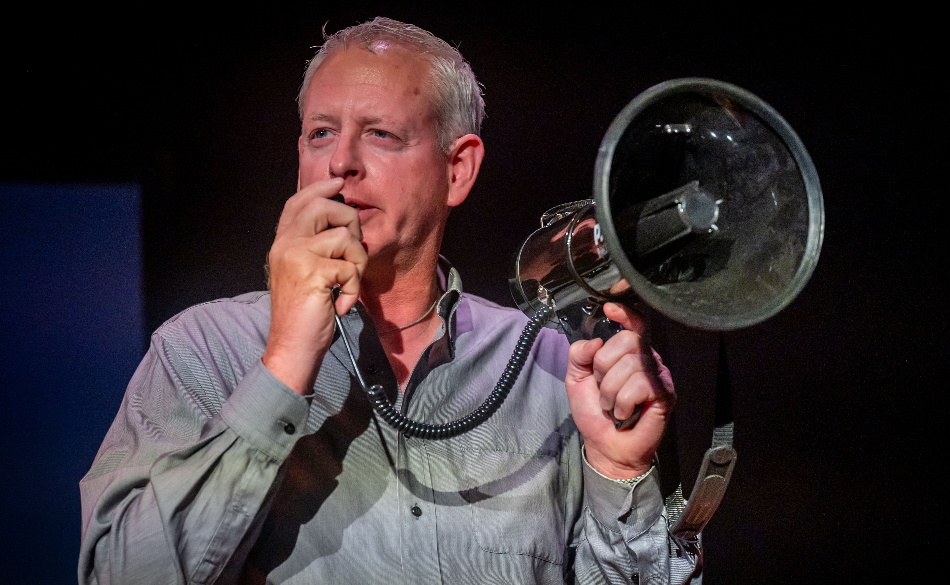
Buescher's vision for "Le Bal," and the work of the amazing cast at Trap Door—Dan Cobbler, Genevieve Corkery, Cat Evans, Emily Nichelson, Gius Thomas, Jasz Ward and Carl Wisniewski—stretch the bounds of what theater can be.
“Le Bal,” adapted and designed by Steven Buescher comes recommended; a unique theatre experience and another example of why Trap Door is a treasure. “Le Bal” runs through June 20, 2026 at Trap Door Theatre 1655 W. Cortland in Chicago.
This review is proudly shared with our friends at www.TheatreInChicago.com.
Trap Door's 'Galileo,' Beautifully Produced, Is a Knowing Parable for Our Times

“Galileo” written in 1938 by German playwright Bertolt Brecht, tells the straightforward story of the 17th century physicist and astronomer’s run-in with church authorities for asserting that the earth revolved around the sun. For this Galileo, played with Brechtian finesse by Trap Door’s David Lovejoy, was hauled before the Roman Inquisition, and threatened with torture until he recanted.
Brecht’s play centers on how this conflict played out in Galileo’s personal and professional life, and his final years under house arrest under the watchful eyes of the authorities. Galileo was torn between unfettered scientific assessment of the world, and his need to make a living. Even before the play opens, director Max Truax has Lovejoy’s Galileo seated, nearly naked, facing away from the audience posing in contemplation, reminiscent of Rodin’s famous sculpture. Throughout the scenes that follow, Galileo’s nakedness seemed to represent the periods when he was thinking most freely. He seemed to be dressed when he was engaging the public or the authorities.
But the style of Brecht’s script for “Galileo” is not naturalistic - this version of the script was the second, written in English with Charles Laughton who starred in it in 1947 - and the audience is distanced from the characters who dwell with him: Galileo’s daughter Virginia (Genevieve Corkery), his protege Andrea (Shail Modi), his student Ludovico (Caleb Lee Jenkins), and a character, the Inquisitor, who is present throughout. Brecht wanted audiences to be unattached to the emotions of the characters, so they could focus intellectually on the story and the social values he wanted to convey, a style known as Epic.
Lines are repeated multiple times with different emphases. At certain points, the actors address the audience directly, breaking the fourth wall, said to be another technique favored by Brecht. The Inquisitor (Joan Naid) who is blindfolded in early scenes, at times seems more like a spouse to Galileo in the household.
Lovejoy’s performance of Galileo is described by Trap Door as “a humanizing portrait,” and he is in this respect distinct from the other characters on stage. One example: when his daughter Virginia’s betrothal is threatened by Galileo’s branding as a heretic for his work, she registers no emotion. We simply hear the facts of the matter. Lovejoy’s performance is intense, and a remarkable achievement overall: and he is on stage every minute of the two hour show. Also notable is Modi as Andrea, a character with whom I was able to connect.
I can’t say I am a fan of Brecht, and am always surprised that he continues to be popular among troupes and actors. For me Brecht takes a lot of work to appreciate and enjoy. But “Galileo” has remarkable currency for our times, as the retreat from modernism finds factual science and the age of reason under attack by the authorities. For this concern alone the Trap Door production of “Galileo” is valuable. Kudos to Merje Veski for stage design and Jonathan Quigley for projection design that gives us synopses of historical contexts at key moments.
“Galileo” runs through June 14, 2025 at Trap Door Theatre, 1655 W Cortland St. inChicago. Tickets are now on sale at trapdoortheatre.com
*Extended through June 28th




Latest Articles
-
 Music Theater Works Pours a Beachy Cocktail with Escape to Margaritaville
Written by Kimberly KatzA gentle, tide‑easy current settles in right from the start, immediately signaling the kind of story this musical wants to tell. Rather than relying on big, splashy moments, it settles into a warm, beach-side rhythm, inviting the audience into a…
Music Theater Works Pours a Beachy Cocktail with Escape to Margaritaville
Written by Kimberly KatzA gentle, tide‑easy current settles in right from the start, immediately signaling the kind of story this musical wants to tell. Rather than relying on big, splashy moments, it settles into a warm, beach-side rhythm, inviting the audience into a… -
 Chicago Shakespeare Makes Winter’s Tale a Story Worth Telling
Written by Angelo CamposChicago Shakespeare Theater’s production of The Winter’s Tale delivers a compelling evening of theater, showcasing an exceptional company of actors working at the top of their craft. Under the direction of Artistic Director Edward Hall, this staging marks an exciting…
Chicago Shakespeare Makes Winter’s Tale a Story Worth Telling
Written by Angelo CamposChicago Shakespeare Theater’s production of The Winter’s Tale delivers a compelling evening of theater, showcasing an exceptional company of actors working at the top of their craft. Under the direction of Artistic Director Edward Hall, this staging marks an exciting… -
 A Joe & Melanie Thing Theatre Company announces The Hanukkah Humbug at Greenhouse Theater Center - December 3-6
Written by Buzz Center StageThe world premiere of The Hanukkah Humbug brings ghosts, history, tradition, and a whole lot of family fun to the Greenhouse Theater Center just in time for the holidays, Melanie Ann Apel promises a lively, family-friendly experience with this new…
A Joe & Melanie Thing Theatre Company announces The Hanukkah Humbug at Greenhouse Theater Center - December 3-6
Written by Buzz Center StageThe world premiere of The Hanukkah Humbug brings ghosts, history, tradition, and a whole lot of family fun to the Greenhouse Theater Center just in time for the holidays, Melanie Ann Apel promises a lively, family-friendly experience with this new… -
 Remy Bumppo’s Mud Row: A Family Haunted by the Past
Written by Wesley DavidRemy Bumppo opens its 30th anniversary season with Mud Row, a play by Tony Award nominee and MacArthur “Genius” Grant recipient Dominique Morisseau. Expertly directed by Malkia Stampley, this production is a sublime examination of family, inheritance, and the difficult…
Remy Bumppo’s Mud Row: A Family Haunted by the Past
Written by Wesley DavidRemy Bumppo opens its 30th anniversary season with Mud Row, a play by Tony Award nominee and MacArthur “Genius” Grant recipient Dominique Morisseau. Expertly directed by Malkia Stampley, this production is a sublime examination of family, inheritance, and the difficult…
Does your theatre company want to connect with Buzz Center Stage or would you like to reach out and say "hello"? Message us through facebook or shoot us an email at This email address is being protected from spambots. You need JavaScript enabled to view it..
*This disclaimer informs readers that the views, thoughts, and opinions expressed in the text belong solely to the author, and not necessarily to Buzz Center Stage. Buzz Center Stage is a non-profit, volunteer-based platform that enables, and encourages, staff members to post their own honest thoughts on a particular production.