
Displaying items by tag: AmBer Montgomery
The Gift Theatre's Hayward: A Floridian-Style Shiva
There are funerals where grief brings a family together, and then there are funerals where grief opens the door to everything a family has spent years trying to keep buried. In Hayward, playwright Netta Walker turns a father’s funeral into a reckoning with family secrets, unresolved pain, and the ghosts that refuse to stay in the past.
Given a bold world-premiere production by The Gift Theatre, presented at Steppenwolf’s 1700 Theater, Hayward, directed by AmBer Montgomery, reimagines elements of Hamlet and Electra through the eyes of Luna, the youngest daughter in a deeply complicated family. On the day of her father’s funeral, Luna announces that his ghost has come to visit her. What follows is part family drama, part dark comedy, and part haunting exploration of the emotional inheritance passed from one generation to the next.
The play opens with a funeral, and from the moment the family enters, it is clear that this will be no ordinary farewell.
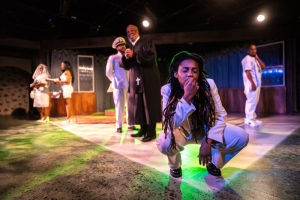
Luna (Ireon Roach), her father’s favorite child, is overwhelmed by grief as she stands at the podium to deliver his eulogy. Her siblings seem considerably less interested in mourning. Eric (Victor Musoni), dressed in a white memorial T-shirt and sagging pants, and Leila (Sydney Charles), wearing a white dress that seems decidedly inappropriate for the occasion, give the impression they would rather be anywhere else. Their oldest brother, AJ (Gregory Fenner), a military man, stands rigidly at attention, as though guarding the proceedings at a state funeral.
Seated apart from the chaos is Maria (Shanesia Davis), the family matriarch, dressed in white, her face veiled and a white handkerchief close at hand. She carries herself with the solemnity of a woman accustomed to holding a family together, even when its members threaten to tear one another apart.
(from left) Alfred Wilson, Gregory Fenner, Shanesia Davis and Ireon Roach in The Gift Theatre's presentation of Hayward at Steppenwolf’s 1700 Theater. Photo by Joe Mazza / Brave Lux.
During the service, Luna sees her deceased father, Tony (Watson Swift). Her vision is quickly dismissed, but the encounter signals that something deeper is happening within this family. At the gravesite, the arrival of Uncle Johnson (Alfred Wilson), who is also a pastor, adds another layer of tension. There is little pastoral comfort in Johnson’s approach. He berates the family, directing particular hostility toward Luna because of who she is.
Religion, family expectations, and personal identity collide, and the resulting arguments reveal a household where love and resentment have become inseparable. The siblings fight, challenge one another, and expose old wounds, yet beneath their dysfunction is a recognizable bond. They may not know how to care for one another gracefully, but the connection remains.
At the center is Luna, whose grief is both the most visible and the most unsettling. Her father’s visits are not simply a supernatural manifestation of mourning; he has a request for her that reaches beyond the grave. As the family’s history unfolds, we learn that Tony served in the military during the Gulf War and returned carrying psychological wounds. The play suggests that the trauma he experienced did not end with him. His children, particularly Luna, may have inherited some of the emotional consequences without fully understanding their origins.
Walker’s most compelling achievement is her creation of characters who feel genuinely complicated. These are not tidy theatrical portraits of a dysfunctional family. They are people whose behavior can be outrageous, infuriating, and unexpectedly tender, sometimes within the same scene. The comedy emerges naturally from their interactions, offering relief without entirely diminishing the pain beneath the laughter.
Montgomery has assembled a strong ensemble and directs the actors with a clear sense of purpose. One of the production’s funniest moments comes when Maria sits center stage and her children gradually gather around her, one by one, as if seeking the comfort of the family’s center. When the last child arrives, Maria simply gets up and leaves them together. The gesture is hilarious, revealing, and familiar to anyone who has watched a family matriarch reach the limits of her patience. It is a moment best experienced rather than explained.
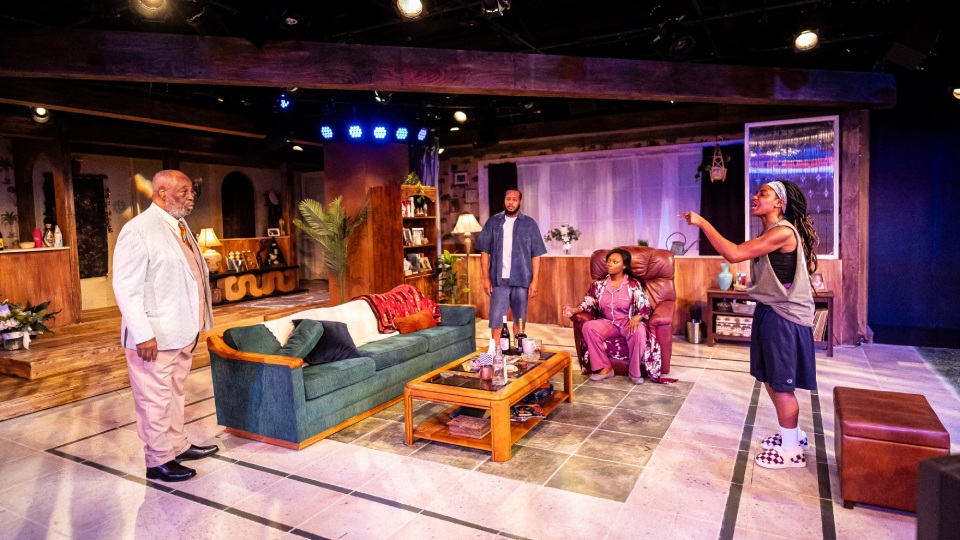
The scenic design is another notable achievement. The stage transforms from a church to a gravesite and eventually into the family’s living room. The final home setting is impressively detailed, providing a convincing domestic space in which the family’s conflicts can continue to unfold. My reservation is the time required to complete the transformation. Although the finished environment is effective, the process of getting there interrupts the production’s momentum.
Ultimately, Hayward is an entertaining and ambitious work that uses humor, supernatural elements, and family conflict to examine the lasting effects of trauma. Walker’s play is interested in the emotional territory families occupy: the memories they avoid, the wounds they pass along, and the love that survives even when they struggle to express it.
Still, the play would benefit from sharpening its central argument about mental health. Tony’s military service and the suggestion of inherited trauma offer fertile ground, but the relationship between psychological injury, family behavior, and Luna’s experiences could be developed with greater clarity. The subject deserves more than implication, particularly when the play so effectively demonstrates how one person’s unresolved pain can shape an entire household.
With its memorable characters, dark humor, and committed performances, Hayward offers a lively and often moving portrait of a family trying to find its way through grief. Like a Floridian-style shiva, the gathering is noisy, irreverent, and emotionally unpredictable. The dead may have been laid to rest, but in this family, the past is very much alive.
RECOMMENDED
When: Through Nov. 15
Where: Steppenwolf’s 1700 Theatre 1700 N. Halsted St. Chicago
Tickets: $45 - $50




Latest Articles
-
 Holiday Hilarity! Paramount presents The Second City’s Nut-Cracking Holiday Revue at downtown Aurora’s Copley Theatre, Nov. 20-Dec. 23
Written by Buzz Center StageNeed something better than old reruns of Hallmark Movies this holiday season? Want to see some real nut-crackers? Then dash on through the snow to catch The Second City’s Nut-Cracking Holiday Revue, November 20-December 23 at Paramount’s Copley Theatre, 8…
-
Mary, A Holiday Dansical Returns for one performance only at Logan Center December 13th
Written by Buzz Center StageBlack Girls Dance®, which centers Black and Brown girls in joyful community, presents its sixth annual production of Mary, A Holiday Dansical, choreographed, written, and directed by Founder Erin Barnett. This fundraiser returns for one night only Sunday, December 13…
-
 The Gift Theatre's Hayward: A Floridian-Style Shiva
Written by Wesley DavidThere are funerals where grief brings a family together, and then there are funerals where grief opens the door to everything a family has spent years trying to keep buried. In Hayward, playwright Netta Walker turns a father’s funeral into…
-
JK Entertainment presents WHEN WE WERE YOUNG AND UNAFRAID at Greenhouse Theater Center November 12 – 29, 2026
Written by Buzz Center StageJK Entertainment has released first look rehearsal photos for WHEN WE WERE YOUNG AND UNAFRAID, the first production of the company's second season. JK Entertainment's production brings this story to Chicago audiences November 12–29, inviting audiences to consider how far…
Does your theatre company want to connect with Buzz Center Stage or would you like to reach out and say "hello"? Message us through facebook or shoot us an email at This email address is being protected from spambots. You need JavaScript enabled to view it..
*This disclaimer informs readers that the views, thoughts, and opinions expressed in the text belong solely to the author, and not necessarily to Buzz Center Stage. Buzz Center Stage is a non-profit, volunteer-based platform that enables, and encourages, staff members to post their own honest thoughts on a particular production.