

Mitchell Oldham
Chicago Black Dance Legacy Project Gala: Radiant & Sumptuous at the Harris
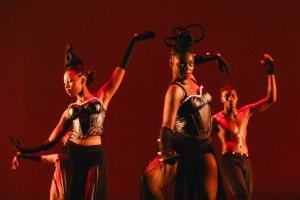
The first thing you notice about the meticulously curated Black dance performance held at the Harris Theater over the weekend is language. The eloquence and weight of the words used to explain why the Chicago Black Dance Legacy Project (CBDLP) exists and what it hopes to achieve.
Organized in 2019, Black dance companies rooted in Chicago joined forces to learn from one another artistically and operationally while working in collaboration with the Reva and David Logan Center for the Arts in Hyde Park and “other University of Chicago entities”. Sustaining viability and preserving legacy were placed at the heart of the project’s end objectives.
Its formation would have several residual benefits. An annual festival of dance performed by the companies who make up CBDLP remains chief among them. Events like the one held Friday night to a sold-out house also raise the profile of Black dance in Chicago and underscore its contributions to the city’s cultural topography and its continuing vitality.
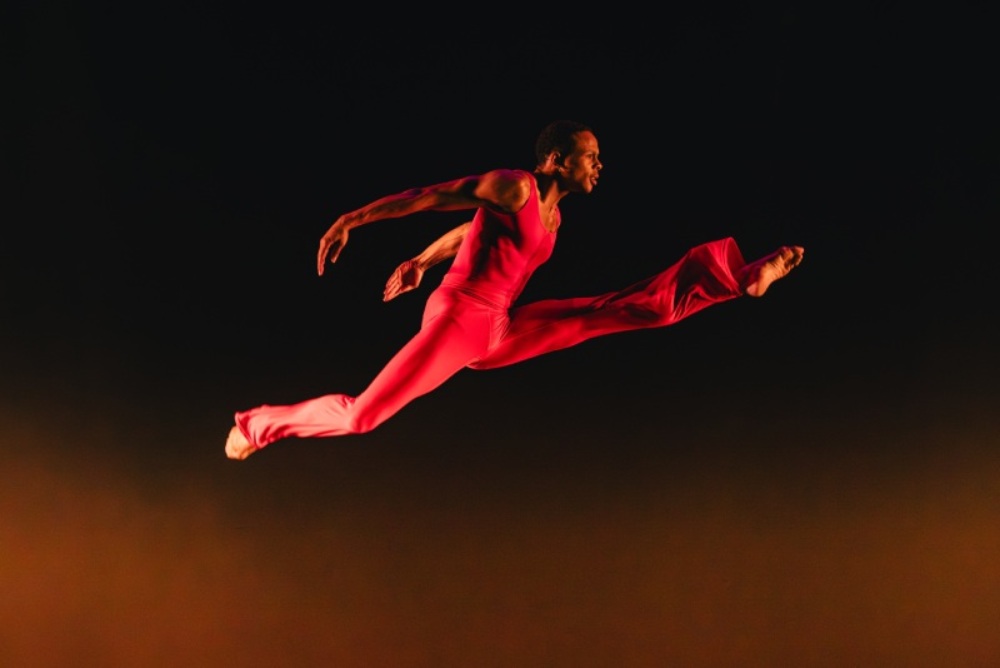
Dancing the Archive: Embodied Histories, Collective Power / Photos by Kyle Flubacker.
Honoring and showcasing the history and the arc of Black dance sat at the core of Dancing the Archive: Embodied Histories, Collective Power, the title of the evening’s multi-textured production. Not only was it dense with dance featured by ten of the project’s cohort companies, video clips that provided essential context on the trailblazers who spearheaded creative renewal within the Black creative community was also woven through this remarkable gala. The clips also helped to convey the importance and significance of the works being performed. Framed as chapters in a book, the dances flowed together to tell a comprehensive story.
Made up of 175 companies, dance culture in Chicago is extraordinarily deep, wide and rich. For Black companies who often face greater exposure challenges, Dancing the Archive serves to train the spotlight on their presence and gifts. The high degree of that talent and its proliferation marked the entire program that opened with a focus on youth.
Each individual work or dance suite performed honored a key individual who is making or has made significant contributions to Black dance or some other aspect of the city’s cultural art forms that reflect the Black experience. Through The Stillness celebrated Homer Bryant, founder of the Chicago Multi-Cultural Dance Center. A work that Mr. Bryant choreographed and performed here by members of his company, it used Albinoni’s Adagio for Organ and Strings to pay homage to concentrated sensuousness. A dance for two performed by Sasha Levy and Davion Bellinger, it was an accomplished composition of strength, control and technical mastery executed with extreme beauty by two young dancers.
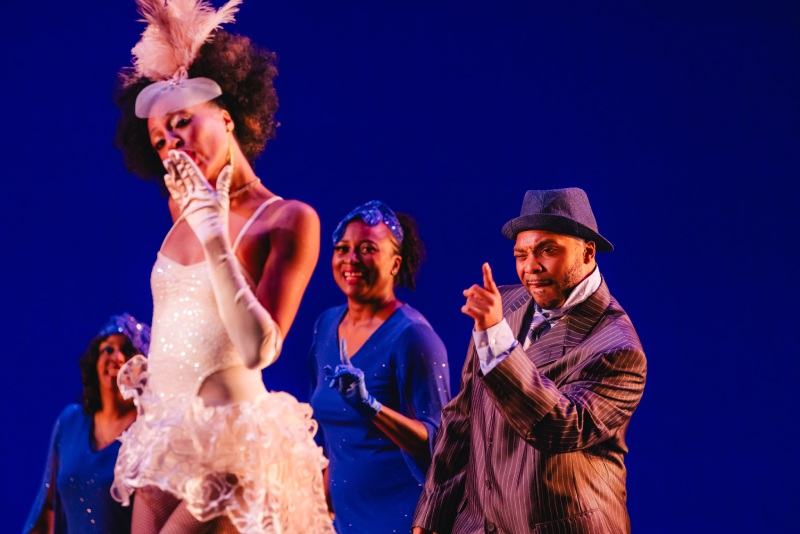
Dancing the Archive: Embodied Histories, Collective Power
The first chapter’s companion piece, Touch U, was a world premiere and an adaptation of Gerald Arpino’s Touch Me. In it, choreographers Bradlee Lathon and Pierre Lockett collaborated with a phalanx of their very youthful and talent-laden dancers at Forward Momentum Chicago to present a dance sparkling with infectious positivity. Bursting with innovative and highly sophisticated contemporary dance design, Touch U felt as if you were watching the next generation of dance on a maiden voyage. One that couldn’t have been more stimulating or aesthetically refreshing.
That sense of captivating vibrancy defined Dancing the Archives. In addition to the absorbing heritage-centered components of the program, dance was used to provide visual markers to history and highlight the place Black dance held during its march. Najwa Dance Corps’ Ancestral Steps looked back to dance crazes 100 years ago in the mid 1920s when the Charleston electrified a generation and the music of Count Basie ruled the airwaves. Later, in another world premiere, M.A.D.D. Rhythms with their Oscar Plays Gershwin Suite (They All Laughed, Summertime, Nice Work If You Can Get It), deftly exalted the “fire, finesse and swing” of tap with cool bravado.
The span of time and of dance expressions that paralleled it was vast. Muntu Dance Theatre of Chicago in Woven jubilantly recalled another time and place when “living archives” were embodied in a central griot-like figure.
Lines in Motion danced by The Era Footwork Collective was all about the kind of suavity that happens when you fuse mellow chill to dazzling footwork; creating repeated flashes of dance lightning in the process.
With Chance the Rapper as honoree, Chicago Multicultural Dance Center and Hiplet Ballerinas placed an impish toe in the future with its playfully eerie Speed of Light; attaching culturally specific overtones to our tech laden times.
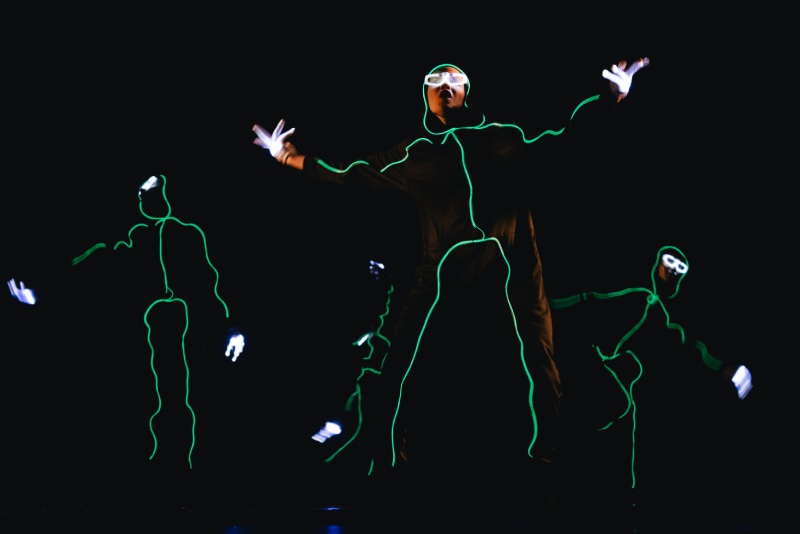
Dancing the Archive: Embodied Histories, Collective Power
Superlatives in either concept, execution or; most commonly, both ran thick in many of the other dances performed. Most of which have never been seen by audiences until now. Dorianne Thomas’s solo in Who Will Comfort Me, a world premier for the record books by the Joel Hall Dancers, was flawless in her display of dance fluency and emotional projection through movement. Attributes found in other performances were just as noteworthy. Praize Productions Inc.’s Leader of the Pack and Deeply Rooted Dance Theater’s excerpt from Crowns instantly come to mind. As does that churning and jubilant tribute to Curtis Mayfield and Lupe Fiasco by Move Me Soul. Curtis Suite and Sour, masterminded by Diana Muhammed, brought back to life the musical catalog of a genius and created a dance piece that complemented it gorgeously.
Because remembrance played such a significant role in the program, the In Memoriam segment commemorating leaders and standard bearers who died in 2025 was particularly notable and memorable. Before presenting the names and images of the fallen, a solo rendition of Precious Lord was sung by Cholé Johnson. Distinguished by its spare simplicity and for Ms. Johnson’s captivating interpretation, the artistic merits of the performance were astonishingly high. The song’s inclusion fittingly reveals the thread of the divine that lies within so much Black creative enterprise. An indispensable component often found in the bedrock of creative inspiration.
Dancing the Archive: Embodied Histories, Collective Power
Chicago Black Dance Legacy Project
August 28, 2026
The Harris Theater for Music and Dance
205 E. Randolph Street
Chicago, IL 60601
For more information: https://www.chicagoblackdancelegacy.org/
- Dancing the Archive Embodied Histories Collective Power
- Chicago Black Dance Legacy Project
- dance Chicago
- Black dance
- Harris Theater
- CBDLP
- Homer Bryant
- Bradlee Lathon
- Pierre Lockett
- Forward Momentum Chicago
- Chicago Multi-Cultural Dance Center
- The Era Footwork Collective
- Chance the Rapper
- Dorianne Thomas
- Cholé Johnson
- The Harris Theater for Music and Dance
- Chicago events
- live dance
- on stage
- Joel Hall Dancers
- Diana Muhammed
- Deeply Rooted Dance Theater
- Muntu Dance Theatre of Chicago
35th Annual Dance for Life Saturated with Excellence

From its beginning in 1992 on the tiny stage of a modest theater, Dance for Life (DFL) has grown and grown over the decades into something glorious. Its purpose over the last 35 years, as conceived by DFL’s creator, Keith Elliott, then with the Joseph Holmes Chicago Dance Theatre, has never altered or faltered. Mobilize a community devastated by a deadly scourge. Raise money to help the stricken. Build solidarity within Chicago’s professional dance culture. Initially and always a festival of dance chiefly focused on that second point, a few things have changed with time. Although AIDS has virtually been vanquished, at least in the first world, health and other needs within the dance community have not diminished. In 2025, DFL affiliated Chicago Dance Health Fund awarded $75,000 to dancers and other dance professionals facing critical need.
The annual celebration of dance very much remains a way for dancers to help other dancers by practicing their art. These days its being done on a much grander scale and showcasing a far wider range of what world class dance looks like and even feels like in the present day.
There were hints the 35th annual Dance for Life performance at the Auditorium Saturday night would be particularly memorable and they all centered on dress. Although venue is always a factor, dance audiences are not especially circumspect when it comes to presentation. Much of the attire on display in the concert hall’s spacious lobby that evening was not only stylish, dashing and glamorous, some pieces touched on the spectacular. Collectively, the energy they generated heightened the sense of expectation that already hung heavy in the air. The display proved just the right harbinger to forecast a sensational night of dance.
Bulging at the seams with the exceptional, the latest iteration of DFL showcased ten dance companies along with two additional finale works - and even a third, a raffle performance. In addition to the traditional large-scale finale that always closes the show, the program would also include a sizzling bonus dance performance that was also featured in the inaugural DFL concert.
This year’s show opened with elegance. Danced to the music of Wolfgang Amadeus Mozart, Deeply Rooted Dance Theater’s Beyond Mortal used sweep and grace to beautifully capture the secular spirituality of Mozart’s score. Choreographed by the company’s Artistic Director Nicole Clarke-Springer, it reveals how one Black-led dance company lives up to its mission to “diversify the aesthetics of contemporary dance”. Fireworks scripted in the language of the ethereal, Beyond Mortal ushered in the night with a nod to serenity and poise.

Giordano Dance Chicago. Photo by Cheryl Mann.
Giordano Dance Chicago decided to leave a different stamp on the gala by amping up a version of its signature heat. There would be several excerpts featured throughout the evening and Giordano chose the best of its 2011 Sabroso to spellbind the thousands seated in the ornate theater. Not only were the dancers speed and precision blinding, their joy blasted from the stage. Triggering genuine awe and lighting up the room with cheers.
The temperature would ebb and flow throughout the night and after such a prodigious display of white-hot energy, a cool down came in the form of romantically sublime ballet. This year a pair of fresh Joffrey faces, Hyuma Kiyosawa and Yumi Kanazawa, superlatively danced Postcards, founder Robert Joffrey’s ode to love, innocence and Paris of the 1920s. With Jorge Ivars’ ravishing accompaniment on piano, the dance ushered in an extended moment of enchantment.
A slight pause and rocket engines soon screeched again with Loud, created by KC Bevis and performed by the Ensemble of Chicago Dance Crash. Street dance and concert dance converged to make scorching hot magic in this mesmerizing performance. Here dance takes on a decidedly charismatic persona. One defined by strength, vigor, dexterity and boundless native imagination. Jazzed up with the burning beats of DJ B-Gram P, the heady mix of club and dance culture lit the theater on fire. One of many highlights that evening, Loud proved once again boundaries in dance simply don’t exist.
Both Ensemble Español Spanish Dance Theater and later Trinity Irish Dance Company stole the show with drama and the ability to turn the sound of synchronized feet striking a stage floor into transfixing music. In this case eliciting two completely different emotional responses that were both riveting.

Trinity Irish Dance Company. Photo by Todd Rosenberg.
Ballet 5:8 luxuriated in the freedom and unique beauty of contemporary ballet. On their heels was another band of boundary pushers. Chicago Dance Artists Piece performed Harrison McEldowney and Jeremy Plummer’s Red, White & Black; employing aerial concepts devised by Plummer. Aerial acrobatics, dance and music by F.U.N. came together to blend brawn-flecked whimsy with a healthy dash of wholesome excitement.
After intermission, and dressed up in colorfully glam togs, Visceral Dance Chicago tapped into mischief. Dancing R E V E L, set to Maurice Ravel’s Bolero, they vamped, seduced and cavorted to the timeless music of an international classic. Devilishly choreographed by Nick Pupillo, it was not only brilliant and unexpected, it was massive delight to watch.

Visceral Dance Chicago. Photo by Cheryl Mann.
Two other works were even more impactful. One was a dance featured in the very first Dance for Life performance called The Man That Got Away. Sultry, sexy and a solid story told in dance, it featured only two dancers. One acted simply as a prop. The other, Johnathon Dole, was the soloist who danced the part of a shattered heart. One that begged and pleaded not to be ignored and cast aside. Dole’s was the kind of dancing that kept rising and rising until it struck magnificent. Buoyed by the right dancer, the right music and the power of bold expressive choreography, The Man That Got Away induced amazement and roars of approval.
The other masterwork was more restrained but no less beautiful or potent. Robyn Mineko Williams and Artists danced a portion of Cloudline, a dream-state piece that used a 30-foot-silk cloth to help accentuate the dance’s atmosphere. Two lovers find one another and embody the mystery and overwhelming satisfaction true love manifests through dance. As portrayed in movement by Morgan Clune and Amari Frazier, a more convincing display of that ideal is impossible to imagine. A benchmark piece, its sudden and surprising ending provoked a collective gasp and then robust ovations.
This year’s concert honors choreographer, mentor and teacher Randy Duncan. Mr. Duncan has created most DFL closing works since its inception, including Renewed; this year’s finale. Made up of dancers from the night’s performing companies, freelancers and students, they comprise a large contingent. And in the muteness of Richard Dayhoff’s quiet gray costumes, there was a somber cast that shadowed their numbers.
As the dance developed and took shape to music and lyrics by Ira Antelis, you could see the themes of resilience and positive conviction shining through. A rejoicing in emerging from darkness to thrive once again. The essence of Dance for Life.
Dance for Life
August 22, 2026
The Auditorium Theatre
50 Ida B. Wells Drive
Chicago, IL 60605
For more information: https://www.cdhf.org/danceforlife
- Dance for Life
- DFL
- Keith Elliott
- Joseph Holmes Chicago Dance Company
- Chicago Dance Health Fund
- Auditorium Theatre
- Wolfgang Amadeus Mozart
- Deeply Rooted Dance Theater
- Nicole Clarke-Springer
- Giordano Dance Chicago
- Ensemble of Chicago Dance Crash
- Ensemble Español Spanish Dance Theater
- Trinity Irish Dance Company
- Chicago Dance Artists Piece
- Visceral Dance Chicago
- Randy Duncan
- live dance
- Ballet
- Chicago Dance
- chicago theatre
- live theatre
- on stage
- Chicago events
Hail Mary/Maria at Theater Wit – A Welcome New Slant on Crossing Over into Adulthood

Coming of age stories resonate more profoundly when they mirror the lived reality of a real person. That’s why the firecracker of a play, Hail Mary/Maria, that’s just begun its far too short run at Theater Wit, is must-see theater for just about anybody who counts themselves as a member of the human family. If you’ve ever been young or wracked with self-doubt, Hail Mary/Maria proves there are avenues that lead to clarity and self-actualization. Making the play act as a raucous, hugely humorous and often touching guide on how to find them.
Very much a reflection of playwright RJ Silva’s own experiences, the story follows the life of Kid (Juan Sedonio), a teenager who immigrated to the US with his mother from the Philippines when he was in the seventh grade. Now in an all-boys high school, he’s a little bit of a loner and completely hooked on the exploits of his favorite pro-wrestler, Maria. He’s also, with great misgivings, about to embark on his first journey into romance.
A badass brawler with heart, it’s Maria we first meet when the play opens. She pumps up the crowd with her bravado, high voltage smile and saucy hair flips. A stark contrast with the subdued and self-enclosed Kid, Maria’s the bolt of energy that serves to ignite a story that’s about to match her spirit.
The core of the play starts innocently enough in school with Kid, which is short for Kindness, sitting alone listening to music through his earbuds. He’s joined by another student who casually strikes up a conversation. Confident and friendly, the boy is feeling Kid out, trying to learn more about him. He trips over the typical stumbling blocks when it comes to pronouncing foreign names and learning new things about a different culture. But there’s no animus. He’s open and curious. They both tap into their recall and remember being aware of each other from previous school encounters. Blond and self-assured, the new arrival’s name is Jack and it’s clear he wants to be friends. Since Jack (Aidan Leake) is really into the new Avatar movie, we can tell it’s the original he’s talking about and that the play’s setting is fifteen years or so in the past.
We can see too from their exchange that Kid, although on the surface quiet and retiring, has some spunk to him. Once he begins talking about why he’s such a fan of the wrestling phenom, Maria, played with zestful impeccability by Carina Lastimosa, we get a glimpse of his animated side. To Kid, she’s an underdog who became the top dog. An inspiration. There’s a lot of pride that comes pouring through in his admiration for her.
We meet Kid’s other role model at home. It’s his Mom, Marie (Marie Tredway). The quintessential Filipina nurse; tireless, indispensable, magnanimous, Marie’s got an iron core that’s fortified and sustained by her faith and belief in Mama Mary. A figure most of us know as the Blessed Virgin Mary. In Kid’s household, she has a shrine set up in her honor and consulted by Kid as well as his Mom for guidance and advise. Filling two roles, Lastimosa shows how easily she can portray widely divergent personalities. As Mama Mary, she beautifully personifies a potent blend of compassion and enlightened understanding when responding to Kid’s solicitations.
Scenes that take you inside Kid’s home are some of the most moving and treasured in the production. Thanks in no small part to Katelyn Montgomery’s wonderfully evocative set. They’re portals into a world rich in tradition, strongly held belief and the type of family values that insure cohesion. Attributes that on one hand are wonderfully sublime and on the other almost quaint. The types of characteristics that may have once flourished in the American culture as well; but have long since dissipated or atrophied.
Very much a collaborative effort, Hail Mary/Maria is directed by Mr. Silva’s husband, Adam Reed. The unconventionality of the central character is complemented by an equally unorthodox directorial approach in Mr. Reed’s debut directing effort. One that fills the one-act performance with heaps of emotional and physical dynamism while encouraging plenty of audience interaction.
Pro wrestling of various shades have long been extremely popular in the Philippines. From the responses of the audience Saturday night, it has a strong following in this country too. Rather than conjuring it only through the imagination, Hail Mary/Maria brings it live and center stage, giving the uninitiated a taste of its electric appeal. The ploy works beautifully, making Hail Mary/Maria as much a rewarding visceral charge as it is a splendid theatrical offering.
From that initial conversation between Kid and Jack, you somehow know Jack had more than friendship on his mind when he sat down next to Kid that day. And he likely sensed that Kid was interested in him, too. As we all know, a lot can be transmitted in a simple glance.
Kid and Jack inch their way toward understanding one another and liking each other even more as their familiarity grows. Something that triggers trepidation and even fear in Kid. How can he reconcile who he is with what he thinks should be? How that dilemma is resolved is what makes this project so appealing. There’s a wholesomeness to it that feels very honest. The solid gold cast help make Hail Mary/Maria a treasure. Both Sedonio and Leake fill their roles with the kind of intangibles that make what they present on stage memorable. A statement that’s just as true for Lastimosa and Tredway. You can’t help but want to see them all in other works that showcase their skill and gifts as well as this project one does.
The only pressing question now might be, what’s the fledgling entertainment enterprise going to roll off their runway next?
Hail Mary/Maria
Presented by Nova Entertainment
Thursday, August 20th - 7:30pm
Friday, August 21st – 7:30pm
Saturday, August 22nd - 2:30pm & 7:30pm
Sunday, August 23rd - 2:30pm
Venue: Theater Wit in Theater 2
1229 W. Belmont Avenue
Chicago, IL 60657
For more information and tickets: https://www.theaterwit.org/tickets/productions/602/performances
Highly Recommended
Astonrep Approaches Uncle Vanya’s Appeal from a Novel New Angle
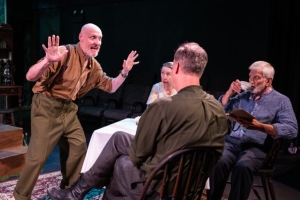
Anton Chekhov, a Russian playwright who was also a doctor, can claim a level of regard few writers achieve and maintain so long after their deaths. Born in 1860, the same year the Republican Party nominated Abraham Lincoln for President, his plays are routinely produced on stages in America and around the world because of what they reveal about who we are. That’s especially true for Chekhov’s Uncle Vanya, written in 1899, just a few years before the playwright died. Its popularity may be due to its mystery. Is it about resilience or is it about failure? Is it a comedy or a tragedy? It’s the kind of work that leaves you with questions about not only its two main characters, Sonya and her Uncle Vanya, but also about us.
A part of the city’s theater community since 2011, Astonrep Productions is a small Chicago company intent on “creating compelling and intimate experiences that challenge audiences”. Their interpretation of Uncle Vanya that opened over the weekend at The Edge Off Broadway succeeds in doing so with some reservations.
It’s the first American company to mount this commissioned 2024 Canadian adaptation of Chekhov’s classic. Liisa Repo-Martell’s revamp of the play dutifully adheres to the structure, plot themes and character composition of the original. But the play’s softer aspects, the features that define its essence and purpose, are less reliable and sure.
Displeasure with self is one of first things we get a sense of when the play opens. But even before that awareness sets in, there’s a curiosity the audience notices while they’re selecting their seats before the play begins. A man is slouched in an upholstered chair with one leg over its arm. He’s at the back of the stage and asleep. (We later learn he’s passed out drunk.) Soon after and closer to us, a man and woman are talking. They’re in the sprawling home of a rural Russian estate well over 100 years ago. He’s Mikhail Astrov (Robert Tobin), the local doctor and she’s Marina, a housekeeper very ably played by Liz Cloud, who clearly possesses a warm motherly instinct and a sharp wit. Astrov’s lamenting his fate as a country doctor. It’s all tedium. The people are gossip thirsty “savages”. His life has no fulfillment. He’s not married. He’s not in love with anybody and his youth is behind him. The demands of his work, a sour outlook and his liberties with vodka are catching up with him by slowly dismantling his good looks.
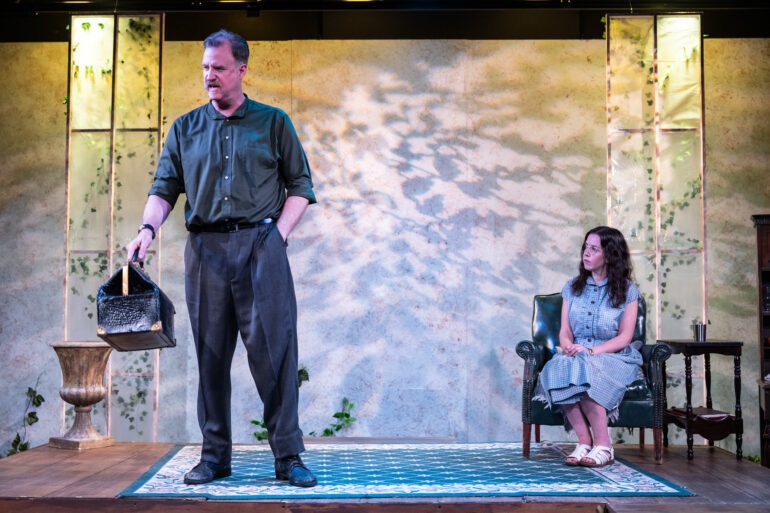
L-R: Robert Tobin, Natalie Hurdle. Photo by Paul Goyette.
By calling him a moron, the doctor’s antipathy for the sleeping man is made clear even before he wakes up.
As more people enter the story, we find ourselves in the middle of a family crisis. Vanya, the man who was sleeping in the chair, and his niece Sonya (Natalie Hurdle) have been the caretakers of the estate since her mother died. Sonya’s father, Alexandre (Geoff Isaac), is a professor in the city who’s been forced out of his university position and has now returned to the homestead. He’d been relying on income from the estate to support his lifestyle in town. He’s not returned alone. Joining him is his much younger and very beautiful second wife, Yelena, with Andi Muriel in the role. Things are tense. Alexandre’s pompous and obliviously demanding. And Vanya, played with visceral intensity by Rian Jairell, is demonstrably resentful.
An appeasing conflict avoider, Sonya’s loyalties are split between the natural draw a child has to her father and her uncle who’s labored with her to keep the estate viable at tremendous personal sacrifice to them both. Now a young woman, she seems to know it’s Vanya who’s been more the nurturing father presence for her and that other than each other, the estate is all that either of them have.
Additional strain is added with the presence of Yelena. Her beauty is like an intoxicant for both Vanya and the dissatisfied doctor, Astrov. They’re both brazen in their desire for her. Watching them shamelessly try to seduce her is equal parts comic and piteous.
With so much instability, friction and doubt in the air, you’d expect to feel the charge of that energy engulfing the air. Directed by Derek Bertelsen, it doesn’t arrive with any real intensity until the second act when Sonya’s father floats the idea of selling the estate. And that’s despite the considerable investments Jairell as Vanya had been contributing up to that point. Because It’s so transparent Alexandre wants the money from the sale to fund his return to the city and his refined form of living, Vanya’s resentment turns to rage. Finally filling the production with heat.
It dials up too when Sonya confesses her attraction, indeed love, for Astrov to Yelena. Unrequited never looked so vulnerable and fragile.
Part of Repo-Martell’s adaptation included revising the language to be more contemporary and ostensibly more approachable. It works in an essential way. Both Jeremiah Barr’s handsome set and Natalie Shoch’s costume designs are ambiguous enough to blur any specific time reference. But in the back of your mind you know this is all happening in a very distant time and place. One where duty and tradition held much more sway. That difference can often be found in the words used to express and explain obligations and choices. Here there’s a nagging sense that you may be missing important steppingstones.
In the end, things aren’t much different from where we found them in the beginning. Except everyone is much more depleted. Drained. But still tasked with shouldering their disappointments and continuing with their lives. In Chekhov’s original script, the word “rest” is used to represent that place of willful resignation that amounts to acceptance of one’s inevitable destiny. In this adaptation, the word “peace” is substituted. They say the same thing about something we’ve all experienced. When we’ve had to pull ourselves up out of the ashes and push forward. Uncle Vanya brings that feeling front and center and offers understanding through catharsis. That alone will keep it in heavy production for a few more centuries at least.
Uncle Vanya
Through July 5, 2026
Astonrep Productions
Venue: The Edge Off Broadway
1133 W. Catalpa Avenue
Chicago, IL 60640
For more information or tickets: https://www.astonrep.com
This review is proudly shared with our friends at www.TheatreInChicago.com.
Magic Pairs with Artistic Expressions of Empathy in EAM’s Summer Art Exhibitions

Elmhurst Art Museum’s two new exhibitions feature a pair of artists with Midwestern roots whose outlooks and perceptions of the world lead in quite different directions. Both of their creative paths are paved with output that prod our inquisitive instincts and ask our eyes to look a little closer. One is unmatched in the way it provokes actual wonder.
Jeannette Andrews was a young teenager from Wheaton and already enthralled with magic when she found herself in a contemporary art museum one day. Her mind immediately saw parallels between what attracted her to the mystery and enchantment of magic and what was on the museum’s walls. For her, the conceptual similarities between the two were so strong that she couldn’t fathom why no one was exploring their link.
The budding conjurer would go on to build a career that includes performative magic. She also began seriously looking into the synergies and commonalities between contemporary visual art and the body of knowledge and practices that produce magic. That interest and effort provide the foundation for Of Wonder, Mind and Magic, nine magic-focused installations that make up her first solo exhibition now running at the museum until late August.

All photos by Siegfried Mueller.
“Learning secret information that’s not easily found” is a powerful motivating force in Andrews’ life. It’s led her to conduct exhaustive research into some of the most esoteric areas of magic. A great deal of the work in her show also focuses on the physical sciences and deviations in how people believe they perceive the natural world and how they in fact do. The magician/artist’s ruminations on a dense thicket of “what if” scenarios eventually culminate in either a performance piece or, in the case of Of Wonder, Mind and Magic, an art installation that focuses on what was once called the dark arts.
What is, remains is an example of how Andrews interweaves the properties of the physical world and that of magic. An interactive or immersive piece that asks visitors to take specific actions while looking at a suspended sphere and its shadow, it’s a disappearing act that’s brought into an arts centric setting. While following the instructions of a recorded voice, participating museum visitors will find the sphere disappears and reappears at will.
Awe inducing for its simplicity and the incredulity it triggers, Bottling the Impossible is, once you fully absorb its significance, a remarkable show of skill. Riffing off the classic ship in a bottle conundrum, objects are displayed in a small Bulleit whiskey bottle with no obvious way for them to have gotten there. A chess piece, a pocket mirror and a complete sealed deck of playing cards all sit benignly in their separate bottles; defying both logic and the natural order. Andrews confessed it took more than two years of research and false steps before she was able to master this genuinely impressive challenge.

Several of the other installations are more interactive with technology on hand to guide visitors on what to expect and do. Andrews, who’s currently an artist in residence at Brown University, has enjoyed similar affiliations with other notable institutions including MIT and Harvard. The breadth and penetrating quality of her work appeal to anyone who enjoys interacting with creatively unorthodox approaches to interesting and sometimes arcane concepts.
Near Eternity, the contributions of sculptor Jeremiah Hulsebos-Spofford, is inspired by the way time and the changes it brings to our lives impact how we view the past, present, future and ourselves.
Life can be viewed as a series of transitions and the ways we respond to them are endless. Artists react through their work. In Near Eternity, Hulsebos-Spofford’s low carbon sculptures are widespread. They can be found gracing the interiors of the museum’s prestigious adjunct building, outdoors among the greenery of Wilder Park adjoining the museum and just inside the main entrance. Notions of loss and mortality, contemplations on human vulnerability due to infirmity or age and the silent confusion and unanticipated emotions that accompany some of life’s more poignant passages are all represented in wood or polyester resin.
Several examples are found in McCormick House directly adjacent to the museum’s main building. In it, Hulsebos-Spofford reimagines either familiar or iconic items and overlays empathetic sensibilities onto them. In Hyperplexia: Splint, he takes an object used to brace injuries and produces a “meditation on support structures” that take in the emotional and architectural as well as the physical.

In another room, Mies van der Rohe’s timeless Barcelona chair gets a similar treatment. Elegant perfection gets a redo that emphasizes what it feels like to be susceptible or exposed to harm or injury. All for the purpose of highlighting the “tension between preservation and decay”.
Temperamentally lighter and more playful works are in the park where an artistic homage to Mr. Coffee can be found along with a radically chill Shark Cat cast in bronze, fashioned after the social media craze of the same name.
Like most of us, artists have many facets to their sensibilities. Along with encouraging us to think deeper through art, Mr. Hulsebos-Spofford also derives a great deal of pleasure knowing artwork in public spaces can instigate instant and random joy. A balance that makes a show of any kind a more complete and gratifying experience.
Of Wonder, Mind and Magic
Near Eternity
Through August 23, 2026
Elmhurst Art Museum
150 South Cottage Grove Ave.
Elmhurst, IL 60126
For more information on both exhibits: https://elmhurstartmuseum.org
Guest’s New Andy Warhol Play A Study in Primo Theater

When Terry Guest left Atlanta and arrived in Chicago ten years or so ago, a bracing reality check caused the young actor to make a bold pivot. Three years of auditions and zero bites on the acting front, he turned himself into a playwright and used a deceased uncle as his inspirational muse. At the Wake of a Dead Drag Queen was born, with Guest placing himself in the starring role. Rave reviews, real recognition and an impressive collection of Jeff Awards followed. As they used to say during the dawn of space exploration, “Houston, we have liftoff.”
That was in 2019 and since then the actor and playwright has been exploring other opportunities to extend his keenly astute vision about life and people into the theatrical ecosphere. More plays were written, last year At the Wake of a Dead Drag Queen was reprised and a brand spanking new dazzler by Guest just launched its world premiere at Jackalope Theatre in Edgewater a few days ago. If there’s any logic in the universe, it’ll enjoy a very similar reception to his inaugural tour de force.
Because it’s so creatively extravagant, Andy Warhol Presents: The Cocaine Play lives in a universe all its own. There’s enough drama and suspense to be slightly Hitchcockian, but it’s also unrelentingly funny. It’s arguably biographical, but not in any way you’d expect. Because it indulges in the supernatural, you can say it possesses strong elements of mystical realism. Nothing about it is predictable. And it has two endings. Both killer.
If you had to name one thing that forms its nucleus, it would be fame. The single name variety. Blinding individual glory. Guest probes into what it’s like to have it and what it means to crave it.
We get a sample of the first right at the opening when Marilyn Monroe appears resplendently before us and gives a little run down on what it’s like to be her. The instant recognition, the automatic smiles, the rapturous attention, the sheer adoration. But she isn’t “that” Marilyn. And she’s not really an avatar. You could say she’s a concept of the blond bombshell turned into flesh. Played with decadent deliciousness by Alexis Ward, she’s the psychological stand-in for the mega-star from Hollywood’s past.
A quick shift and we’re suddenly in a New York apartment with a woman, Edie Sedgwick, complaining to a friend about her inattentive, I-don’t-understand-him-at-all-anymore, husband. We’ve already learned from the friend she’s talking to, Andy Warhol, that we’ve gone back in time to the 1960s. And even though he’s a painter too and wears a bushy white wig, he’s not that Andy Warhol. Like Marilyn, Andy and Edie are facsimiles of the people we think they are. And like every other member of the four-member cast, everyone’s Black.

(L to R) David Michael Dowd, Jasmine “Jazzy” Cheri Rush and William Anthony Sebastian Rose II in ANDY WARHOL PRESENTS: THE COCAINE PLAY.
William Anthony Sebastian Rose II occupies the role of Andy, and a more droll, brilliantly glib performance will likely not be seen on another stage anytime soon. He and Edie’s husband Michael (David Dowd) are having a very hot little affair on the side. Regardless of how trivial or momentous, all interactions are laced with coke. Indulging in cocaine hits is so pervasive it’s like watching piranha in a constant feeding frenzy.
They’re all in the creative arts. Edie (Jasmine “Jazzy” Cheri Rush) is an actress married a painter. She and Michael are flat out rabidly ambitious, and both invest the sweat and tears to make it in their crafts. Unfortunately, their striving just doesn’t end up going anywhere. Andy’s less driven or sure of himself. Much more reticent. When an opportunity arises for him and Michael to catch some limelight, it’s Andy, after being pushed by his lover/friend, who prevails. His portrait of the late Marilyn Monroe catapults him to fortune and fame.
Guest not only wrote the Andy Warhol script; he also directs this three-act marvel that moves like a bullet train on freshly greased tracks. This production shows too that he’s a master at shaping performances. All four glow with a blindingly high gloss.
The play spans three decades. Sydney Lynne’s scenic design stamps all of them with genuine uniqueness and style. Dress transforms with the times too and, in this case, only Edie’s wardrobe changes noticeably as the years roll by. As costume designer, Maddy Shows makes sure they sync perfectly with the period and sing with class. Much the same can be said for Ayanna Bakari and that cavalcade of wigs she presents. Stellar.
Cohesive and boppin’ original music binds the play together from the very beginning to the absolute end, yielding what can only be called yet another delectable surprise bonus.
Fame, we later find, isn’t sitting all that well with Andy. Something about it is oppressive and Marilyn keeps showing up like a specter he’d really like to leave him alone for a while. Still treading water, Edie and Michael aren’t faring much better. She left for LA to try and make it in the movies since NY never ignited. Micheal continues to paint in the Big Apple and remains mired in the same obscurity. The chance at a long shot makes him desperate, brings his resentment regarding Andy’s success to the fore and sets him to scheming. After all, he rationalizes, Andy would never be where he is if it weren’t for him. Things then turn very dark and get just as hot. Hence the first ending that’s so intense there should be a way to one day to enshrine it in the National Archives.
It’s the second closing that comes out of nowhere that will blast your other sock off.
Andy Warhol Presents: The Cocaine Play
Through July 6, 2026
Jackalope Theatre
Broadway Armory Park
5917 N. Broadway Street
Chicago, IL 60660
For more information and tickets: https://www.jackalopetheatre.org/
Highly Recommended
Intuit’s New Exhibits Spark Verve Through Art

Gatecrashers. That’s the term newspapers nearly 100 years ago called the works of self-taught artists when they began “crashing the gates” of the elite art world. It was then when names like Horace Pippin, Anna Mary Robertson (Grandma Moses), and Martin Ramírez were just beginning to be considered consequential contributors to America’s creative excellence.
Since then, a broader understanding and appreciation has grown for the vision and perspective of artists who, for an assortment of reasons, remained or continue to be, untrained. Once the focus shifts from the origins or situational attributes of the artist and to the artistic quality and merit of their artwork, the wealth of talent obscured by bias becomes infinitely more visible.
Recently renovated into a bright jewel-box of an exhibition space, Intuit Art Museum (IAM) in West Town has been championing the output of self-taught and outsider artists for the past 35 years. A trio of new exhibitions that opened in early April gives testimony to the vitality and psychological energy emanating from this branch of the art world. The showings also offer a fresh re-introduction to the breadth of aesthetic beauty found in this creative offshoot. Art at its most natural and original.

Installation views courtesy Intuit Art Museum
Life is an Art: The Collection of Jan Petry showcases the discerning eye of one collector in this rich and highly varied genre. Petry, who enjoyed a long affiliation with IAM when she served as a museum board member for several years, donated more than 60 works from her collection to the museum before her death in 2024. Including paintings, sculptures, folk art and subject matter that was extremely dear to her personally, the Life is an Art exhibition reveals how deep and diverse self-taught art can be.
Greek born Drossos Skyllas’s painting, Tree of Life creates an otherworldly mood of surreal calm as it tells a timeless story regeneration. The skill in which Skyllas manipulates light, causing the painting to be bright and subdued at the same time, immediately attracts. Initially the contrast draws you to the painting where, once you’re before it, you fall even deeper into its compositional riddle.

Tree of Life by Drossos Skylla - M. Oldham, photography
Across the room, a Martin Ramírez watercolor with crayon and paper, (Untitled - Caballero 1950) captures with its subtle complexity. Ramirez often depicted men on horseback, warriors from some bygone south of the border past. In Caballero, a man sits on his mount pointing a highly stylized pistol. The intricate pattern of lines surrounding him on three sides makes him look as if he’s on a stage. Above him, a lavishly ornate canopy locks him in, creating a snapshot of some real or imagined experience through “a world of patterns and repetitions”.

Caballero by Martin Ramirez- M. Oldham, photography
Paintings that spring from biblical inspirations give artistic expression to deeply held belief. The end results can be stunning. Reverend Samuel David Phillips' Revelations gains power the longer you look at it. Through Phillips’ depiction of the seven headed beast in the Bible’s last chapter, he captures the unfathomable essence of apocalypse.

Revelations by Reverend Samuel David Phillips - M. Oldham, photography
Considered one of the most famous self-taught artists of the 20th century, Howard Finster tweaks a conventional portrait piece by turning it into a well-intentioned warning. In his painting Earth Being Watched, otherworldly but seemingly amiable spirits and a single angel peer over and around mountain peaks at three people meaningful, in their own way, to the artist. One of them is Finster’s grandson. The image and the message are a far departure from Revelations’ apprehensive prophesy and show how divergent faith-based art can be in the self-taught realm.
The exhibition dedicated to the Petry collection churns with work that surprises and stimulates; admirably encapsulating the diverse wonder that can be found in this stream of creativity.
In the adjoining room, elegant futuristic whimsy made of tin fill a warmly lit welcoming space. Drawing with Metal: Sculpture by Bill Brady takes self-taught art to a very unexpected place. One full of sleek timeless conjectures of the imagination constructed of light weight metal. Now in his 80’s and still prolific, Brady learned metalworking from his father and went from re-producing the past to designing and making his own creations. Many of them intended to be suspended in the air, his work evokes space, timelessness and perpetual serenity.
Impressions of the City, honoring the work of native Chicagoan Marvin Young, pulses with the energy of a metropolis. Young recreates the cityscape of his youth and the people who inhabit his world. Then he supercharges them with life. Chicago walk-ups are bulked up, are exaggerated and seem to come alive as they lean slightly; as if they’re about to take motion. Cars and taxicabs crossing bridges catch the urgency of rush hour traffic and perfectly mirror its frenetic intensity. Look closely and you’ll notice one of the cars in the string is faced in the wrong direction. In another drawing, a bus has far too many seats. These puzzling touches add a humanizing element to his drawings that gives them new dimension and singes them with curiosity.

Untitled from Impressions of the City, Marvin Young artist - M. Oldham photography
Young’s portraits of people are interesting, even provocative in their candor. One of them quite large, they’re like sketches intended as much to capture some universal inner resolve as they are to interpret a face. Perhaps it’s because his subjects have a certain knowing quality about them. A tolerant and dignified c’est la vie persona that makes them interesting and commanding of respect. Young rarely, perhaps never, provides titles to his works. Each one stands on its own, nameless. Via a video monitor on the exhibition floor, Young explains making this art is a hobby for him. Something that’s always given him inestimable pleasure simply by doing it. A feeling of that’s very similar to joy and gratification this artistic three-fer induces in its visitors.
Life is an Art: The Collection of Jan Petry
April 9, 2026 - March 21, 2027
Impressions of a City: Drawing by Marvin Young
April 9, 2026 – August 23, 2026
Drawing with Metal: Sculpture by Bill Brady
April 9, 2026 - October 4, 2026
Intuit Art Museum
756 N. Milwaukee Ave.
Chicago, IL 60642
For more information: This email address is being protected from spambots. You need JavaScript enabled to view it.
Highly Recommended
Redtwist’s Sobering ‘night Mother Asks Us to Look for the Unseen

Mother-daughter relationships are somehow deemed different. More seminal than the bond between a father and son. More instinctive than between sisters. When trust is broken, all bets can certainly be off. But that doesn’t seem to be the case for Thelma and Jesse, a mom and her daughter who live together in Marsha Norman’s magnificent ‘night Mother, just opening at Redtwist Theatre in Edgewater. They have a balance and flow that suggests a seasoned understanding. A harmonic acceptance of their lives together.
Thelma, played so fully by Redtwist ensemble member, Kathy Ruhl, is a pleasing mix of pragmatism and discreet earnestness. A woman who’s lived a long life, withstood a lot and is making the most of the years in her final season. Knitting on her well-cushioned sofa, cell phone dangling from her lanyard, TV playing in the background, she’s thinking about how she’s going to satisfy her sugar fix. And settles on a snowball before contemplating many other options as the evening passes.
Thanks to the prodigious thought and scrupulous detail Bobbie Buie poured into the set design, Thelma’s modest home has the soft glow of easy unpretentious comfort. Everywhere there are signs that point to a contentment that’s been well earned. The world she created, along with Harper Justus’s precise and subtle sound design, saturated you in place.
Anne Sheridan Smith in the role of her daughter, Jesse, is much more wired; frenzied in an organized way. When she shoots out of her bedroom door, she’s clearly a woman on a mission to get a lot of things done. Quickly. As she settles down, she’s simply determinedly methodical and impressively so. There’s some light haggling with her mother. It seems like something they just occasionally do. Normal. Tonight, giving her mother a manicure is high on Jesse’s to do list. It’s not long before they settle down at the kitchen table and normal goes away.
A small cloud of foreboding drifted in when Jesse began looking for some things in their makeshift attic. One of them is a gun. When her mother keeps pressing her on why she wants or needs one, she forces her daughter’s hand. Jesse declares to her mother, not coldly but matter-of-factly, that tonight she’s going to use it to kill herself.
It’s the kind of statement that instantly triggers incredulity. And automatically, by reflex, Thelma’s “mom” response zooms past tilt. Even though she may not initially believe Jesse, she hears her. And intuitively she wants to fix it as she struggles to even comprehend the magnitude of what she’s been told. ‘night Mother soon becomes a push and pull with Jesse always exhibiting the greater strength against a formidable opponent. She has the inner conviction to see this grim task through. You can sense that when she first told her mother what she was going to do. Like her mother, we too want to know why.
A dissection of one person’s why is what this intricate and intimate story is all about. And the way Smith inhabits her character, she functions as an outstandingly plausible stand-in for many of us. People who not only have had enough but also look at themselves and don’t see enough.
Her mother doesn’t really understand. Not at first. It’s as the tandem airing of their lives that reveals how it’s come to this.
Well into this gripping one act performance, wonderfully directed by Redtwist’s Artistic Director, Dusty Brown, Thelma describes herself as a “plain country woman”. Life for her is something you just did. It’s the kind of existence where naivete and ignorance may thrive in abundance, but neither carries an especially detrimental cost. When it came to Jesse’s early childhood rearing of Jesse though, perhaps it did. Thelma and her husband discovered late in their daughter’s development that the fits she experienced as a child were epileptic. Undiagnosed and untreated for far too long, Jesse internalized them as manifestations of a personal flaw. A flaw that inevitably, in her mind, produced terrible consequences.
She never directly states it, but it’s clear she blames herself for the way her son, Ricky, is turning out. A thief, drugs, regularly in run-ins with the police. Thelma says it’s just a phase. He’ll grow out if it and be a “fine young man”. But through a haze that’s draped in quiet anguish, Jesse senses otherwise. It’s the same with her ex-husband. In Cecil’s case, he was there and then he was gone. The man her mother found for her, who she came to love and who chose not to stay.
They’re all hard blows. Jesse has weathered them. Now it sounds like she’s tired. Sick of it all. Living with her mother. Lonely present. Lonely future. She’s felt this way for so long that she’s used the last 10 years to plan for this night. She’s gotten it so fine-tuned, she can give her mother detailed instructions on who to call when after the deed is done, and why.
For this compassionate plunge into the unthinkable, Marsha Norman won the Pulitzer Prize for drama in 1983. A native of Kentucky, you can hear a faint sound of the south in the way Thelma and Jesse talk to one another. The weight of the subject matter, the care in which these two women are drawn and portrayed, the way every argument Thelma raises against this tragic decision is rebuffed by unswayable conviction, keeps you rapt. A sliver of life captured beautifully and unforgettably on the stage.
‘night Mother
Through May 24, 2026
Redtwist Theatre
1044 W. Bryn Mawr Ave.
Chicago, IL 60660
For tickets and more information: https://www.redtwisttheatre.org
Highly Recommended
This review is proudly shared with our friends at www.TheatreInChicago.com.
New Leadership on Display at Alvin Ailey Dance Theater with Alicia Graf Mack

Sustaining legacy is no simple task, especially when considering the arts. How do you preserve continuity of spirit while simultaneously establishing artistic harmony with the past, present and future? Knowledge, skill and vision at the top are always critical. But there are other intangibles that ultimately determine long term success.
When Robert Battle unexpectedly announced he could no longer act as artistic director for Alvin Ailey American Dance Theater in 2023 for health reasons, one of the most accomplished and revered dance companies in the United States began a search to fill a pair of epic shoes. Since its inception in 1958, nearly 70 years ago, the company has only had three artistic directors, Mr. Ailey himself, his designated successor and former principal Ailey dancer, Judith Jamison, and Mr. Battle whose initial association with the Ailey company was that of a guest choreographer. He’d go on to distinguish himself as a master in his field.
Late in 2024, Alvin Ailey Dance Theater chose Alicia Graf Mack, at the time director of the dance division at Juilliard, to become its fourth artistic director. She began her tenure as Ailey’s new artistic director in July last year.
Mack’s background and credentials are all exemplary and on their own portend a fruitful stewardship. Born in California and raised in Columbia Maryland, her parents, one Jewish the other African-American, were socially engaged academics who encouraged their children’s creative interests. Mack trained in ballet and by 17 was accepted into Dance Theater of Harlem where, at nearly 6’ tall and willowy, her height and grace contributed to building her celebrity. Consequential injuries necessitated that she quit dance, leading her to acquire a History degree at Columbia University.
After finishing Columbia, Mack returned to the Dance Theater of Harlem where the company’s financial difficulties made her homecoming brief. Applying to the American Ballet Theater and being rejected because of her height, she approached the Ailey company where she was not only accepted into the company, but she was also “embraced” in her totality.

Artistic Director Alicia Graf Mack. Photo by Andrew Eccles.
Her initial time with Ailey, from 2005 and 2008, allowed Mack to explore and hone other dance styles more deeply and to intellectually mature as a dancer. After leaving the company to obtain a degree in non-profit management at Washington University in St. Louis, she returned to Ailey in 2011 where she enjoyed notable success as one of its premier dancers until 2014. Mack then redirected her career and devoted it to education.
At a luncheon held in her honor at Chicago’s Auditorium Theater earlier this year, Mack talked about the people and experiences that led her from being an aspiring teenage dance professional to heading one of the world’s leading dance organizations. As she recounted her past, the emotional intelligence and natural humility she’s noted for were readily apparent. In her remarks, the new artistic director recognized the wealth of experience, knowledge and talent resident in the Ailey staff and stated she would be relying on those resources to help her fulfill her mission. She also credited the mentorship she received from dance titans, including Ms. Jamison, pioneering Black ballerina Lorraine Graves and the legendary Carmen de Lavallade. The advice and counsel they all shared will prove valuable assets for the future.
Just as she balanced the need to adapt to tomorrow while respecting heritage at Juilliard, Mack addressed doing much the same in her new role with Ailey. Not only is she mindful in honoring the “Ailey aesthetic”, but she also shared her interest in bringing in new choreographic voices to complement, expand and enhance the principles and values Mr. Ailey displayed in his work and that of the choreographers he admired.
Providing avenues for dancers to achieve fulfillment in their craft is also central to Mack’s mission. One she’s shown to advance through an ethos of affirmation.
As the climax to the Auditorium’s 2025-2026 Celebrating Women in Dance season later this month, the Alvin Ailey Dance Theater engagement at the theater is a welcome to Ms. Mack. The three-day run will see two programs performed. In addition to Alvin Ailey’s classic Revelations and an excerpt from Judith Jamison’s 2005 Reminiscin’, the remaining five dances are contemporary creations of pioneering luminaries in choreography. All five works saw their world premieres in 2025.
Giordano’s Ignite the Soul Dance Concert a Study in Topflight Versatility

It’s no secret every new dance season is filled with its own undercurrent of anticipation. Regardless of the company, audiences who follow them silently wonder what will be the prevailing theme that will dominate a troupe’s next major performance. What attributes will signal growth and maturity. What kind of insights are going to be shared through a gifted choreographer’s storytelling skills. What unexpected feat of technical or physical prowess is going to once again prove dance’s unmatched ability to translate the full scope our humanity.
Some companies can always be relied on to provide brilliant responses to those kinds of musings. Giordano Dance Chicago (GDC) is one of them and their Ignite the Soul program at the Harris Theater for Music and Dance Friday night demonstrated that even with more than 60 years’ experience dancing at the top, the growing process never ceases. The will and desire to keep striving, learning and absorbing does much more than simply avert atrophy. It fuels the kind of energy that invigorates everyone on the stage and in the seats. And it enables some of the galvanizing moments found in Ignite the Soul.
A broad ranging show that spanned genres of dance and artistic temperaments, half of the program’s six dance roster consisted of works that have never previously been performed publicly. Two of the three world premieres were made possible by donors who, not so uncommonly, prefer to remain anonymous.
The show opened with resident choreographer Al Blackstone’s Latin inspired, Sana. Receiving its own world premier last year, the dance lives as comfortably in the realm of contemporary dance as it does jazz. Meant to evoke notions of healing, Sana highlights the beneficence of community and the power of the collective. Thrillingly dynamic and often probing, Stahv Danker’s original score makes for a potent force that enhances Sana’s appeal.
Over the years, GDC has fine-tuned the way it incorporates film shorts to provide supporting information about the company, its history, its dancers, the choreographers it partners with and the wealth of community initiatives it conducts. Each season these interludes become more polished and prove more indispensable. One preceded each of the evening’s new dance segments; providing priceless insights into what fuels a talented choreographer’s creative process. By the time tap dancer, choreographer and arts executive Mike Minery finished his explanation on how My Kind of Girl came about, you couldn’t wait to see the world premier he collaborated with GDC’s Artistic Director, Nan Giordano, to produce for the company.

Adam Houston and Sasha Lazarus - photo by Zach Kemper.
Through his lead in, we learn how crucial tap is to much of modern dance and how instructive it can be to a dancer’s technical foundation. Then we were reintroduced to how therapeutic and beautiful the dance form can be when Minery himself took to the stage with GDC’s splendid Erina Ueda to enrapture the hall with a gorgeous tap duet. In this hyper-digitized, infamously disconnected world, My Kind of Girl is as analog as a warm hug and twice as pleasing. Loaded with dance prowess of the highest level and bathed in Frank Sinatra’s silky voice backed by Count Basie’s band, the audience couldn’t help but cheer heartily after My Kind of Girl came to its swoon worthy close.
Following that welcome touch of sweetness, the company brought out the flame throwers with Sabroso, a 2011 torcher crafted by Del Dominguez and Laura Flores. Quintessential Giordano in its presentation, dancers shimmied and strutted their way through a sassy half dozen Latin dance styles that came packed with plenty of sensual heat. Flaunting knock-out sequined costumes designed Nina G., the women in the company made sultry soar while their male counterparts wrapped machismo in a thick layer of sophistication. Adam Houston and Analysse Vance picture perfect Bolero highlighted the exceptional individual artistry dancers bring to a performance. The kind that always guarantees delight.
Something of the transformational arrived with Jon Rua’s namuH, a dance signifying the power and importance of love at its most basic and pure. Rua’s video explanation of his personal background and the trajectory of his career from street dancer to choreographer ideally framed the dance that followed. The word “Human” spelled backward, namuH feels as if it has one foot in the present day and one in the future. Bjork and Stateless’s music draw an intense landscape. Rugged and difficult. Coupled with neutral, utilitarian costumes worn by the dancers and you sense a sterile almost bleak world. The energy and magnetism come from the dance and the dancers who, despite any obstacle or hardship, invariably end up leaning on each other to keep on keeping on.
The music, the way the dance unfolds, the unorthodox movements whose origins clearly derive from the grit of urban streets, all draw you in and leave you captivated. As rewarding as the choreography itself is, the company’s dancers give it life by fully internalizing its precepts and projecting its message so beautifully.
This is about as far away from jazz dance as you can get, but namuH’s central theme of cohesion and co-dependence; as well as the way it helps us see the latent generosity in all of us, make it an ideal match for this venerable dance company that can shape shift so elegantly.
Excerpts of Ronen Koresh’s 2015 Crossing/Lines preceded the night’s finale and final world premiere, Dumb Luck!, choreographed by Mr. Blackstone. A salute to the country’s upcoming 250 anniversary and an intentional lighthearted salve to our erratic times, Dumb Luck!, with its nautical pastiche and post-war verve, is a happy escape to nostalgia. Nina G.’s period sailor outfits take you right back to the grand old days of splashy Hollywood musicals. Coasting on jazz gold via the sounds of The Nate King Cole trio, the Manhattan Transfer, and Big Bad Voodoo Daddy, dancers cavort while maintaining tight but jaunty dance formations.
A very fine effort, strengthening the dance’s core character would make it more even more distinctive.
Whetting the appetite for more is what Dumb Luck! and the rest of the dances making up Ignite the Soul’s program do all too well. Placing those expectation reveries about their next stage outing on high boil once again.
Ignite the Soul
Giordano Dance Chicago
April 10-11, 2026
Venue: The Harris Theater for Music and Dance
205 E. Randolph Street
Chicago, IL 60601
For more information about Giordano Dance Chicago: https://www.giordanodance.org
This review is proudly shared with our friends at www.TheatreInChicago.com.




Latest Articles
-
 Music Theater Works Pours a Beachy Cocktail with Escape to Margaritaville
Written by Kimberly KatzA gentle, tide‑easy current settles in right from the start, immediately signaling the kind of story this musical wants to tell. Rather than relying on big, splashy moments, it settles into a warm, beach-side rhythm, inviting the audience into a…
Music Theater Works Pours a Beachy Cocktail with Escape to Margaritaville
Written by Kimberly KatzA gentle, tide‑easy current settles in right from the start, immediately signaling the kind of story this musical wants to tell. Rather than relying on big, splashy moments, it settles into a warm, beach-side rhythm, inviting the audience into a… -
 Chicago Shakespeare Makes Winter’s Tale a Story Worth Telling
Written by Angelo CamposChicago Shakespeare Theater’s production of The Winter’s Tale delivers a compelling evening of theater, showcasing an exceptional company of actors working at the top of their craft. Under the direction of Artistic Director Edward Hall, this staging marks an exciting…
Chicago Shakespeare Makes Winter’s Tale a Story Worth Telling
Written by Angelo CamposChicago Shakespeare Theater’s production of The Winter’s Tale delivers a compelling evening of theater, showcasing an exceptional company of actors working at the top of their craft. Under the direction of Artistic Director Edward Hall, this staging marks an exciting… -
 A Joe & Melanie Thing Theatre Company announces The Hanukkah Humbug at Greenhouse Theater Center - December 3-6
Written by Buzz Center StageThe world premiere of The Hanukkah Humbug brings ghosts, history, tradition, and a whole lot of family fun to the Greenhouse Theater Center just in time for the holidays, Melanie Ann Apel promises a lively, family-friendly experience with this new…
A Joe & Melanie Thing Theatre Company announces The Hanukkah Humbug at Greenhouse Theater Center - December 3-6
Written by Buzz Center StageThe world premiere of The Hanukkah Humbug brings ghosts, history, tradition, and a whole lot of family fun to the Greenhouse Theater Center just in time for the holidays, Melanie Ann Apel promises a lively, family-friendly experience with this new… -
 Remy Bumppo’s Mud Row: A Family Haunted by the Past
Written by Wesley DavidRemy Bumppo opens its 30th anniversary season with Mud Row, a play by Tony Award nominee and MacArthur “Genius” Grant recipient Dominique Morisseau. Expertly directed by Malkia Stampley, this production is a sublime examination of family, inheritance, and the difficult…
Remy Bumppo’s Mud Row: A Family Haunted by the Past
Written by Wesley DavidRemy Bumppo opens its 30th anniversary season with Mud Row, a play by Tony Award nominee and MacArthur “Genius” Grant recipient Dominique Morisseau. Expertly directed by Malkia Stampley, this production is a sublime examination of family, inheritance, and the difficult…
Does your theatre company want to connect with Buzz Center Stage or would you like to reach out and say "hello"? Message us through facebook or shoot us an email at This email address is being protected from spambots. You need JavaScript enabled to view it..
*This disclaimer informs readers that the views, thoughts, and opinions expressed in the text belong solely to the author, and not necessarily to Buzz Center Stage. Buzz Center Stage is a non-profit, volunteer-based platform that enables, and encourages, staff members to post their own honest thoughts on a particular production.