

John Accrocco
“A Strange Loop” Lets the Intrusive Thoughts Win at Raven Theatre in partnership with About Face Theatre

A musical, but it’s just the voices in your head. Sounds just crazy enough to win the 2020 Pulitzer for Drama. “A Strange Loop” by Michael R. Jackson finally makes its Chicago premiere at Raven Theatre in a co-production with About Face Theatre. Mikael Burke directs a fantastic production with a knock-out cast.
Not many musicals are awarded a Pulitzer for Drama. Only 10 in fact. So, when one is selected (before it plays Broadway), there’s a lot of curiosity. “A Strange Loop” is the best kind of new musical—in that it’s hard to explain. In the era of an abundance of movie-turned-musical adaptations, it’s refreshing to see something entirely unique.
In this seven-person, one-man show, Usher (Eddie Weaver) is working as an usher at a Broadway theater while writing a musical about an usher who works at a Broadway theater. In a series of songs spurned on by his intrusive thoughts, (played by a delightful cast of six) Usher’s creative process is laid bare, and we see the playwright struggling with his identity as a black gay man.
Ever at odds with his “Internal white girl”, Usher spends his life stuck ruminating on his relationship with his parents, his sexuality, his gender, his race and his place in the world. In cleverly written, but firmly R-rated songs, we learn about his troubled relationship with his unintentionally cruel parents and his discomfort in his own skin.

John-Payne, Michael Turrentine, Eddie Weaver, Mattheus Barbee and Christopher Wayland. Photo by Joe Mazza / Brave Lux.
Weaver’s voice and sheer vulnerability as a performer make this 95 minute show a highly concentrated emotional experience. Usher’s internal monologue is brought to life by a wildly talented ensemble of six with character names like “Thought 1” and “Though 2” played by Micah Mixon, Matheus Barbee, Christopher Wayland, Michael Turrentine, John-Payne and Naphtali Curry.
“A Strange Loop” is a show that plays against the norms of traditional musical theatre in almost every aspect, yet it borrows so effortlessly from a lot of what likely inspired Michael R. Johnson. Instead of being driven by plot, Johnson goes full meta with a concept musical like “Company” meets “for colored girls who have considered suicide / when the rainbow is enuf” but with the playfulness of “Rent”. Each song is an exploration of a life that files down to a heartbreaking raw nerve.
This show never wallows in sadness though. As is often the case, comedians mask a great deal of pain. Johnson plays up the surreal absurdity of Usher’s life. In one song alone the audience is clapping along to a church choir beautifully belting “AIDS is God’s punishment!” all the while Usher is grappling with the trauma of being raised in a strict religion that his parents still belong to. This show is dark comedy about a man finding acceptance with himself, which is highly relatable for those who chronically overthink.
There’s something really special happening in this production. This cast fills the theater to the rafters with soaring vocals and brings the house down with roaring laughter. Michael Turrentine plays Usher’s mother in a way that anybody with a mother can chuckle at. His performance taps into a near constant sense of energy that make “A Strange Loop” highly satisfying to watch and listen to. You’ll be singing some of the unsettling lyrics right out the door.
Now through November 22 at Raven Theatre. 6157 N. Clark Street. 773-338-2177.
Robert Falls Directs a Sinfully Satisfying Don Giovanni at Lyric Opera of Chicago

Let he without sin cast the first stone, Lyric’s “Don Giovanni” seemingly says when they bring up the house lights while the cast cheerfully sing about sinners being smote. Lyric Opera of Chicago kicks off the season with a thrilling revival of their 2014 collaboration with former Goodman artistic director Robert Falls.
Generally considered one of the best operas ever written, “Don Giovanni” sets a high bar for opera lovers, specifically Mozart fans. Oddly enough it was the first opera ever performed by the Lyric all the way back in 1954. Thankfully, you’re in good hands with legendary Chicago director Robert Falls at the helm. Falls returns to direct this remount of his 2014 production, and his fingerprints are all over it.
Falls is best known for the Broadway-ready new and classic works during his tenure at Goodman Theatre. Now that he’s retired from Goodman, he works in an emeritus capacity, bringing his signature style to other local institutions. Just last year he directed a celebrated revival of “Amadeus” at Steppenwolf, another Mozart-adjacent show. His next directing project will be with Edgewater storefront company, Redtwist Theatre.

Christian Van Horn as Don Giovanni and Anna El-Khashem as Zerlina. Photo by Cory Weaver.
Opera plots can be a little hard to follow, but here, Falls delivers a concise and straight forward version that requires little flipping back and forth in the program. Scenes are neatly divided and each scene is larger than life thanks to Walt Spangler’s sets and Ana Kuzmanic’s costumes. Every scene is a feast for the senses, but not in a way that distracts from Mozart’s breathtaking music played by the Lyric Opera Orchestra led by Enrique Mazzola.
Don Giovanni is everyone’s favorite playboy. That is unless you’re one of the women he’s seduced and abandoned. Lyric not only cast wonderful singers in the roles, but they brought in singers who also exude the kind of sexuality and comic timing that makes this such a fun opera. Mozart had a playful sense of humor and the bromance between Christian Van Horn in the titular role and his sidekick Leporello played by the dashing Tommaso Barea is genuinely laugh out loud funny. Not to mention Van Horn’s commanding baritone.
The female ensemble: Donna Anna (Mane Galoyan), Donna Elvira (Nina Solodovnikova), and Zerlina (Anna El-Khashem) are all gorgeous singers, but each bring their characters to life in an almost slapstick way. Particularly Anna El-Khashem who gleefully sings to her husband that he’s free to beat her and pull out her hair because of her triste with Don Giovanni on their wedding night. The absurdity of the lyrics through her childlike yearning is hilarious.
“Don Giovanni” is hard to classify as either a comedy or a tragedy. Mozart’s operas tend to have a bright and cheery sound to them, but this one is less upbeat than say, “Marriage of Figaro” and the plot takes a decidedly more intense turn by the middle. It’s the best of both worlds. Mozart’s music paired with Falls’ theatrical sensibilities make this easily one of the most watchable operas ever produced. Clocking in at just under 3 and a half hours, nothing about this production feels redundant. Each moment is packed with enough amusement that a wry little grin will stay plastered on your face even after the final brava. (through November 1 at Lyric Opera of Chicago, 20 N Wacker Drive. (312) 827-5600)
https://www.lyricopera.org/shows/upcoming/2026-27/don-giovanni/
Class is back in session with Victory Gardens’ World Premiere of The Humanities
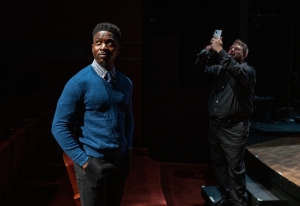
Coincidentally (or not), Victory Gardens’ new play about a controversial campus speaker opens just days after the one-year anniversary of Charlie Kirk’s assassination. Returning from a lengthy hiatus, Victory Gardens once again lights up the Biograph Theater with the world premiere of Zayd Ayers Dohrn’s new play “The Humanities”.
This thrilling play takes place on an American college campus where an opinionated voice is scheduled to speak. At the top level, an intellectual battle brews between professors and the college administration, while the students openly revolt.
Jonas (Ernest Bently) is a new professor on campus, hand selected by the department chair Martin (Steve Pickering) and his professor wife Margot (Naomi Evans). Jonas is young and ambitious, unwilling to get involved in the petty troubles of students and faculty. Martin and Naomi have other ideas. When Martin invites Luka (Daniil Krimer), an ultra-right-wing speaker on campus he kicks off a series of events that could lead the college, and Jonas, to ruin.
Carole (Sabine Wan) straddles the line between education and commerce as the dean while trying to appease the students and queer professor Milta (Isa Arciniegas). On the ground, students Hampton (Derrick Sanders III) and Xander (Piper Murphy) are taking action into their own hands.
Zayd Ayers Dohrn’s script is densely packed, structured in parts much like a college lecture. Each professor has their own somewhat incomprehensible monolog that speaks to how people can say so little with so many words. That’s not to say these passages are empty, and that’s the point. What college student could actually follow these verbal gymnastics though? Perhaps these speeches say more about how some educators are afraid to share their real opinion. Afterall, feelings aren’t facts.
“The Humanities” is a riveting exploration of the cost of free speech. Of course, our first amendment protects it, but it doesn’t account for good taste. Luka is played so smooth and charmingly by Daniil Krimer that you almost forget he’s a neo-Nazi, until he starts his speech. And that’s the unsettling part; under the law he’s just as entitled to hate speech as to tolerance messaging. And that those who criticize him in this play aren’t exactly perfect themselves.
Dohrn paints a rather cynical portrait of higher education, but in other ways he has a lot of faith in youth. Without the radical intentions of Xander and Hampton, there would be no point in rehashing the systematic problems of American academic institutions. In many ways it’s what makes this play so unique.
For those wondering if Victory Gardens has been restored to its former glory under new leadership, “The Humanities” proves they’ve still got it. Edward Torres directs a great cast. While originally billed as starring SNL alum Nora Dunn, British American actress Naomi Evans seems better fit for the role. She has a sleekness about her that makes some of the sexual plotlines a bit more palatable. Steve Pickering embodies that stodgy professor in this era almost as pitifully as Albee’s George was to the 1960s. There’s a certain tragedy in his performance.
While maybe a bit of trimming could help file this play down to a finer point, Victory Gardens choosing Dohrn’s script as their season opener is a brave choice. Almost an admission of self-awareness in an ever-dividing world in which institutions are no longer held on the same pedestals.
Through October 4 at Victory Gardens Theater. 2433 N Lincoln Ave. (773) 871-3000)
An Immersive Sunday in the Park with George at Kokandy Productions

Composition, tension, balance, light, and harmony come together seamlessly in Kokandy Productions’ revival of Sondheim’s opus, ‘Sunday in the Park with George’. Director Derek Van Barham transforms the basement of the Chopin Theatre into a three dimensional reproduction of Georges Seurat’s ‘A Sunday Afternoon on the Island of La Grande Jatte’ for this beloved musical’s return to Chicago.
Sondheim was never known to write ordinary musicals. His smash hit ‘Company’ is considered the first “concept” musical. Wherein, the story has no real plot, instead themes are explored through song. ‘Sunday in the Park with George’ with whom he worked with James Lapin is similar in that it’s hard to describe exactly what it’s about, per se. In succinct terms, it’s a fictionalized account of how Georges Seurat painted his pointillism masterpiece while trying to balance interpersonal relationships. Specifically, his flailing relationship with the painting’s focal point, Dot. It’s as if Sondheim was exploring his own obsessiveness and how it hindered him in many ways.
‘Sunday in the Park with George’, which won the 1985 Pulitzer for drama, has a special connection to Chicago as the famed painting hangs in the Art Institute. The last time a local storefront theatre revived it was 2010. However, longtime Chicago theatre lovers are unlikely to forget Gary Griffin’s production at the Chicago Shakespeare Theater in 2004, later remounted in 2012. Though it’s a favored musical by many, it’s not one often produced because you really need all the right ingredients to do this one justice.
Kokandy has gathered those ingredients for this imaginatively staged new version. Derek Van Barham, who also serves as artistic director has been noodling on this show for the near decade he’s been working with Kokandy and the result is simply gorgeous.
A large and talented ensemble is led by Kevin Webb as Georges and Missy Wise Vanderzee as Dot. The two are not only incredible vocalists but each are wonderful in bringing their characters off the canvas and into real life. Webb’s take on Georges is vulnerable, less stoic, less cold, less fixed. Vanderzee is also much warmer and less shrill than the original cast recordings. Going from 1800s Dot to 1980s elderly Marie can prove to be tricky for some actors but Vanderzee does a great job of bridging the gap with humor and pathos.
Perhaps no other adjective is more apt to describe this production than bittersweet. Nearly devoid of melodrama and yet cuts right to the emotional bone. Under Nick Sula’s music direction Sondheim’s orchestrations are performed with such attention to detail that audiences hang around well past the curtain call. Some of the best choral arrangements ever composed for the stage finds their stride as the company and music moves fluidly through G “Max” Maxin IV’s brilliant staging.
Van Barham has made something special here. Moving the staging from the traditional proscenium to an in-the-round black box provides so much more room to play around with the spectacle of live theatre. Rather than aiming for utmost fidelity to the ‘Sundays’ that have come before it, Kokandy opts to create their own signature production that will be remembered as one of Chicago’s best.
Through November 1 at Kokandy Productions at Chopin Theatre. 1543 W Division St. 773-278-1500
*Extended through November 29th!
https://www.kokandyproductions.com/
Kokandy’s HAIR Revival Finds a Modern Footing
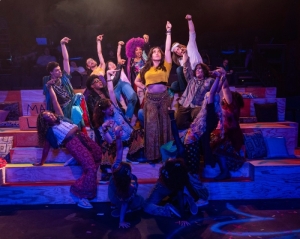
Kokandy Productions’ HAIR revival lets the sunshine in this summer at the Chopin Theatre. Directed and choreographed by Brennan Urbi, this remount is a fresh, funky and poignant riff on the classic 1960s tribal love-rock musical by Galt MacDermot. The large cast of new and returning Kokandy faces bring this musical out of its time capsule and into the 21st century with incredible vocals and unwieldy energy. In short, this cast is having a blast and so will you.
HAIR is one of the rare musicals whose songs actually crossed over into mainstream pop/rock. Perhaps most notably by way of The 5th Dimension’s iconic medley of ‘Aquarius’ and ‘Let the Sunshine In’ from 1969. However, one doesn’t have to look far to find songs like ‘Good Morning, Starshine’ and the title track ‘Hair’ used throughout pop culture. Re: Simpsons did it. Most people who have never seen HAIR the stage musical, or its film adaptation are at least somewhat familiar with its refraining choruses.
That said, by now HAIR has been lampooned as a shallow hippie fever dream known for simulated pot smoking and full-frontal nudity. Some elements of the musical might support the stereotype, but Urbi digs deeper into the lyrics and book by Gerome Rangi and James Rado and creates a much more cohesive and contemporary production than even the renowned 2009 Broadway revival.
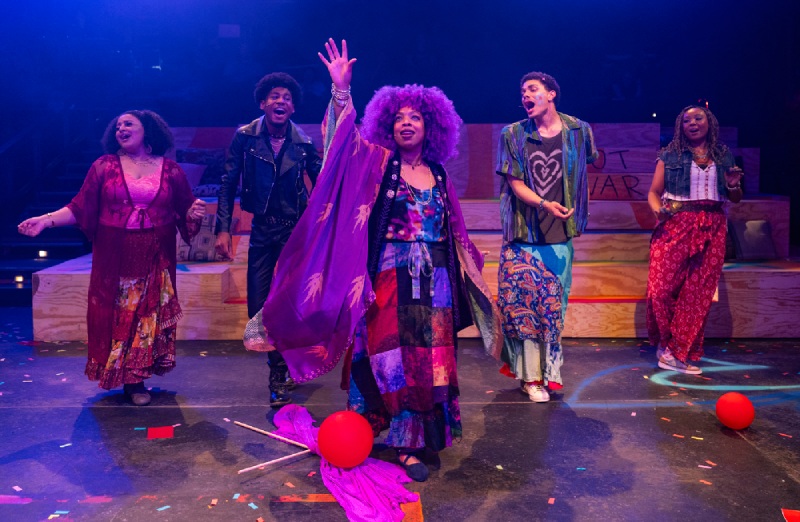
(left to right) Diana Marilyn Alvarez, Joshua Emmanuel, Chosen Mitchell, Kijani Xand Caitlin Dobbins in Kokandy Productions’ revival of HAIR. Photo by Michael Brosilow.
While HAIR might lack an immediate plotline, it instead spends the first third of the show exploring the themes of the 1960s counterculture through conceptual songs that don’t quite further the action but are incredibly catchy. Claude, Berger and Sheila emerge as the show’s main protagonists, which is where things get more interesting.
Berger is the tribe’s ringleader, a young sexually charged dropout played by Zac Richey. His main concern is certainly the “free love” element of hippy culture and not much else. Claude serves as the show’s moral compass–another dropout who questions the ethics of dodging the draft and whether hippie culture is as altruistic as it claims. Sheila, played by Catherine Rodriguez O’Connor, is an activist caught between the two male leads. Her voice is showstopping throughout, especially during the arresting finale.
Style is an essential component of HAIR. While it’s impossible to stray far from the 1960s given its direct references to the Vietnam War, costume designer Rachel Sypniewski and lighting designer G “Max” Maxin IV, bring a certain modern rave aesthetic to Kokandy’s production. Those who choose to sit on scenic designer Eleanor Kahn’s conversation pit-flavored set will be richly rewarded by all the trippy lights and wild action happening around them.
HAIR is a largely ensemble-driven show and they’re doing their job well here. The character Dionne begins the show with a stirring version of ‘Aquarius’ impeccably sung by Chosen Mitchell. Honestly, any production of HAIR is only as good as its Dionne. You won’t be able to take your eyes off Mitchell whose vocal gymnastics throughout the show will make the hair on your arms stand up. Styled perfectly against the club lighting, Mitchell proves to be the show’s hidden gem. It’s a hard bar to clear as this ensemble is giving some of the tightest harmonies Kokandy has ever produced.
This revival of HAIR is one for the Chicago books. It captures the spirit of the 1960s, but with the frustrations of 2026 youth culture it begs the question, how on Earth are we still singing about more or less the same societal ills?
Through September 13 at Kokandy Productions at the Chopin Theatre. 1543 W Division St. 773-278-1500
- Kokandy Productions
- HAIR
- Chopin Theatre
- 1960s musical
- hippies
- Brennan Urbi
- Galt MacDermot
- The 5th Dimension
- Aquarius
- Let The Sunshine In
- Gerome Rangi
- James Rado
- Zac Richey
- Catherine Rodriguez OConnor
- Rachel Sypniewski
- G Max Maxin IV
- Musical theatre
- anti-war
- live theatre
- chicago theatre
- Chicago events
- Chicago stage
- on stage
- Wicker Park
Tom Stoppard’s epic finale Leopoldstadt is an instant classic at Writers Theatre

What would you do if you found out your heritage wasn’t what you thought it was? In Tom Stoppard’s case, he wrote a sweeping, epic play about it. Glencoe’s Writers Theatre brings Leopoldstadt to the Chicago area for the first time since its West End and Broadway runs in the early 2020s. Directed by Carey Perloff, a longtime friend and collaborator of Stoppard’s, this final stage play proves to be among his best.
Stoppard passed away late last year but he left a decades-long cannon of seminal stage and screenplays. When his semi-autobiographical play “Leopoldstadt” began performances in the West End in early 2020, he was sure it would be his last. Though he wrote it in a year, it took nearly 30 years to find the narrative. Stoppard, who was raised as a gentile most of his life, was told by a family member in 1993 he was of Jewish heritage and that many of his family members were murdered in the Holocaust. Stoppard escaped Czechoslovakia as a child and was raised in the UK entirely unaware.
A blended Jewish-Catholic family’s history in 20th century Vienna is divided neatly into four pivotal scenes with a sizeable cast of some of Chicago’s best. In the first scene, a Christmas party (1900), we’re shown a Vienna in which Jews were considered equals. Families had interfaith marriages and shared holiday celebrations. By the second scene (1924), WWI has redrawn the maps of Europe. Austria, as well as the family, finds itself in a precarious place. Scene three (1938) portrays an Austria fully committed to the Third Reich and family alliances are put to the test when the family is forced out of their home by the Nazis. The final scene (1955) happens in the aftermath of Austria’s reunification following WWII. This last scene mirrors Stoppard’s own life and serves as an emotional climax to a play that is often dense with political and historical theory.

The cast of Leopoldstadt. Photo by Michael Brosilow.
Writers Theatre’s production is as faithful to the original as you can get. Carey Perloff directed the Boston and D.C. premieres too. Along with an all-star cast of Chicago heavy hitters, Perloff’s production will likely be remembered as the definitive Midwestern revival. Between Ken MacDonald’s set and Alex Jeager’s costumes, audiences are sure to be swept away to a different time and place that can feel eerily reminiscent to the present.
As the eras change so do the actors playing the characters. Stoppard’s script trusts that the storytelling is so engaging that audiences will figure out who’s who by the context clues, and he was right. Some may find the story hard to follow but thankfully a helpful lobby installation catches everyone up on the history of Austria during this time period.
Writers Theatre favorite Kate Fry plays a Catholic woman, Gretl, who marries into a prominent Jewish family. Her performance is at first charming but by the end heartbreaking. Jessie Fischer delivers a transformative performance, particularly during the final scene. Rounding out the male ensemble is Ian Barford as Hermann who plays a converted catholic, but it’s his deterioration that is unforgettable. Justin Albinder is given the meatiest part of the final scene and his ability to switch from one emotion to the next is some of the most natural acting of the evening.
Leopoldstadt is every bit as epic as something like Gone with the Wind. Much like the famed novel and movie, this play tells the story of a civilization, a family, lost to the tragedy of war. It’s a story of a family’s near extinction. Stoppard’s brilliance is on full display and how lucky are we to have this capstone for his illustrious career?
Through August 16 at Writers Theatre. 325 Tudor Ct, Glencoe, IL. 847-242-6000
https://www.writerstheatre.org/events/leopoldstadt
This review is proudly shared with our friends at www.TheatreInChicago.com.
A Red Orchid’s The Targeted Builds a Case for Compassion

If you’ve ever worked in an urban coffee shop, chances are you’ve encountered at least one ultra-paranoid kook who believes the government is spying on them. Often they’re filling out long journals or manifestos. Or perhaps that one crazy uncle we all seem to have who believes in way too many conspiracy theories. These loveable, but disturbed weirdos commonly refer to themselves as “targeted individuals.”
Hanna Kime’s new play The Targeted makes its world premiere at A Red Orchid Theatre. In it, she empathetically explores the lives of these folks and what draws them to their beliefs. Though it is at times humorous, Kime’s play is not exploitative. Rather, she builds an entire ecosystem for not only those affected by this kind of thinking, but the ways in which others profit from it.
Grace Dolezal-Ng directs a bonafide dream cast of some of Chicago’s best actresses. They turn the main stage at The Chopin into a woodsy, weekend retreat called The Solidarity and Truth Summit. Rhonda (Kirsten Fitzgerald), Didi (Natalie West) at first seem very nice and chummy when welcoming newcomer Sherry (Sadieh Rifai), but as the weekend wears on, fractures begin to form. Rhonda is immediately mistrustful of Mia (Stephanie Shum), another newbie who is very upfront about not being a believer in government tracking conspiracies; she’s only there to support her misguided younger brother Eric (Glenn Obrero). The power structure becomes more complicated once the organizer of the summit, Jeff (Lawrence Grimm), starts giving whacky lectures.
In 95 minutes of quick-moving scenes, each character reveals how this affliction has sabotaged their personal lives. At the beginning, you can almost convince yourself these people are normal, just with some strange ideas. Sadieh Rifai plays Sherry with such naive conviction that you can’t imagine a simple, suburban housewife could ever be tempted by this rabbit hole. Through her character, Kime makes a thinly veiled parallel to the “Q-Anon” to “Trad Wife” pipeline. In contrast, Kirsten Fitzgerald’s Rhonda is hard as nails and her desire to control the weekends’ narrative speaks directly to just how dangerously persuasive conspiratorial ideology can be.
The central storyline presents itself in the relationship between Eric and Mia though. As a non-believer, Mia is outnumbered and it’s not long before she begins questioning her own sanity. Stephanie Shum plays the voice of reason with a quintessential authority. Her character’s demand for truth shows how frustrating independent thinking can feel in group settings.
While there is certainly a rubber-necking quality to the topic at hand, Kime never treats her characters as some sort of Netflix documentary sideshow specimens. Natalie West plays one of the weirder believers but her quirky softness makes her one of the show’s most endearing characters, even if she is hawking metaphoric snake oil for a living.
In the end, Kime lets the audience make up their own mind as to whether these folks actually believe what they’re talking about, or whether they’re just extremely lonely. It’s hard to criticize conspiracy theorists in an era in which almost every aspect of our federal government seems to be conspiring against its people. Kime builds a case for compassion with The Targeted.
Through June 21st at A Red Orchid Theatre. At Chopin Theatre. 1543 W Division St. 773-278-1500.
This review is proudly shared with our friends at www.TheatreInChicago.com.
A New Home, A Necessary Warning: Timeline’s Enemy Lands Hard

Timeline Theatre unveils their chic, new Uptown home with its inaugural production–Henrik Ibsen’s ever-relevant “An Enemy of the People”. A streamlined text by acclaimed playwright Amy Herzog cuts right to the bone in this fast-paced version straight from Broadway.
It shouldn’t come as a surprise that Timeline chose to open their new space with Ibsen’s classic play about a town that prioritizes economics over public health. History continues to repeat itself. Whispers of AI data centers seemed to be on everyone’s lips during the intermission as the modern day parallel is impossible to ignore. Timeline, who is known for their dramaturgical installations by Maren Robinson, doesn't shy away from the ugly reality that our Great Lakes are under attack from the tech billionaire class who aim to guzzle ungodly amounts of our fresh water.
The play begins on a chipper note, an economically downtrodden town brims with excitement for their new spa and resort that is sure to boost local prospects. That is until plucky Dr. Thomas Stockmann (Will Allan) makes a chilling discovery about the contaminated water source. At first his friends at the local newspaper are behind his decision to inform the townspeople, but as his brother Peter, the mayor (Behzad Dabu), becomes involved support begins to waver. Soon his adult daughter Petra (Campbell Krausen) is his only ally.

Petra Stockmann (Campbell Krausen, background from left), Hovstad (Grayson Kennedy), and Captain Horster (Charles Andrew Gardner) watch attentively as Dr. Thomas Stockmann (Will Allan, foreground) reviews shocking scientific revelations.
Herzog’s version is more akin to a chamber play than Ibsen’s, perhaps less grand in scale but certainly easier to digest. She also inserts some modern political flourishes that give more depth to the female protagonist Petra. With a slimmer cast and script, individual performances stand out and the intensity is more sustained. And by the second act, the audience becomes part of the cast in a way. This device works especially well because of the brilliant performances of this intimate cast.
“An Enemy of the People” becomes just as frustrating as Miller’s “The Crucible”. That infectious sense of outrage comes down to Will Allan’s devastatingly honest portrayal of a man who loses everything for the pursuit of truth. Allan has a gift for physicality, often interjecting some levity wherever possible. Audience participation becomes hard to contain as he’s continuously silenced by the newspaper staff and his greedy brother. Behzad Dabu opts for a more pragmatic interpretation of the mayor than straight up villain. In fact, there are moments where despite the poisonous water, you might find yourself agreeing with him, therein lies the danger. The emotional anchor of the show is Campbell’s Krausen’s Petra. Much like Allan’s performance, the shift from light to dark is heartbreaking.
Timeline’s glow up from Wellington to North Broadway is something to marvel at. Uptown has gained a Steppenwolf-level theater. Legendary Chicago director Ron OJ Parson brings a certain sophistication well deserving of this sleek 250-seat theater. Everything is just right here. John Culbert’s stylish set and stage magic really fills this gorgeous new performance space. Uptown really is quite lucky to have this wonderful new theater in its backyard.
Through June 27 at Timeline Theatre. 5035 N Broadway. 773-281-8463 x1
This review is proudly shared with our friends at www.TheatreInChicago.com.
- Timeline Theatre
- An Enemy of the People
- Maren Robinson
- Will Allan
- Behzad Dabu
- Campbell Krausen
- Amy Herzog
- Ron OJ Parson
- John Culbert
- on stage
- live theatre
- Chicago plays
- Chicago events
- Now playing
- henrik ibsen
- TimeLine Uptown
- Chi Theatre
- Uptown Chicago
- Public Health Crisis
- Political Drama
- Civic Responsibility
Grelley Duvall Best Actress Delivers a Pop‑Culture Fever Dream at Chopin

The Oscars might be over, but this “Best Actress” is just getting started. Welcome to the weird world of the Grelley Duvall Show, or Alex Grelle. His unique approach to cabaret has amassed quite a fanbase over the years. Suffice it to say, there’s nothing else quite like it. In two acts, Grelle and his team blend his favorite female performances with highly choreographed musical numbers set to toe-tappin’ hits performed by a live band.
Directed by Kasey Foster, “Best Actress” tells the origin story of the Grelley Duvall Show and what inspired a young Alex Grelle and his creative partner Jesse Morgan Young. Their obsessive knowledge of pop culture as seen through the lens of queer millennials is unmatched. They throw anything from a given day on cable TV in the 1990s into the blender and it’s up to the audience to keep up. The irreverent humor, costumes, and slickly produced video segments add up to an evening of hilarious deep cuts and surprise cameos.
To be honest, not all experimental cabaret style theatre is good. Rest assured Best Actress is not that. Rather it’s a 2-hour musical extravaganza with solid gold choreography by Erin Kilmurray and Kasey Alfonso and a kick-ass band led by (and featuring the vocals of) Aunt Kelly. Alex Grelle is a certified triple threat: he can sing, he can dance and he can kick. The team he’s assembled for this production has made something really special for anyone really, but especially for the pop culture obsessed, vintage shopping community.
Joining Grelle onstage is a powerhouse ensemble - Kara Brody, Madigan Burke, Lolly Extract, Darling Shear, Patrick Stengle, and Mary Williamson - plus a handful of puppets that feel like characters in their own right. And make no mistake: Grelle isn’t the only one throwing kicks. This cast matches his energy beat for beat, putting on quite a show. Again, Killmurray and Alfonso’s choreography is killer.
Grelley Duvall Best Actress is one of those shows it’s almost best to not know much about going in. It’s also one of those shows that should just run open-ended for a while, because once you see it, you’ll be trying to explain to people for weeks what exactly it was.
Through April 12 at the Chopin Theatre. 1543 W Division St. 773-278-1500
This review is proudly shared with our friends at www.TheatreInChicago.com.
A soaring Seagull at Red Theater

For some, an evening of Chekhov may sound like pure misery, but Red Theater’s “The Seagull” running at The Edge Off Broadway soars. The original adaptation by Red Theater cohort Ian Mayfield imagines Anton Chekhov’s emotionally searing dramady as a chamber play. Under his direction, this faithful version is a hidden gem of this winter’s storefront theatre scene.
Though known for depressing family melodramas, Chekhov did have a sense of humor, and perhaps in no other play is his cynical wit more on display than “The Seagull”. Any production is only as good as its neurotic, self-involved Arkadina. Anne Sheridan Smith is a captivating presence in the role of the celebrated actress. She brings an amusing larger-than-life performance that’s devilish to watch. Lovelorn and constantly drinking Masha played by Magdalena Dalzell delivers cutting physicality that’s also quite thrilling.
Jamie Herb is one of the production’s strongest assets in the role of Nina. Her performance takes full advantage of the closely drawn staging. She tells entire stories with haunting gazes. Her eventual breakdown feels more disturbing than the play’s actual tragic conclusion. However, perhaps no character is as pitiful as Medvedenko the schoolteacher. Ben Murphy plays the role with a subdued quietness that’s like whatever the opposite of “golden retriever boyfriend” energy is.
Original scoring by Jonathan Hannau lends to the chamber play atmosphere and elevates the ambiance. Maggie McGlenn’s sumptuous costumes combined with Hunter Cole’s minimal staging keep the focus on the action. As the actors move in and around the space, audiences will feel personally drawn in, as if they’re a silent guest at a party.
Red Theater’s “The Seagull” is a great example of what makes Chicago’s fringe and storefront scene so exciting. While many may look to the bigger institutions like Goodman or Steppenwolf to tackle major works by important playwrights, with the right talent in place a small theater can be just as impactful, if not more in some cases. Ian Mayfield’s version spends a lot of time dissecting Chekhov’s musings on artistic forms, and that curiosity about the craft of theatre feels evident in this cast. The result is a labor of love, and exactly what you want from a good night of theatre–that you lived through something.
Through March 15 at Red Theater at The Edge Off Broadway. 1133 W Catalpa Ave. Tickets via www.redtheater.org
This review is proudly shared with our friends at www.TheatreInChicago.com.



Latest Articles
-
 Music Theater Works Pours a Beachy Cocktail with Escape to Margaritaville
Written by Kimberly KatzA gentle, tide‑easy current settles in right from the start, immediately signaling the kind of story this musical wants to tell. Rather than relying on big, splashy moments, it settles into a warm, beach-side rhythm, inviting the audience into a…
Music Theater Works Pours a Beachy Cocktail with Escape to Margaritaville
Written by Kimberly KatzA gentle, tide‑easy current settles in right from the start, immediately signaling the kind of story this musical wants to tell. Rather than relying on big, splashy moments, it settles into a warm, beach-side rhythm, inviting the audience into a… -
 Chicago Shakespeare Makes Winter’s Tale a Story Worth Telling
Written by Angelo CamposChicago Shakespeare Theater’s production of The Winter’s Tale delivers a compelling evening of theater, showcasing an exceptional company of actors working at the top of their craft. Under the direction of Artistic Director Edward Hall, this staging marks an exciting…
Chicago Shakespeare Makes Winter’s Tale a Story Worth Telling
Written by Angelo CamposChicago Shakespeare Theater’s production of The Winter’s Tale delivers a compelling evening of theater, showcasing an exceptional company of actors working at the top of their craft. Under the direction of Artistic Director Edward Hall, this staging marks an exciting… -
 A Joe & Melanie Thing Theatre Company announces The Hanukkah Humbug at Greenhouse Theater Center - December 3-6
Written by Buzz Center StageThe world premiere of The Hanukkah Humbug brings ghosts, history, tradition, and a whole lot of family fun to the Greenhouse Theater Center just in time for the holidays, Melanie Ann Apel promises a lively, family-friendly experience with this new…
A Joe & Melanie Thing Theatre Company announces The Hanukkah Humbug at Greenhouse Theater Center - December 3-6
Written by Buzz Center StageThe world premiere of The Hanukkah Humbug brings ghosts, history, tradition, and a whole lot of family fun to the Greenhouse Theater Center just in time for the holidays, Melanie Ann Apel promises a lively, family-friendly experience with this new… -
 Remy Bumppo’s Mud Row: A Family Haunted by the Past
Written by Wesley DavidRemy Bumppo opens its 30th anniversary season with Mud Row, a play by Tony Award nominee and MacArthur “Genius” Grant recipient Dominique Morisseau. Expertly directed by Malkia Stampley, this production is a sublime examination of family, inheritance, and the difficult…
Remy Bumppo’s Mud Row: A Family Haunted by the Past
Written by Wesley DavidRemy Bumppo opens its 30th anniversary season with Mud Row, a play by Tony Award nominee and MacArthur “Genius” Grant recipient Dominique Morisseau. Expertly directed by Malkia Stampley, this production is a sublime examination of family, inheritance, and the difficult…
Does your theatre company want to connect with Buzz Center Stage or would you like to reach out and say "hello"? Message us through facebook or shoot us an email at This email address is being protected from spambots. You need JavaScript enabled to view it..
*This disclaimer informs readers that the views, thoughts, and opinions expressed in the text belong solely to the author, and not necessarily to Buzz Center Stage. Buzz Center Stage is a non-profit, volunteer-based platform that enables, and encourages, staff members to post their own honest thoughts on a particular production.