
Displaying items by tag: Glenn Obrero
Now Boarding: Bonnie’s Last Flight, a Sky‑High Comedy with Real Heart
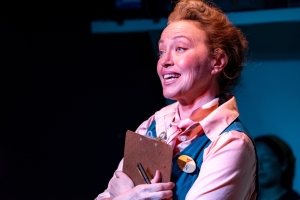
Rivendell Theatre Ensemble closes its milestone 30th season with Bonnie’s Last Flight, a sly, sky‑high comedy set during a flight attendant’s final day on the job - a blend of sharp satire and warm, traditional character comedy that’s genuinely, disarmingly funny. Jan has always carried a quiet love for writing, and now she’s earned a spot in an elite program - a dream she’s never fully allowed herself to chase. Handing over her wings means more than leaving the airline; it means finally giving herself permission to focus, to create, and to figure out who she is when she’s no longer defined by the job that shaped her life. But instead of treating her retirement as a tidy celebration, the play leans into the strange limbo that comes when a long‑held identity is about to disappear. Jan isn’t just stepping off a plane - she’s stepping out of the role that has shaped her routines, her friendships, and the way she moves through the world. That kind of transition can feel exhilarating, but it can also feel like freefall: What happens when the structure you’ve relied on for decades suddenly dissolves? Who are you when the uniform comes off?
Around her, the cabin is filled with a wonderfully mismatched crew navigating their own turbulence. Greig, her closest colleague - and one of the few people Jan truly considers family - is somehow the only person on board who doesn’t realize this is her final flight. While Jan quietly braces for the unknown, Greig clings to nostalgia – reminiscing about the 70s and 80s when people flew with style and grace, which in turn translated to proper behavior as passengers. LeeAnne, the rookie attendant, is still wobbling her way through the basics and is convinced the rest of the crew resents her simply for being young. Meanwhile, the Captain - who relies a little too heavily on mid‑air “comforts” - and the Co‑Pilot form an offbeat duo doing their best to keep the ride smooth and the mood light, even as everything around them threatens to veer off course. And then there’s Mark Twain – Jan’s guiding light and inspiration - drifting through the cabin like a sardonic travel spirit, adding an off‑kilter, almost dreamlike layer to the already unpredictable atmosphere. At any given moment, he might toss out a Twain‑ish zinger like, “Don’t argue with stupid people - they’ll drag you down to their level and beat you with experience.”
And yes - the title Bonnie’s Last Flight does mean something specific. The play waits to share it, and it’s worth letting that moment land on its own.
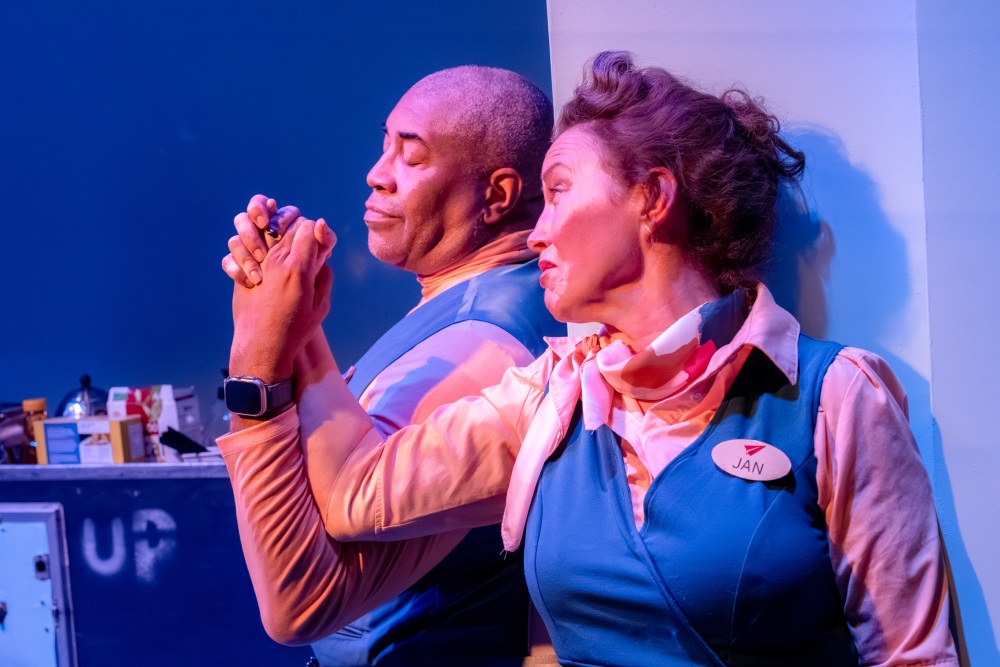
Paul Oakley Stovall as Greig and Rebecca Spence as Jan. Photos by Jenn Udoni.
Rivendell’s latest offering finds sharp, playful humor in every recognizable quirk of air travel - from the ritual of cramming bags into overhead bins to the exaggerated seatbelt pantomime, from the sad little routines of in‑flight food service to the collective sigh of a delayed takeoff, and even the inevitable moment when the Boingo internet keeps going down. Playwright Eliza Bent (The Regulars, Karen, I Said) threads these details together with wit and oddball charm - comic gold, really - especially in the way she captures the crew’s half‑coded, half‑conspiratorial communication style. Director Devon de Mayo amplifies that energy by staging the entire piece as an 85‑minute real‑time passage through the air on the gloriously scrappy Smelta Airlines, traveling from “use your imagination” to Chicago. Audience members are assigned boarding groups before entering, and once inside, the immersion never breaks - we are the passengers, and the cast treats us as such. In Rivendell’s intimate 40–50 seat house, the action unfolds close enough to feel immediate, with scenes playing out just a few feet away and often surrounding you entirely. Surprise song‑and‑dance numbers erupt out of nowhere and are executed with precision that feels almost impossible in such close quarters. As someone who now dreads flying, I thoroughly enjoyed being on this airborne adventure.
On top of the cleverly crafted script and fine‑tuned direction, the cast’s blend of Rivendell regulars with notable newcomers is the last flourish that makes the whole thing take off. Rebecca Spence, a longtime Rivendell ensemble member fresh off her appearance in Chicago Shakespeare Theater’s Fault directed by Jason Alexander and her screen work on Taylor Sheridan’s The Madison, returns with a commanding presence as Jan, grounding the production with a performance that moves effortlessly between wry humor and quiet emotional depth. Up close, we see what a truly talented actor she is - we feel every beat of her internal calculus, the uncertainty, the flickers of excitement, the moments of reflection, and even the disappointments, all delivered with a subtlety that makes her journey resonate long after the plane arrives in Chicago.
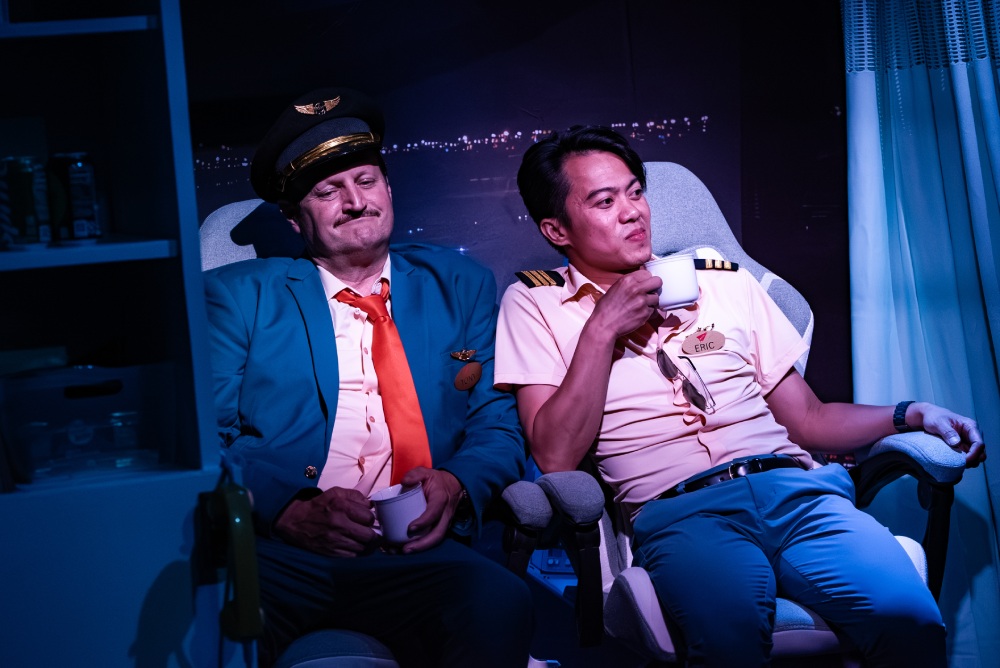
Eric Slater (left) as Pilot and Glenn Obrero as Co-Pilot in Bonnie's Last Flight.
Spence is joined by fellow Rivendell ensemble members Jessica Ervin, Eric Slater, and Glenn Obrero, each bringing sharp timing, confident comic instincts, and just the right touch of vulnerability when the moment calls for it, with Paul Oakley Stovall and LaKecia Harris rounding out the cast as fantastic additions who elevate the ensemble’s already cohesive dynamic.
Eric Slater’s dry‑witted Captain/Pilot lands every beat with understated precision, while Jessica Ervin’s off‑balance LeeAnne provides a wonderfully unpredictable charge that never feels forced. Glenn Obrero’s earnest Co‑Pilot (“Jesus,” as the Captain likes to refer to him), brings a lovable silliness along with genuine warmth, a combination that gives the show extra bounce. Paul Oakley Stovall, a standout as Greig, draws on his wide‑ranging stage experience to deliver a performance full of nuance, comic assurance, and centered emotional presence that adds unexpected depth to the production. The ensemble’s cohesion is further strengthened by LaKecia Harris, whose turn as Mark Twain brings a sly, confident rhythm that meshes seamlessly with the group’s comic fabric. Together, they’re dynamite - fully in tune with one another and performing with the cohesion of a team that’s been flying together for years.
At its core, Bonnie’s Last Flight is less about airline chaos and more about the uneasy moment when a person realizes the next chapter of life doesn’t come with a boarding pass. Jan is standing at the edge of retirement, a place where excitement and dread blur together. Leaving a long‑standing job can feel like stepping off a moving walkway: suddenly the rhythm that shaped your days disappears, and you’re left wondering who you are without the role that once defined you. While Jan wrestles with that quiet panic, the rest of the cabin spirals in their own directions - LeeAnne dodging emotional landmines, the Captain leaning too hard on liquid courage, and Erik trying to squeeze a thought into the noise. Beneath the jokes and mishaps, the play nudges at something more human: the fear of losing purpose, the hope of reinvention, and the strange freedom that comes when life forces you to start over.
This design team gives us the feel of being inside an airplane, creating an environment that gently echoes the experience of settling into a cabin. Scenic designer Regina García shapes Rivendell’s intimate space into a compact aircraft interior, complete with a cockpit, a small lavatory, a food‑and‑drink station, and lighted walkways that recall the soft glow of aisle markers guiding passengers to their seats. Saawan Tiwari’s costumes reinforce the world with grounded, character‑specific details that nod to real airline crews without slipping into caricature. Garnett Bell’s lighting adds subtle shifts that mirror the ambience of a cruising cabin or the quick changes that accompany an announcement. And Satya Chavez’s sound design supplies the familiar chimes, the pressurized hush of doors, and the clipped rhythm of airline instructions, creating an auditory landscape that instantly situates us in the sky.
In short: Bonnie’s Last Flight promises a strange, playful, and slightly chaotic airborne adventure - a character‑driven comedy about people stuck in the sky and stuck in their lives, trying to figure out what comes next. The humor lands repeatedly with precision, but what ultimately gives the show its staying power is the heart that surfaces beneath and during the laughs - those small, sincere moments of connection and longing that linger long after the final descent.
Already extended to October 25th at Rivendell’s home on Ridge Avenue, this production is a sure‑fire good time that’s sure to send you back to the friendly skies with a smile. For tickets and more show info, visit https://www.rivendelltheatre.org/bonnieslastflight.
Highly recommended.
A Red Orchid’s The Targeted Builds a Case for Compassion

If you’ve ever worked in an urban coffee shop, chances are you’ve encountered at least one ultra-paranoid kook who believes the government is spying on them. Often they’re filling out long journals or manifestos. Or perhaps that one crazy uncle we all seem to have who believes in way too many conspiracy theories. These loveable, but disturbed weirdos commonly refer to themselves as “targeted individuals.”
Hanna Kime’s new play The Targeted makes its world premiere at A Red Orchid Theatre. In it, she empathetically explores the lives of these folks and what draws them to their beliefs. Though it is at times humorous, Kime’s play is not exploitative. Rather, she builds an entire ecosystem for not only those affected by this kind of thinking, but the ways in which others profit from it.
Grace Dolezal-Ng directs a bonafide dream cast of some of Chicago’s best actresses. They turn the main stage at The Chopin into a woodsy, weekend retreat called The Solidarity and Truth Summit. Rhonda (Kirsten Fitzgerald), Didi (Natalie West) at first seem very nice and chummy when welcoming newcomer Sherry (Sadieh Rifai), but as the weekend wears on, fractures begin to form. Rhonda is immediately mistrustful of Mia (Stephanie Shum), another newbie who is very upfront about not being a believer in government tracking conspiracies; she’s only there to support her misguided younger brother Eric (Glenn Obrero). The power structure becomes more complicated once the organizer of the summit, Jeff (Lawrence Grimm), starts giving whacky lectures.
In 95 minutes of quick-moving scenes, each character reveals how this affliction has sabotaged their personal lives. At the beginning, you can almost convince yourself these people are normal, just with some strange ideas. Sadieh Rifai plays Sherry with such naive conviction that you can’t imagine a simple, suburban housewife could ever be tempted by this rabbit hole. Through her character, Kime makes a thinly veiled parallel to the “Q-Anon” to “Trad Wife” pipeline. In contrast, Kirsten Fitzgerald’s Rhonda is hard as nails and her desire to control the weekends’ narrative speaks directly to just how dangerously persuasive conspiratorial ideology can be.
The central storyline presents itself in the relationship between Eric and Mia though. As a non-believer, Mia is outnumbered and it’s not long before she begins questioning her own sanity. Stephanie Shum plays the voice of reason with a quintessential authority. Her character’s demand for truth shows how frustrating independent thinking can feel in group settings.
While there is certainly a rubber-necking quality to the topic at hand, Kime never treats her characters as some sort of Netflix documentary sideshow specimens. Natalie West plays one of the weirder believers but her quirky softness makes her one of the show’s most endearing characters, even if she is hawking metaphoric snake oil for a living.
In the end, Kime lets the audience make up their own mind as to whether these folks actually believe what they’re talking about, or whether they’re just extremely lonely. It’s hard to criticize conspiracy theorists in an era in which almost every aspect of our federal government seems to be conspiring against its people. Kime builds a case for compassion with The Targeted.
Through June 21st at A Red Orchid Theatre. At Chopin Theatre. 1543 W Division St. 773-278-1500.
This review is proudly shared with our friends at www.TheatreInChicago.com.
'The Chinese Lady' is Powerful, Poignant, and Not to Be Missed

TimeLine Theatre’s ‘The Chinese Lady’ is a powerful show - poignant, learned, sophisticated - and illuminating. Ninety minutes of engaging drama (no intermission) that left me somewhere between laughing, crying, and standing on my feet to cheer.
Directed by Helen Young from the script by Lloyd Suh (an award-winning playwright now in residence at New York’s New Dramatists) is based on the true story of Afong Moy (Mi Kang gives a stellar performance), brought to New York in 1834 as a living museum exhibit when she was just 14. For 25 cents a ticket, Afung Moy portrayed aspects of life in exotic China: eating a meal with chopsticks, walking in petite slippers covering her tiny bound feet, making tea, and speaking to the audience about life in her homeland.
As the first Chinese woman to come to the U.S. and American public, we gather from Moy’s presentation that her contractors—New York merchants of Asian imports who are unseen in the play—hoped to inspire an appreciation of China’s culture and people. Her pparents contracted with the merchants for a two-year servitude at the museum. This stretched on for 55 years.
The exhibit space that forms the scenery (Arnell Scanciaco is scenic designer) is built in a Chinese style, and adorned with fine pottery and carvings (Rowen Doe handles properties) the type that merchants would likely have brought from her homeland.
Afong Moy is assisted in her presentation by Atung (Glenn Obrero is equally excellent in this two-person show). Atung draws the curtain, serves the meal, and fluent in English and Chinese, translates and speaks for her. Over time she gains sufficient fluency to make Atung “superfluous” for speaking to the audience. Their stage personae and their personal relationship forms the structure for the play, and the playwright exploits this expertly.
Because Afong Moy is speaking directly to the ticket holders—that role played by the audience— the fourth wall of the stage is non-existent. We watch the arc of Afong Moy’s acclimation to her new home. When offstage, she lives with an American family and at first expresses disdain for their potatoes and corn, and eating with forks. "Chop sticks are elegant," she says.
We meet her again at age 16, and find Afong Moy is now enjoying American food, and longs to go to San Francisco. Scenes revisit her at various intervals, as she ages, and loses her Cantonese, she forgets what her parents looked like, and question who she is. Over time ticket prices escalate to $15. In adulthood she is invited to the White House by Andrew Jackson. We also see the sweep of history through her eyes: the Opium Wars that led to European domination by decimating Chin with drugs; the construction of the transcontinental railway during the Civil War by Chinese immigrants; and later the rise of anti-immigrant sentiment, and the passage of the Exclusionary Act which in 1882 banned Chinese immigration.
Secondary themes—the relationship between Atung and Afong Moy in dual planes of unrequited love; Atung and Afong Moy’s growing awareness that they are largely without a life, wearing clothes not their own, speaking words that have been scripted—form existential reveries. They express too the horror of this decadent cultural colonialism. And yet, the indomitability of Afong Moy’s human spirit, her aspirations, are not extinguished.
‘The Chinese Lady’ runs through June 18 at Theater Wit, 1229 W. Belmont in Chicago. It comes highly recommended.
Review: The Great Leap at Steppenwolf Theatre

“It was the best of times, it was the worst of times,” repeats James Seol in Lauren Yee’s new play “The Great Leap” now playing at Steppenwolf Theatre. Jesca Prudcencio directs this modern twist on the Dickens classic “A Tale of Two Cities”, which divides its action between 1980s San Francisco and Beijing.
“The Great Leap” refers to a period of social revolution in China beginning in the 1950s that spilled over into chaos by the late 1980s. Yee’s play is based on a series of real life basketball games in which her father played on behalf of America in Beijing during the 80s. Her father, much like the main character Manford, was a basketball star of San Francisco’s Chinatown. From this bit of personal history, Yee creates a fictional friendship match between USF and Beijing which culminates in the height of the Tiananmen Square protests.
Manford, played by the indefatigable Glenn Obrero is a fast-talking basketball wunderkind from the streets of Chinatown. He convinces down-on-his-luck coach Saul Slezac (Keith Kupferer) to bring him to Beijing for a high-profile rematch between the two countries. Slezac is the standard cocky American who credits himself for bringing basketball to China eighteen years prior when he trained the Republic of China coach, Wen Chang (James Seol). Though the game is coined a friendship match, the stakes are high for both coaches as well as Manford who has limited post-high school options.
For many theater-goers, plays about sports can be a snooze, but Yee’s play is rarely just about basketball. “The Great Leap” is a history lesson about a revolution in China that failed. Many of today’s teenagers are entirely unaware of the Tiananmen Square Massacre and the famous image of the man with bags in front of a tank. The playwright uses basketball as an allegory for the communist party’s tension with the west.
Performances and production run strong here. Those with only a lukewarm interest in sports will be dazzled by the theatrical vision Jesca Prudencio has for this show. The basketball choreography creates a sense of excitement in the brightly lit set by Justin Humphres. It’s not often that a major house has an entirely Asian American cast (with the exception of Keith Kupferer). It is on the stellar and inspiring performances by James Seol, Glenn Obrero and Deanna Myers that this play hinges. Though Kupferer gets most of the laughs as the crass American coach through which Yee pokes fun at her own Asian American heritage. James Seol establishes himself as the main character with a performance that is as humorous as it is heartfelt.
“The Great Leap” comes at a relevant time in history. As we observe the 30th anniversary of the June 4 protests, Yee asks us if diplomatic relations have improved or degraded. An ongoing trade war between the two nations as well as uprisings in Hong Kong are food for thought. As complex as the social revolution was, Yee’s play uses hindsight to suggest it was a simpler time, or at the very least a time of great hope.
Through October 20 at Steppenwolf Theatre. 1650 N Halsted. 312-335-1650
Lifeline Breathes Magical Life into Madeline L'Engle's A Wrinkle in Time

Lifeline Theatre is currently bringing to life the 1963 Madeline L’Engle award-winning, sci-fi novel for young adults, A Wrinkle in Time. It is the first in a series of five books that follow the escapades of Meg Murray, a thirteen-year-old student whom her teachers see as stubborn and difficult. The story follows Meg’s adventure as she and her younger brother, Charles Wallace (a prodigy child genius), search through space and time for their missing scientist father who has vanished after working on a mysterious project called a tesseract. It is during this pursuit that Meg and Charles Wallace, along with along with school friend, Calvin O’Keefe, run into a myriad of characters that get stranger and stranger along the way.
Before long they find out their true enemy is a bodiless brain called IT, who controls the planet Camazotz and communicates through The Man with Red Eyes. IT’s mission is to robotize everyone by removing their free will. At the same time, another evil force lurks throughout the universe that is only known as The Black Thing. A tall order for the trio of children to conquer on their own, help comes to them in the form of the three Mrs. W’s – Mrs. Whatsit, Mrs. Who and Mrs. Which – each of whom offers a special power, or insight, in their fight to save their father. It is an exploit where the impossible becomes possible and courage and love proves to be the strongest force of all.
Lifeline brought this classic story to the stage first in 1990 based on the adaptation of James Sie. It returned in 1998 and is back today, nineteen years later. Probably not the easiest story to adapt for the stage, Lifeline does a remarkable job in creating a futuristic world full of color and space age lighting as they do in creatively staging special effects such as flying through time. The set is skillfully designed to give us the appearance of being lost in the dark vastness when needed, or to find ourselves light years away on a strange planet in a strange universe. Finely-crafted original costumes and hi-tech sound effects sprinkle the final touches in fashioning this ultramodern world we are thrust into for two hours.
Meg Murray needs an exterior that is defiant and bold, though underneath she is smart, confident and caring. Jamie Cahill is able to capture these qualities to give us a believable Meg, for without the play does not work. Cahill is bratty when called for, rebelliously shouting to get her way, she is appropriately emotional as she longs for her father and she is convincing as a teen who would be curious and astonished as a journey such as hers unfolds.
Trent Davis took on the role of Charles Wallace for the play’s opener, taking turns during its run with Davu Smith also cast for the role. Davis exhibits some mature acting chops for such a young man, impressing the audience with his fitting facial expressions, natural line delivery and comic timing. Rounding out the well-cast triad of adventurous kids is Glenn Obrero as Calvin O’Keefe, who is fun to watch as the eldest of the three, kind of taking on a big brother role.
Though his role wasn’t as expanded as many others in this production, Michael McKeogh still leaves an impression as Meg and Charles Wallace’s father, persuasively revealing the father-like qualities any kid would want to have in their own parents. Each of the three Mrs. W’s adds their own spark whether by oddities in their own character or in humorous musings with each other or the children - Mrs. Whatsit (Madeline Pell), Mrs. Who (Javier Ferreira) and Mrs. Which (Carmen Molina). Slightly changing from the novel, The Man with Red Eyes becomes known simply as Red Eyes, and is fiercely played by Naima Hebrail who towers over the stage and crowd with her commanding voice and tremendous presence.
If unfamiliar with Madeline L’Engle’s novel, the stage version is easy enough to follow and enjoy as a new adventure. However, this production might be a bit more special for those who have read the book as we get to see an imaginative recreation of a story many of us have held so close to our hearts as young readers opened up to a new world.
Family-friendly and keenly directed by Elise Kauzlaric, A Wrinkle in Time is a true time traveling quest for some of us to fondly reminisce and for some of us to experience its magic for the first time. A Wrinkle in Time is being performed at Lifeline Theatre through April 9th. For more show information, click here.
*Extended through April 23rd



Latest Articles
-
 Detroit ’67: A Basement Becomes a City on the Brink
Written by Wesley DavidDetroit was burning in the summer of 1967, inside one basement, life was still going on. That contrast is at the heart of Dominique Morisseau’s Detroit ’67, now being produced by Pulse Theatre Company in residence at eta Creative Arts…
Detroit ’67: A Basement Becomes a City on the Brink
Written by Wesley DavidDetroit was burning in the summer of 1967, inside one basement, life was still going on. That contrast is at the heart of Dominique Morisseau’s Detroit ’67, now being produced by Pulse Theatre Company in residence at eta Creative Arts… -
 Now Boarding: Bonnie’s Last Flight, a Sky‑High Comedy with Real Heart
Written by Ken PayneRivendell Theatre Ensemble closes its milestone 30th season with Bonnie’s Last Flight, a sly, sky‑high comedy set during a flight attendant’s final day on the job - a blend of sharp satire and warm, traditional character comedy that’s genuinely, disarmingly…
Now Boarding: Bonnie’s Last Flight, a Sky‑High Comedy with Real Heart
Written by Ken PayneRivendell Theatre Ensemble closes its milestone 30th season with Bonnie’s Last Flight, a sly, sky‑high comedy set during a flight attendant’s final day on the job - a blend of sharp satire and warm, traditional character comedy that’s genuinely, disarmingly… -
Chicago Shakes' Play On!: With a Syncopated Harlem Beat
Written by Wesley DavidThere are some productions you watch, and then there are productions that make your heart swoon and your toe tap. Sheldon Epps’ Play On! is definitely the latter. Now playing at Chicago Shakespeare Theater, this exuberant musical takes Shakespeare’s Twelfth…
-
 Step Right Up and Ride the Cyclone (The Musical) at Metropolis Arlington Heights
Written by Anne RakowieckiIf anyone has ever told you to buckle up and enjoy the ride, they were talking about life—and even if they didn’t know it, they were talking about Ride the Cyclone, the musical. When six teenagers die in a rollercoaster…
Step Right Up and Ride the Cyclone (The Musical) at Metropolis Arlington Heights
Written by Anne RakowieckiIf anyone has ever told you to buckle up and enjoy the ride, they were talking about life—and even if they didn’t know it, they were talking about Ride the Cyclone, the musical. When six teenagers die in a rollercoaster…
Does your theatre company want to connect with Buzz Center Stage or would you like to reach out and say "hello"? Message us through facebook or shoot us an email at This email address is being protected from spambots. You need JavaScript enabled to view it..
*This disclaimer informs readers that the views, thoughts, and opinions expressed in the text belong solely to the author, and not necessarily to Buzz Center Stage. Buzz Center Stage is a non-profit, volunteer-based platform that enables, and encourages, staff members to post their own honest thoughts on a particular production.