
Displaying items by tag: Daniil Krimer
Class is back in session with Victory Gardens’ World Premiere of The Humanities
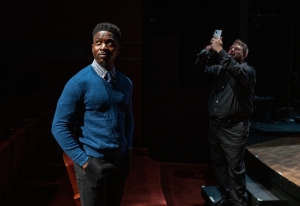
Coincidentally (or not), Victory Gardens’ new play about a controversial campus speaker opens just days after the one-year anniversary of Charlie Kirk’s assassination. Returning from a lengthy hiatus, Victory Gardens once again lights up the Biograph Theater with the world premiere of Zayd Ayers Dohrn’s new play “The Humanities”.
This thrilling play takes place on an American college campus where an opinionated voice is scheduled to speak. At the top level, an intellectual battle brews between professors and the college administration, while the students openly revolt.
Jonas (Ernest Bently) is a new professor on campus, hand selected by the department chair Martin (Steve Pickering) and his professor wife Margot (Naomi Evans). Jonas is young and ambitious, unwilling to get involved in the petty troubles of students and faculty. Martin and Naomi have other ideas. When Martin invites Luka (Daniil Krimer), an ultra-right-wing speaker on campus he kicks off a series of events that could lead the college, and Jonas, to ruin.
Carole (Sabine Wan) straddles the line between education and commerce as the dean while trying to appease the students and queer professor Milta (Isa Arciniegas). On the ground, students Hampton (Derrick Sanders III) and Xander (Piper Murphy) are taking action into their own hands.
Zayd Ayers Dohrn’s script is densely packed, structured in parts much like a college lecture. Each professor has their own somewhat incomprehensible monolog that speaks to how people can say so little with so many words. That’s not to say these passages are empty, and that’s the point. What college student could actually follow these verbal gymnastics though? Perhaps these speeches say more about how some educators are afraid to share their real opinion. Afterall, feelings aren’t facts.
“The Humanities” is a riveting exploration of the cost of free speech. Of course, our first amendment protects it, but it doesn’t account for good taste. Luka is played so smooth and charmingly by Daniil Krimer that you almost forget he’s a neo-Nazi, until he starts his speech. And that’s the unsettling part; under the law he’s just as entitled to hate speech as to tolerance messaging. And that those who criticize him in this play aren’t exactly perfect themselves.
Dohrn paints a rather cynical portrait of higher education, but in other ways he has a lot of faith in youth. Without the radical intentions of Xander and Hampton, there would be no point in rehashing the systematic problems of American academic institutions. In many ways it’s what makes this play so unique.
For those wondering if Victory Gardens has been restored to its former glory under new leadership, “The Humanities” proves they’ve still got it. Edward Torres directs a great cast. While originally billed as starring SNL alum Nora Dunn, British American actress Naomi Evans seems better fit for the role. She has a sleekness about her that makes some of the sexual plotlines a bit more palatable. Steve Pickering embodies that stodgy professor in this era almost as pitifully as Albee’s George was to the 1960s. There’s a certain tragedy in his performance.
While maybe a bit of trimming could help file this play down to a finer point, Victory Gardens choosing Dohrn’s script as their season opener is a brave choice. Almost an admission of self-awareness in an ever-dividing world in which institutions are no longer held on the same pedestals.
Through October 4 at Victory Gardens Theater. 2433 N Lincoln Ave. (773) 871-3000)
David Mamet's 'Henry Johnson' in High Powered Premiere at Victory Gardens Biograph

“Henry Johnson,” David Mamet’s new play running at the vintage Biograph Theatre, is like many of his works, enigmatic and demanding of his audience. With Mamet one must pay close attention to the dialog, packed with foreshadowing and reveals. Miss a line or even a word, and you’ll miss out.
This focus on the dialog is the essence of what Mamet’s works are about - plumbing the interior workings of the characters, as they face their lives. It also allows Mamet to examine in depth the forces at play in any human interaction, which in my take the playwright sees as transactional.
Expectations were clearly high for the Midwest premier of “Henry Johnson” by the Pulitzer winning Chicago playwright (“Glengarry Glen Ross,” “American Buffalo”) and screenwriter (“The Untouchables,” “Hoffa,” “The Postman Always Rings Twice”).
The biggest letters are Mamet’s name on the marquee at the Biograph. This is Victory Gardens Theater's home, where it is celebrating 50 years with this show. Its legendary founder, Dennis Zacek, takes executive producer credits on the production.
The promise of a rare new stage work by Mamet (as well as its planned release this summer as a film starring Shia LeBoeuf) drew a strong team of pros as well:
Directed by Edward Torres (co-founder of Teatro Vista), it stars Thomas Gibson (TV’s “Criminal Minds”), Keith Kupferer (“Ghostlight”) as a prison guard, Al'Jaleel McGhee (“A Soldier’s Play” Broadway tour) as Mr. Barnes and “Chicago PD” character Daniil Krimer as Henry.
“Henry Johnson” has what people come to David Mamet for - the thinking script, the demands on audiences to fill in the dots, the mystery, the unexpected reversals. For me, what is most intriguing about “Henry Johnson” is how Mamet explores a character, Henry, a beta male who is readily susceptible to being dominated by alpha male personalities.
It opens as Mr. Barnes, Henry’s boss, questions him on his unusual request: to find a job for a parolee that Henry once knew in college. McGhee’s Barnes digs into Henry’s motivation, asking him “What attracted you?” Henry’s answer: “He had this power over women,” relating how he could pick up women in bars and go home with them easily.
Barnes is hard driving, suggesting to Henry that he is under the spell of this one-time college buddy (who never appears in the play), now a convicted felon. Barnes gets Henry to state he is not physically attracted to this guy, just under his thumb.
Henry can accuretly relate back to Barnes his assessment of him - that Henry is putting the welfare of a past friend ahead of the interests of the company. Henry can hear it, but presumably he is so much in thrall to this “friend” he cannot be persuaded to discard him.
“You saw him after college?” Barnes asks.
Henry: “Before he went to prison.”
Barnes: “He was grooming you.”
The unseen friend was also a steady winner in card games, inexplicably lucky. Barnes ventures that the other men, also dominated by the friend’s charisma, let him win. “They were paying him rent.” In my experience, this is really how the dynamics of unhealthy male social hierarchy can work. When Barnes asks what he thought about his friend’s conviction, Henry replies, “I had no opinion. I thought it was my responsibility to have no opinion.”
In an abrupt change of scene, we now find Henry newly arrived at a prison cell - Barnes caught him embezzling, presumably for this unseen friend, and the audience must conclude he’s been convicted. Henry’s cellmate, Gene (Thomas Gibson) digs into Henry enough to determine his untoward fealty to his friend. Then he lectures him continuously, and Henry offers only desultory replies. As with Barnes, Henry is able to relate back to Gene, “You think my interest {in him] is an addiction.”
The setting shifts to the prison library, and the guard in charge is played by Kupferer. And then finally, a climactic scene, also in the prison library, where Mamet ties up the story for us, in a shocking end..
True to Mamet, the dialog doesn’t lead us through a plot - but an examination of where the characters are emotionally at key points along a timeline. Abrupt shifts in the setting are unexplained - Mamet expects us to figure it out, and we like him for that - but he’s not giving much to go on in each quadrant of the play: an inquiry in an office; a prison cell; a prison library; and a closing setting that spoiler concerns will leave undescribed.
The script seems less a play, than an extended treatment for a screenplay. The dialog is less compelling than Mamet’s signature works, which take a lot of rehearsal to refine the playwright’s intended cadences. Kupferer and McGhee come closest to getting this down. With all that, it’s Mamet, and so “Henry Johnson” comes highly recommended. It runs through May 4 at Victory Gardens Theater.
*This review is also featured on https://www.theatreinchicago.com/!





Latest Articles
-
 Cast and Production Team Announced for Fleetwood-Jourdain Theatre's THE NICETIES, October 31 – November 15
Written by Buzz Center StageFleetwood -Jourdain Theatre, an award-winning theatre company that has been thrilling audiences with over four decades of unique, inspirational, and invigorating Black American and African Diaspora-centered storytelling, has announced the cast and production team for the final production of its 2026 season. THE…
Cast and Production Team Announced for Fleetwood-Jourdain Theatre's THE NICETIES, October 31 – November 15
Written by Buzz Center StageFleetwood -Jourdain Theatre, an award-winning theatre company that has been thrilling audiences with over four decades of unique, inspirational, and invigorating Black American and African Diaspora-centered storytelling, has announced the cast and production team for the final production of its 2026 season. THE… -
Goodman’s centennial is its all‑time most successful year, with 300,000 patrons at 4,000 performances & events
Written by Buzz Center StageThe Goodman wraps its 2025/2026 Centennial Season, an unprecedented line-up marking the 100th anniversary of Chicago's flagship not-for-profit theater, as the most successful in its history. Today, the theater released its "A Century of Impact" report, detailing milestone programming and attendance…
-
 Class is back in session with Victory Gardens’ World Premiere of The Humanities
Written by John AccroccoCoincidentally (or not), Victory Gardens’ new play about a controversial campus speaker opens just days after the one-year anniversary of Charlie Kirk’s assassination. Returning from a lengthy hiatus, Victory Gardens once again lights up the Biograph Theater with the world…
Class is back in session with Victory Gardens’ World Premiere of The Humanities
Written by John AccroccoCoincidentally (or not), Victory Gardens’ new play about a controversial campus speaker opens just days after the one-year anniversary of Charlie Kirk’s assassination. Returning from a lengthy hiatus, Victory Gardens once again lights up the Biograph Theater with the world… -
 Layered, Lovely, and Lasting; The Joffrey Ballet's Liliom Lights up The Lyric Opera
Written by Kendall RoyzenSometimes when reach into the past to resurrect or revive an old story, it doesn’t age well. The subject matter could be problematic, the material divisive, the cultural context lost through the fabric of time. Without proper context we tend…
Layered, Lovely, and Lasting; The Joffrey Ballet's Liliom Lights up The Lyric Opera
Written by Kendall RoyzenSometimes when reach into the past to resurrect or revive an old story, it doesn’t age well. The subject matter could be problematic, the material divisive, the cultural context lost through the fabric of time. Without proper context we tend…
Does your theatre company want to connect with Buzz Center Stage or would you like to reach out and say "hello"? Message us through facebook or shoot us an email at This email address is being protected from spambots. You need JavaScript enabled to view it..
*This disclaimer informs readers that the views, thoughts, and opinions expressed in the text belong solely to the author, and not necessarily to Buzz Center Stage. Buzz Center Stage is a non-profit, volunteer-based platform that enables, and encourages, staff members to post their own honest thoughts on a particular production.