
Displaying items by tag: Albert Theatre
The Attic at Goodman Theatre Redefines Memoir Through Breathtaking Physical Storytelling
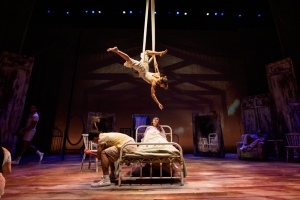
At intermission, I sent Ken, Buzz Center Stage’s managing editor, a text: “So thankful I made it!! It’s intermission, and if there’s one show anyone sees it should be this.” By the time the lights came up at the end of The Attic, I couldn’t have agreed with intermission-me more.
The idea behind lifelong circus artist Shana Carroll’s autobiographical play began inside a CT scanner. Watching its bridge move in and out of sight above her, Carroll realized how much of her life could be told through the things she had seen while lying on her back. From her childhood bed to her mother’s and her child’s, from motel rooms to hospital rooms, each view from below held another piece of the story she now wanted to tell.
That story became The Attic: Things I’ve Seen While Lying on My Back, Carroll’s onstage memoir now receiving its world premiere in Goodman Theatre’s Albert Theatre. Carroll, a cofounder of Montreal circus collective The 7 Fingers, the company behind the production, also serves as its writer, director and choreographer.
The Attic perfectly walks the line between abstract and concrete storytelling. The pivotal events and overarching themes of Carroll’s life remain clear and accessible, while circus arts and contemporary dance explore the smaller details and dynamics that traditional narration could never fully capture. This is not a play with circus tricks added to it; it is a singular piece of theatre that replaces conventional blocking with a breathtaking physical language.
Tyler Meredith serves as Carroll’s onstage stand-in, carrying nearly the entire narration while moving alongside – and frequently flying among – the rest of the ensemble. Even within such a heavily collaborative production, Meredith deserves special recognition for the sheer feat of guiding the audience through Carroll’s life with such emotional depth, physical precision, and clarity, all while taking part in the circus work herself.
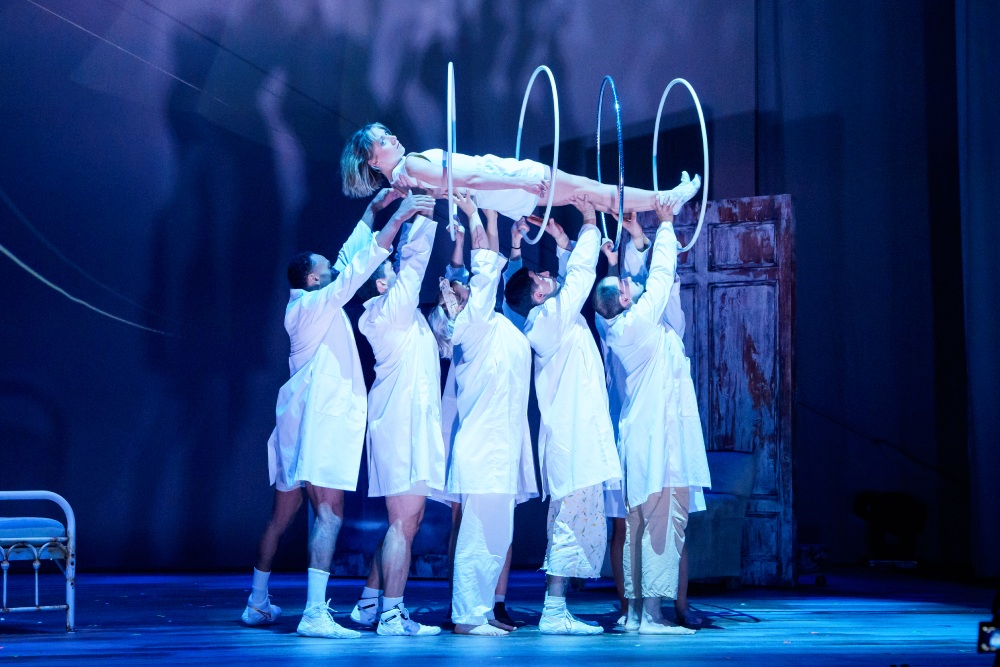
(Top) Anna Kichtchenko. (L-R, bottom) Melvin Diggs, FranAlvarez, Lucy Tan, Santiago Rivera Laugerud and Eduardo De Azevedo Grillo in The Attic at Goodman Theatre.
Still, The Attic cannot have only one star. Every one of its ten performers is essential to creating the world onstage. The remaining nine rarely leave the audience’s sight, and I defy you to find a moment when any of them is truly still. Rather than waiting at the edges of a scene, they continually ebb and flow with Carroll’s memories, moving like a single current that stretches across the entire stage while remaining connected at every point.
Nothing feels like a transition or choreographed scene change, even though every minute contains (no exaggeration) hundreds of precise decisions, from the subtlest shift in focus to a death-defying catch. If every movement executed by just one performer over ten minutes were written down, the resulting document would be longer than this entire review. The level of detail, polish, and commitment is staggering. Live theatre constantly reaches toward the seemingly impossible goal of appearing this intricate and effortless; The Attic achieves it.
Among an ensemble overflowing with talent, Nancy Luna is especially impossible to look away from. A fearless and mesmerizing flyer, she repeatedly launches herself – or is effortlessly launched by Fran Alvarez – into the air with a freedom that makes even the production’s most difficult feats feel instinctive.
The technical elements are equally precise. Projections, lighting and scenic movement distinguish and layer Carroll’s memories without overwhelming the physical storytelling. Even as performers soar and tumble in the background, the production carefully directs the audience’s focus, allowing the spectacle to strengthen the story rather than distract from it.
Although its explorations of illness, motherhood and mortality are geared more toward adults, The Attic offers enough acrobatics, movement and theatrical imagination to captivate nearly anyone. Carroll’s memoir is the beautiful thread connecting each mesmerizing scene, but every individual sequence is remarkable enough to stand on its own.
Plenty of shows claim to keep audiences on the edge of their seats. Shana Carroll’s The Attic earns that phrase in nearly every possible sense. The Attic: Things I’ve Seen While Lying on My Back runs at Goodman Theatre through October 4. Tickets are available at goodmantheatre.org/show/the-attic.
Goodman's HOLIDAY – A Modern Take on a Dramedy About the True Price of Wealth

Holiday is a play written by Philip Barry in 1928 before the tragic stock market crash of 1929. It has been made into two movies, most notably in 1938 starring Cary Grant and Katherine Hepburn. This adaptation, artfully authored by Richard Greenberg, has brought a case study in the class system and its relationship with money and assets is not only thought-provoking but clever. The use of modern idioms mixed with classic patter delivery of movies of the thirties and forties keeps the audience rapt awaiting the next joke or witticism to land. The direction by Robert Falls is a translation of reticence and underlying suppressed emotion of a family possessing generational wealth on the upper east side of New York City. Falls delivers Greenberg’s words in a manner so true that the piece has a voyeuristic tone.
The play opens in the main modernized parlor of a Manhattan mansion so beautifully appointed that audible gasps could be heard throughout the audience. The scenic design by Walt Spangler is so spot on in depicting “Old Money” right down to the mallard decoys on the mantel that it transports everyone into the Seton family fortunes. Lighting designer Amith Chandrashaker’s work baths the Seton family like a beautifully seated family portrait. When the curtains are parted to allow daylight to seep into the parlor, it makes one question what time they arrived at the theatre. It is in this opening scene that we meet the Seton family and guests. Julia Seton (played by Molly Griggs) the compliant entitled daughter and her new beau, Johnny Case played with great range by Luigi Sottile. Linda Seton, the defiant sibling seeking to change the world and identify with the residents and children of Red Hook played with just the right mixture of outrage and vulnerability by Bryce Gangel and Ned Seton (Wesley Taylor), the youngest namesake brother who has failed to measure up. And, the scion of the fortune, Edward Seton played with steely reserve by Jordan Lage who ensures “the equilibrium of the house is not disrupted” as one scene tells us.
The story unfolds as Julia is besotted with Johnny Case, a new beau met in a “spa”, and we watch her try to mold him into a man to join the family business after first making his own millions. Case ended up in the “spa” through an intervention by friends who realized he was working himself to misery. Being around the family and relations of Julia Johnny begins to reexamine his life’s purpose and path. With a healthy dose of sarcasm from Linda and Ned we see wealth and privilege scoffed at as much as it is valued and revered by Julia. Johnny is a ping pong ball in the family’s game of emotions and parlayed witticisms. We travel in time through a season of proposal and an engagement announcement to other reasons to celebrate. We visit the childhood traumas of a mother dying young of cancer with her dreams of being a prima ballerina dashed by Edward Seton and his insistence on the importance of an heir. Each child is a character study in the privilege and travails of the very wealthy. Johnny Case, who is first viewed as a pawn in their family games goes through his own evolution and the realism of wealth, money and power. Wesley Taylor is the standout of a well guided and directed ensemble. He plays Ned with such mirth, hilarity and tragic pain that one moment he has you laughing and the next on the verge of tears. Every scene he is in becomes pivotal.
The other unexpected “star” of this show is the scenic design and transition. One moment you are in the parlor and then next act transported to the childhood nursery/playroom of memories styled by their mother. It hardly seems possible but in almost a magical fable like scene change we end up in the parlor. It’s a feat rarely seen on stage and every member of the design and stage management team needs to be aware that their contribution to this piece is pivotal, both literally and figuratively. The scenic design alone is a reason not to miss this show but go for the laughs and beautiful line delivery such as “Alexa stop the joy”. Modern, relatable and beautifully delivered.
There’s nothing not to love about Cary Grant and Katherine Hepburn but Robert Fall’s direction of these talents honor this beautifully written adaptation which is a mini-Holiday for anyone who attends.
HOLIDAY, now playing at the Goodman’s Albert Theatre in Chicago through March 1, 2026.
https://www.goodmantheatre.org for ticket and performance time information.
Mary Beth Euker is a founding director of Cricket Theatre Company in Lake Zurich, Illinois, has appeared in shows at Devonshire Theatre in Skokie and Woodstock Opera House and directs in Lake Zurich at various schools and for Cricket.
*UPDATE - Extended through March 8th
This review is proudly shared with our friends at www.TheatreInChicago.com.
Goodman's "A Christmas Carol" still tops list for Holiday fun in Chicago

Chicago has no shortage of Christmas traditions. In other words, if you’re looking for holiday fun it’s not very hard to find something to do with your friends, significant other or family. Rich traditions such as Zoolights at Lincoln Park Zoo, Joffrey’s Nutcracker, Christkindlmart, Christmas film classics at Music Box, and the official Christmas Tree Lighting Ceremony in Millennium Park are fantastic choices that are sure to put a little zest into your holiday spirit, but Goodman Theatre’s A Christmas Carol might have to top the list.
Celebrating its 40th year of warming hearts through the holidays, this year’s production of A Christmas Carol might just be the best yet. Larry Yando returns to Goodman as Ebenezer Scrooge, a role he has taken on with brilliance for the past nine years. Yando is just about as fun to watch as it gets from his miserable, miserly like behavior to his reborn childlike love of humanity after three spirits visit him to show him his past, present and future.
As the story by Charles Dickens goes, Scrooge is a man with little heart. He is a man who pinches every penny, treats his employee like a flunky without mercy, as he works his fingers to the bone, wants nothing to do with his remaining family and has nothing but miserable rebuttals for those who wish him a Merry Christmas, replying with “Bah Humbug!” When his former, and now deceased, partner, a man much like Scrooge appears to him on Christmas Eve to warn him of his horrid ways and the cost it has on so many and will on himself, we learn that Scrooge will be visited by three spirits – Christmas Past, Christmas Present and Christmas Future.
As each spirit visits Scrooge, more and more is revealed about his nature. He remembers he didn’t start out as he is now. He was a good-natured boy with hopes and dreams once upon a time. In the present he sees how those who know him feel about him. Though mean and cruel to many, they still thank him and toast to him. He see’s the hardships his mistreated employee Bob Cratchit and his family face on his meek salary. He is obviously embarrassed as they still find reasons to be thankful to Scrooge. He sees a future that is bleak. He is just a miserly old man quickly forgotten.
“Are these the things that will be or the things that may happen?” He asks the spirit, hoping for a chance to redeem himself.
While Yando undoubtedly is a tour de force in the role as Scrooge, the entire cast is a powerhouse. Ron E. Rains is highly believable as the tenderhearted Bob Cratchit and is easy to feel for almost immediately. Joe Foust as Jacob Marley is also tremendous as is Lisa Gaye Dixon who wows the audience with her incredibly strong performance as the Ghost of Christmas Present. Kareem Bandealy also gives the production a strong assist as he skillfully fields a handful of roles including that as the show’s narrator, Topper and a hopeful young Scrooge who misses his chance at love choosing a chance at making more money instead -a decision that haunts him his entire life.
The ever-changing set is visually stunning as it changes from Scrooge’s house interior (curtains surrounding his bed and all) to the Cratchit’s humble kitchen where the room is crowded as the family sits around a table to eat a meager portion of roast duck for Christmas. Stars shine amongst the blackness as Christmas Present takes Scrooge on a ride he’ll never forget.
Goodman also breaks the mold casting a girl in the role of Tiny Tim Cratchit. Fourth grader Paris Strickland who delivers the famous line at show’s end “God bless us, every one” is excited to play Tiny Tim telling the Chicago Tribune, “I feel excited and proud of myself for getting a really inspiring role. Tiny Tim can bring hope to everyone, and I can bring hope to everyone.”
Goodman’s A Christmas Carol is not only rich tradition in Chicago, it is a fun-filled holiday treat that is sure to warm the heart and remind us that giving is better than receiving.
Highly recommended.
A Christmas Carol is being performed in the Albert Theatre at Goodman Theatre through December 31st. For more show information visit www.goodmantheatre.org.




Latest Articles
-
 The Attic at Goodman Theatre Redefines Memoir Through Breathtaking Physical Storytelling
Written by Maddie BurroughsAt intermission, I sent Ken, Buzz Center Stage’s managing editor, a text: “So thankful I made it!! It’s intermission, and if there’s one show anyone sees it should be this.” By the time the lights came up at the end…
The Attic at Goodman Theatre Redefines Memoir Through Breathtaking Physical Storytelling
Written by Maddie BurroughsAt intermission, I sent Ken, Buzz Center Stage’s managing editor, a text: “So thankful I made it!! It’s intermission, and if there’s one show anyone sees it should be this.” By the time the lights came up at the end… -
 Babes With Blades's Announces William Shakespeare's KING LEAR, playing October 22 - November 21
Written by Buzz Center StageBabes With Blades Theatre Company’s (BWBTC) announced today new production dates for the final production in its 2026 season, William Shakespeare’s King Lear, directed by Alison Dornheggen and fight choreography by Jess Pennachio, the new dates are now October 22 - November 21 in Theatre 3 at Theater Wit,…
Babes With Blades's Announces William Shakespeare's KING LEAR, playing October 22 - November 21
Written by Buzz Center StageBabes With Blades Theatre Company’s (BWBTC) announced today new production dates for the final production in its 2026 season, William Shakespeare’s King Lear, directed by Alison Dornheggen and fight choreography by Jess Pennachio, the new dates are now October 22 - November 21 in Theatre 3 at Theater Wit,… -
Open Space Arts Presents BEFORE WE ARE HISTORY October 23 – November 8
Written by Buzz Center StageOpen Space Arts presents BEFORE WE ARE HISTORY, a three-week theatrical exploration of LGBTQ+ theater created during and in response to the AIDS crisis, running October 23 through November 8, 2026, at Open Space Arts, 1411 W. Wilson Ave. in Chicago.The project…
-
The Jinkx & DeLa Holiday Show - December 6th at Auditorium Theatre
Written by Buzz Center StageThe greatest holiday show south of the North Pole returns for its 9th year with another brand spankin' new wintertide wonder! Award-winning comedy icons, writers, actors, and drag queen powerhouses BenDeLaCreme & Jinkx Monsoon are coming back to town with…
Does your theatre company want to connect with Buzz Center Stage or would you like to reach out and say "hello"? Message us through facebook or shoot us an email at This email address is being protected from spambots. You need JavaScript enabled to view it..
*This disclaimer informs readers that the views, thoughts, and opinions expressed in the text belong solely to the author, and not necessarily to Buzz Center Stage. Buzz Center Stage is a non-profit, volunteer-based platform that enables, and encourages, staff members to post their own honest thoughts on a particular production.