
Displaying items by tag: Shifra Werc
Opera Festival of Chicago Delivers an Assured, Full‑Hearted La Bohème
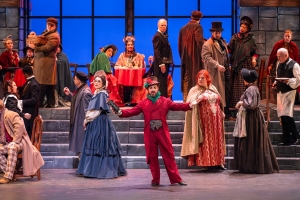
Opera Festival of Chicago continues its season with two mainstage productions - La Bohème and Adriana Lecouvreur - each featuring the Opera Festival of Chicago Orchestra and Chorus and performed at the George Van Dusen Theatre at the North Shore Center for the Performing Arts in Skokie.
I had the chance to see Giacomo Puccini’s La Bohème, directed by Festival General Director Sasha Gerritson and conducted by Sir Emanuele Adrizzi, and it proved to be an outstanding, deeply felt evening of music and drama.
Giacomo Puccini’s La Bohème unfolds in the chilly garrets and bustling cafés of 1830s Paris, where a group of young artists survive on charm, wit, and the fragile hope that beauty might be enough to sustain them. The opera begins in a drafty attic shared by the poet Rodolfo and the painter Marcello, whose playful banter masks the hunger and hardship of their bohemian life. Everything shifts when Mimì, a shy, dreamy seamstress with a failing candle and failing health, knocks on their door. Her tender connection with Rodolfo ignites instantly, carrying them into the vibrant chaos of Café Momus, where Marcello’s fiery former lover Musetta steals the spotlight with her flirtations and razor‑sharp instincts.
But as winter settles in, the opera’s warmth gives way to harsher truths. Only the rich are safe and well fed in this cold bleak landscape of artistic poverty. Mimì’s illness worsens, and Rodolfo’s fear of losing her fractures their love, even as they cling to moments of sweetness. Both Mimì and Rodolfo are swept up in the sudden, poetic rush of feeling that sparks between them during their first meeting over her extinguished candle, a moment Puccini shapes with irresistible warmth. Their ensuing duet, “O soave fanciulla,” is written as a rush of idealized, almost dreamlike love - sung here with such radiance that it feels too perfect to endure, and tragically it doesn’t, as the briefness of their time together becomes one of the opera’s most heartbreaking truths.
By the final act, the bohemians reunite in their attic, trying to conjure laughter out of scarcity, until Musetta arrives with the gravely weakened Mimì. What follows is one of opera’s most devastating endings: a quiet, intimate vigil as Rodolfo realizes too late that the love he tried to protect has slipped beyond saving. Puccini shapes this world with music that aches, soars, and ultimately reminds us how fiercely we hold on to joy, even as life insists on its fragility. Puccini also paints a world in which artists of every stripe are routinely exploited by the comfortable classes - the dull rich, who commission work and then pay only sporadically, as if deprivation were somehow a necessary ingredient of genius. In reality, it is the indifference of these wealthy patrons that forces the bohemians into constant hardship, driving them to beg, borrow, and even steal simply to keep food on the table and have their housing bills covered.
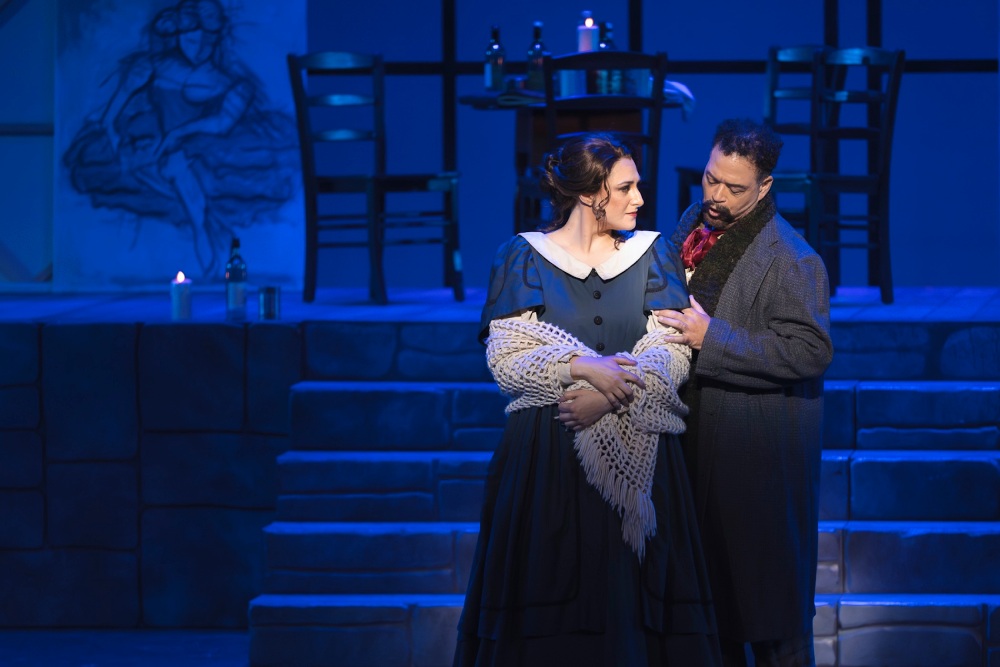
(L to R) Alexandra Razskazoff, “Mimi” and Nathan Granner, “Rodolfo” in LA BOHÈME. Photos by A.Deran Photography.
This La Bohème features a cast whose vocal and dramatic instincts sharpen Puccini’s world into something immediate and deeply felt. Alexandra Razskazoff’s Mimì is nothing short of luminous - her soprano glowing with warmth yet edged with delicacy, embodying a young woman whose softness hides a life lived perilously close to the margins. A rising artist with an increasingly international footprint, Razskazoff traces Mimì’s arc with such emotional transparency that her final moments land with quiet, devastating force. Opposite her, tenor Nathan Granner brings a beautifully burnished tone and an instinctive musicality to Rodolfo. Long admired for his expressive phrasing and crossover versatility, Granner sings with a poet’s sensitivity; his Rodolfo is impulsive, romantic, and heartbreakingly human, especially as love and fear begin to pull him apart.
Catherine Antonia Samartin lights up the stage as Musetta, her bright, agile soprano and irresistible charisma making every entrance feel like a spark catching fire. Musetta is also the victim of this us versus them world where her beauty and charms are commodified on the older wealthy man she is forced to keep company with in order to receive her beautiful wardrobe and warm home to live in. Her scenes with Kenneth Stavert’s Marcello are especially electric. Stavert, with his rich, grounded baritone and wonderfully lived‑in ease, brings both humor and heart to the painter whose bravado barely conceals his vulnerability. Anthony Reed’s Colline provides a beautifully resonant counterweight to the lovers’ volatility - his “Vecchia zimarra” delivered with a quiet, dignified ache that speaks volumes about loyalty and sacrifice. Jonathan Wilson brings quicksilver energy and crisp comedic timing to Schaunard, shaping the role with warmth and buoyancy, while veteran bass William Powers steals scenes with effortless charm as both Benoit and Alcindoro, reminding audiences why he remains one of American opera’s most reliable character treasures. David Greene adds a welcome burst of color as Parpignol, enriching the Act II bustle with a touch of whimsy. This ensemble shapes a Bohème that feels vividly inhabited and emotionally true, a testament to what Puccini’s world becomes when every performer contributes with such specificity, generosity, and heart.
One of the production’s most striking assets is its massive, 50‑plus‑member chorus, whose sheer presence reshapes the entire world of La Bohème. Their sound adds a thrilling sweep to Puccini’s score, amplifying the emotional stakes and giving the bustling Parisian scenes a vivid, lived‑in texture. In Act II especially, the sheer size and vocal richness of the ensemble create a sense of overwhelming festivity, making the Christmas Eve Café Momus tableau feel like a city bursting with life. But the chorus also deepens the opera’s more intimate moments, surrounding the central lovers with a sonic landscape that underscores both the joy and the fragility of their world. It’s a rare gift to hear a chorus of this scale in a production of Bohème, and here it elevates the performance into something grander, more immersive, and undeniably unforgettable.
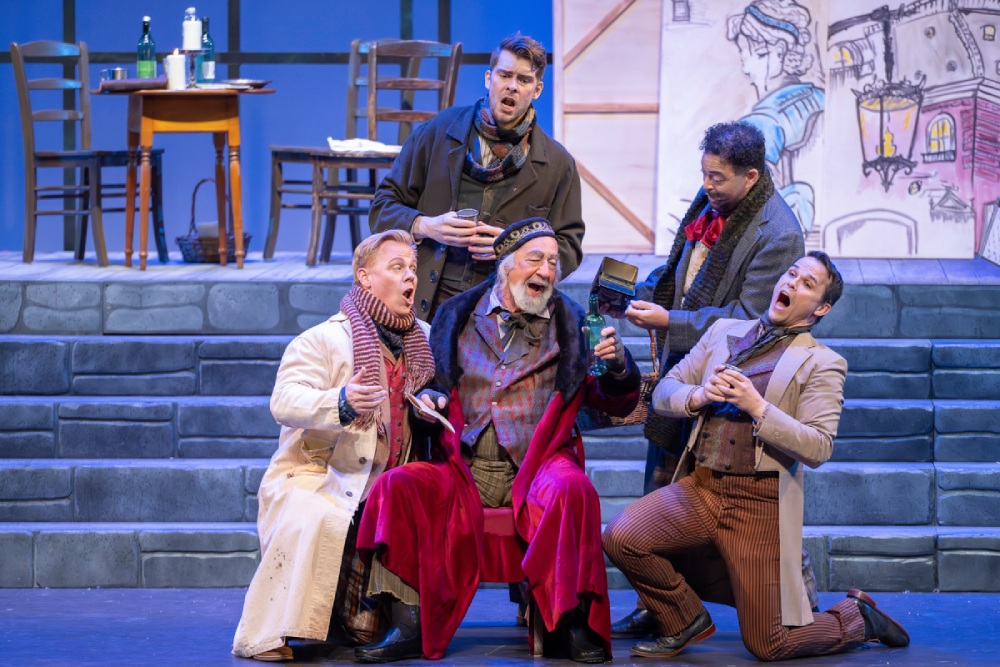
(L to R) Kenneth Stavert, “Marcello;” Anthony Reed, “Colline;” William Powers, “Benoit;” Nathan Granner, “Rodolfo” and Jonathan Wilson, “Schaunard” in LA BOHÈME from Opera Festival of Chicago. Photos by A.Deran Photography.
The set itself is perfectly workable and the large video boards truly animate the space, supplying shifting imagery of snowfall and other atmospheric touches throughout the evening. Because the opera is sung in Italian, overhead supertitles - crisply projected and easy to follow - add a modern presentational layer that supports the storytelling without ever competing with Puccini’s world.
This La Bohème resonates with honesty, heart, and thrilling musicality, carried by a cast and chorus performing at the height of their powers. It’s a standout achievement for Opera Festival of Chicago - and a compelling reason to experience not only this production but also their Adriana Lecouvreur, by Francesco Cilea, directed by Shifra Werch and also conducted by Sir Emanuele Andrizzi, which promises its own dramatic and musical rewards.
Recommended.
Performances are held at the North Shore Center for the Performing Arts in Skokie.
La Bohème - Friday, June 26 at 7:30 p.m., Wednesday, July 1 at 7:30 p.m., and Sunday, July 5 at 2 p.m.
Adriana Lecouvreur - Sunday, June 28 at 2 p.m. and Friday, July 3 at 7:30 p.m.
Tickets range from $25 to $150 and are available at www.OperaFestivalChicago.org.




Latest Articles
-
 Steppenwolf’s Topdog/Underdog: When History Deals the Cards
Written by Wesley DavidSusan-Lori Parks’ Topdog/Underdog, the Pulitzer Prize-winning masterpiece, is the kind of play that changes depending on when—and how many times—you see it. Directed by Kenny Leon, this revival stars Tony nominee Glenn Davis as Lincoln and Namir Smallwood as Booth,…
Steppenwolf’s Topdog/Underdog: When History Deals the Cards
Written by Wesley DavidSusan-Lori Parks’ Topdog/Underdog, the Pulitzer Prize-winning masterpiece, is the kind of play that changes depending on when—and how many times—you see it. Directed by Kenny Leon, this revival stars Tony nominee Glenn Davis as Lincoln and Namir Smallwood as Booth,… -
 'I’m Going to Marry You Tobey Maguire,' Full of Laughs, Ends With a Fizzle
Written by Bill EslerHere’s a play that should be really good, based on its reputation alone. Written by Chicago comedy writer Samantha Hurley, I’m Going to Marry You Tobey Maguire premiered off Broadway at The Cell Theater in 2023. Now Refracted Theatre Company has…
'I’m Going to Marry You Tobey Maguire,' Full of Laughs, Ends With a Fizzle
Written by Bill EslerHere’s a play that should be really good, based on its reputation alone. Written by Chicago comedy writer Samantha Hurley, I’m Going to Marry You Tobey Maguire premiered off Broadway at The Cell Theater in 2023. Now Refracted Theatre Company has… -
 League of Chicago Theatres announces "It's Theatre Season" and celebrates the industry's impact
Written by Buzz Center StageThe League of Chicago Theatres announces the return of It's Theatre Season, a campaign inviting Chicagoans and visitors to discover something new on stages across the city and suburbs while supporting the theatres that make Chicago one of the country's…
League of Chicago Theatres announces "It's Theatre Season" and celebrates the industry's impact
Written by Buzz Center StageThe League of Chicago Theatres announces the return of It's Theatre Season, a campaign inviting Chicagoans and visitors to discover something new on stages across the city and suburbs while supporting the theatres that make Chicago one of the country's… -
Steppenwolf Theatre Continues 51st Season with World Premiere of ADIRONDACK CHAIR CIRCLE October 22 — December 6
Written by Buzz Center StageSteppenwolf Theatre Company, the nation's premier ensemble theater company, is pleased to launch its 51st Season with the world premiere of Chicago playwright Stephanie Alison Walker's biting satire Adirondack Chair Circle, directed by Tony Award winner Pam MacKinnon (Downstate, Edward Albee's Who's Afraid of Virginia…
Does your theatre company want to connect with Buzz Center Stage or would you like to reach out and say "hello"? Message us through facebook or shoot us an email at This email address is being protected from spambots. You need JavaScript enabled to view it..
*This disclaimer informs readers that the views, thoughts, and opinions expressed in the text belong solely to the author, and not necessarily to Buzz Center Stage. Buzz Center Stage is a non-profit, volunteer-based platform that enables, and encourages, staff members to post their own honest thoughts on a particular production.