
Displaying items by tag: Arnulfo Maldonado
Steppenwolf’s Topdog/Underdog: When History Deals the Cards
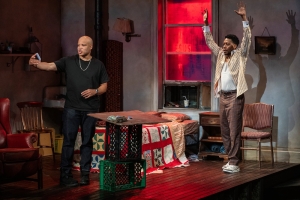
Susan-Lori Parks’ Topdog/Underdog, the Pulitzer Prize-winning masterpiece, is the kind of play that changes depending on when—and how many times—you see it. Directed by Kenny Leon, this revival stars Tony nominee Glenn Davis as Lincoln and Namir Smallwood as Booth, two brothers whose names alone tell us that Parks is preparing to play a very dangerous game with her audience.
The play was originally produced in Chicago by Steppenwolf Theatre Company in 2003, directed by ensemble member Amy Morton, with ensemble member K. Todd Freeman as Booth and David Rainey as Lincoln. More than two decades later, this revival demonstrates just how much material Parks packed into the story of two brothers living on the edge of survival.
Parks begins her own version of Three-Card Monte by giving us the names Lincoln and Booth. We already know the historical ending: John Wilkes Booth assassinated Abraham Lincoln. Parks puts that card on the table immediately—and then spends the rest of the play moving it around.
Lincoln and Booth are not historical figures, of course, but the names become a psychological trap. Lincoln works as an Abraham Lincoln impersonator, repeatedly allowing strangers to “assassinate” him as part of the act. The brothers themselves simulate the murder, turning history into performance and performance into something increasingly dangerous.
That is where Parks’ Three-Card Monte becomes so effective. We know the card. We know what is coming. Yet Parks keeps moving our attention elsewhere—to money, women, abandonment, brotherly rivalry, masculinity and the desperate need to survive. The audience is watching closely, thinking we know exactly where Parks is going. But like the mark in a Three-Card Monte game, we can never be completely sure which card we are actually watching.
The brilliance is that Parks gives us the ending and still manages to create suspense.
The question isn't simply, “Will Booth kill Lincoln?” We already know that story. Instead, Parks asks us to consider how and why these two brothers arrive at that moment. By the time the real gun is fired, we have become so invested in these men that the historical inevitability becomes a genuine emotional shock.
Having seen Topdog/Underdog several times, I’ve gained new insight into Lincoln and Booth with each production. I’ve always imagined these brothers as relatively young men—perhaps somewhere between 21 and 35 at the oldest. There is something about their desperation, their dreams and their constant jockeying for position that feels connected to men still trying to figure out who they are.
Seeing older actors inhabit these roles changes the equation. This production brings a greater sense of history and introspection to Lincoln and Booth. These aren't simply two young men making bad decisions. They feel like men who have accumulated years of disappointment, mistakes and missed opportunities. Their arguments have the weight of history behind them.
That being said, the acting is first-rate.
Glenn Davis delivers some of the best work I have seen in his storied career. His Lincoln carries weariness beneath the humor, as though every card trick, every performance and every attempt to maintain dignity has taken something from him. Davis understands that Lincoln is not simply trying to make a living; he is trying to hold onto an identity.
There is an extraordinary sadness to his Lincoln because he has found a way to make a living by pretending to be someone who, historically, has already been dead for generations. Every night he puts on the stovepipe hat, becomes Abraham Lincoln and allows strangers to reenact his assassination. The joke is that he survives the murder every night—until, of course, the night he doesn't.
Namir Smallwood is equally compelling as Booth. Smallwood has the remarkable ability to morph into whatever character is placed before him, and here he creates a Booth whose swagger and insecurity exist simultaneously. Booth wants to be seen, respected and successful, but beneath that ambition is a brother desperate to prove himself.
Their relationship is the heart of the play. They love each other, resent each other, depend on each other and compete with each other. They are simultaneously brothers and adversaries. One minute they can make each other laugh; the next, they are fighting over money, women or the invisible scorecard of who has accomplished more.
Arnulfo Maldonado’s set—a room in a New York City boarding house—captures the basic circumstances of their existence, but for me, it is far too sanitized for the gritty New York City world Parks has created.
Rooms like this were common, particularly in neighborhoods such as Hell’s Kitchen. They were tight. Space was at a premium. They were not necessarily neat or clean. These were places where people lived because they had few alternatives. The room should feel less like a place where two men are actually struggling to survive.
That distinction matters because Lincoln and Booth are in survival mode. The room is not simply their home; it is a pressure cooker. Every inch of space should remind us that there is nowhere for these brothers to escape—not from each other, not from their past and ultimately not from the consequences of their choices.
Kenny Leon's direction keeps the focus where it belongs: on two brothers trapped between history, memory and survival. He allows Parks' language, humor and repetitions to accumulate rather than rushing toward the inevitable conclusion.
Ultimately, Topdog/Underdog remains a remarkable piece of American theatre because Parks refuses to let history stay in the past. She takes two names everybody recognizes, places them on two Black brothers living in New York, and transforms a familiar historical tragedy into an intimate story about family, survival, masculinity and fate.
We may enter the theatre believing we know who Lincoln and Booth are and how their story ends. But Parks makes us see them as brothers first—two men desperately trying to survive each other, their circumstances and the histories they have inherited.
By the time the final card is played, the tragedy is no longer about Abraham Lincoln and John Wilkes Booth. It belongs entirely to these two brothers. And that is Parks’ greatest trick: she makes us think we are watching history repeat itself, when what we are really watching is the heartbreaking collapse of an American family.
Highly Recommended
When: Through Nov. 1
Where: Steppenwolf Theatre, 1650 N. Halsted St.
Running time: 2.5 hours (15 minute intermission)
Tickets: $20 -$142.50
312-335-1650



Latest Articles
-
 Steppenwolf’s Topdog/Underdog: When History Deals the Cards
Written by Wesley DavidSusan-Lori Parks’ Topdog/Underdog, the Pulitzer Prize-winning masterpiece, is the kind of play that changes depending on when—and how many times—you see it. Directed by Kenny Leon, this revival stars Tony nominee Glenn Davis as Lincoln and Namir Smallwood as Booth,…
Steppenwolf’s Topdog/Underdog: When History Deals the Cards
Written by Wesley DavidSusan-Lori Parks’ Topdog/Underdog, the Pulitzer Prize-winning masterpiece, is the kind of play that changes depending on when—and how many times—you see it. Directed by Kenny Leon, this revival stars Tony nominee Glenn Davis as Lincoln and Namir Smallwood as Booth,… -
 'I’m Going to Marry You Tobey Maguire,' Full of Laughs, Ends With a Fizzle
Written by Bill EslerHere’s a play that should be really good, based on its reputation alone. Written by Chicago comedy writer Samantha Hurley, I’m Going to Marry You Tobey Maguire premiered off Broadway at The Cell Theater in 2023. Now Refracted Theatre Company has…
'I’m Going to Marry You Tobey Maguire,' Full of Laughs, Ends With a Fizzle
Written by Bill EslerHere’s a play that should be really good, based on its reputation alone. Written by Chicago comedy writer Samantha Hurley, I’m Going to Marry You Tobey Maguire premiered off Broadway at The Cell Theater in 2023. Now Refracted Theatre Company has… -
 League of Chicago Theatres announces "It's Theatre Season" and celebrates the industry's impact
Written by Buzz Center StageThe League of Chicago Theatres announces the return of It's Theatre Season, a campaign inviting Chicagoans and visitors to discover something new on stages across the city and suburbs while supporting the theatres that make Chicago one of the country's…
League of Chicago Theatres announces "It's Theatre Season" and celebrates the industry's impact
Written by Buzz Center StageThe League of Chicago Theatres announces the return of It's Theatre Season, a campaign inviting Chicagoans and visitors to discover something new on stages across the city and suburbs while supporting the theatres that make Chicago one of the country's… -
Steppenwolf Theatre Continues 51st Season with World Premiere of ADIRONDACK CHAIR CIRCLE October 22 — December 6
Written by Buzz Center StageSteppenwolf Theatre Company, the nation's premier ensemble theater company, is pleased to launch its 51st Season with the world premiere of Chicago playwright Stephanie Alison Walker's biting satire Adirondack Chair Circle, directed by Tony Award winner Pam MacKinnon (Downstate, Edward Albee's Who's Afraid of Virginia…
Does your theatre company want to connect with Buzz Center Stage or would you like to reach out and say "hello"? Message us through facebook or shoot us an email at This email address is being protected from spambots. You need JavaScript enabled to view it..
*This disclaimer informs readers that the views, thoughts, and opinions expressed in the text belong solely to the author, and not necessarily to Buzz Center Stage. Buzz Center Stage is a non-profit, volunteer-based platform that enables, and encourages, staff members to post their own honest thoughts on a particular production.