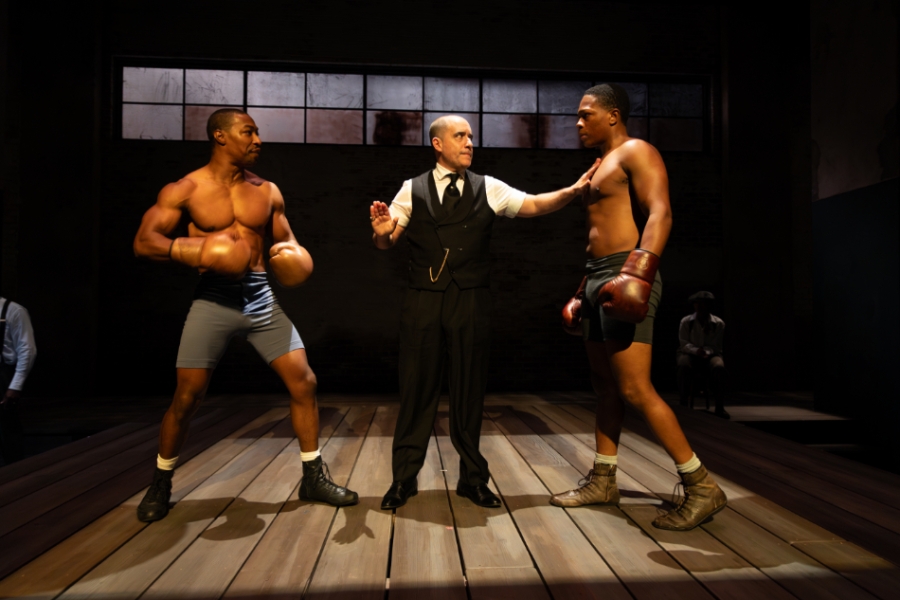
Writers Theatre scores a knockout production with Marco Ramirez’s 2013 play, The Royale. Under the direction of Tyrone Phillips, we see this widely-produced script (it played New York’s Lincoln Center a decade ago) executed to perfection. Centered on boxing legend Jack Johnson, it follows a fictionalized version of his story. In 1910 Johnson became the first Black world heavyweight champion by besting James Jeffries, the reigning heavyweight, who was white.
The show opens with a mesmerizing percussive scene. For this production, the Writers Theatre stage is floored with rough hewn boards to make a boxing arena, the building’s back wall exposed with faded painted bricks. A punching bag hangs at the back of the set and as lights come up, a lone boxer is pummeling it. (Lauren Nichols is Scenic Designer.)
Soon another boxer enters the stage and the two begin a wordless, precisely choreographed percussive dance centered on the bag, their footfalls resounding loudly, reaching a crescendo at the culmination, a scene that draws applause for its sheer inspired beauty. (Rasell Holt is Movement Director.) The audience knows it is in for something big in The Royale.
Ramirez, a well-established Netflix writer (Orange is the New Black, Daredevil) keeps the tale rooted in the true story. Our fictional heavyweight star Jay is played superbly by Broadway star La’Tevin Alexander. And man, he is good!
When Alexander takes the stage, his sculpted body is arresting and he is handsome in a Michael B. Jordan way. But as he begins to deliver his lines, he soon has us in his thrall, a larger than life force, like Muhammed Ali, supreme in his confidence and aiming at the top. Yet Jay is also warm and magnetic. We can’t help getting behind him.
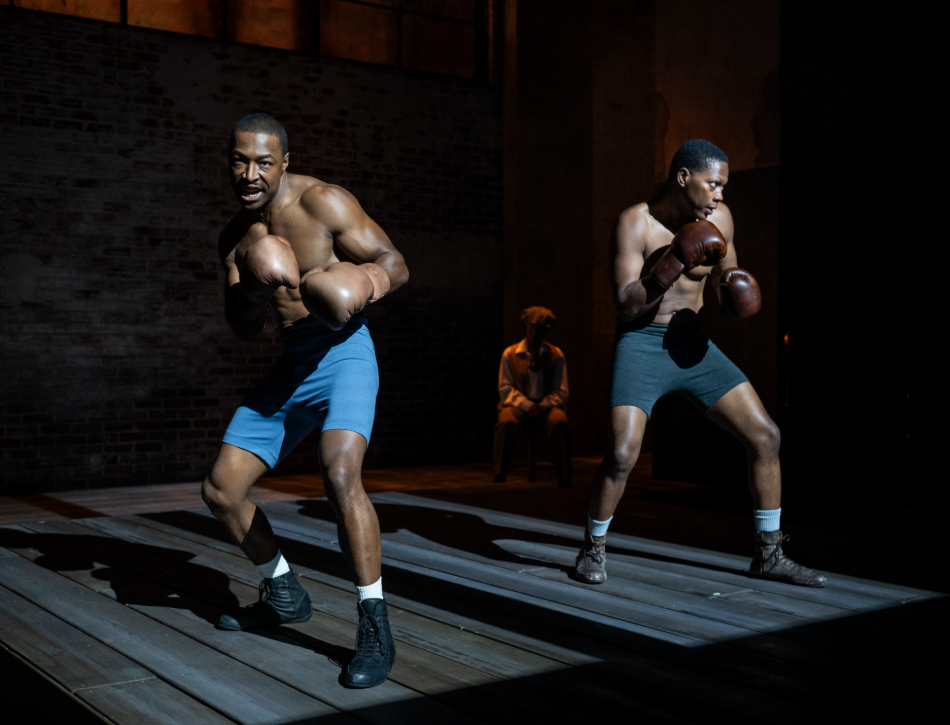
La’Tevin Alexander as Jay (left) and Ajax Dontavius as Fish, in a bout as trainer Wynton (James Vincent Meredith) looks on. Photo by Michael Brosilow..
Entering a spar with a visibly frightened first-time boxer Fish (Ajax Dontavius), Jay works the audience. “How many rounds you want me to give you?” he asks us, all calm and confident. The presentation of the match is inventive: the two stand at angles and shoulder to shoulder, then punch or receive hits toward the seated crowd, stomping their feet to sound the impacts. Particularly inspired is the lighting, which heightens the drama and delineates regions of the stage, such as the boxing ring, rectangles of light narrowing as bouts draw to a close. (Jason Lynch is Lighting Designer.)
After Round 4, Jay prances, feigning boredom perhaps. “How you all doing?” he asks us spectators, adding lightheartedly, “I heard tell there was a fight here tonight.” After he vanquishes Fish, who survives and even lands some blows that surprised his adversary, Jay hires him as his sparring partner.
After the knockout, Jay dons a suit and reveals his ambition to his promoter Max (Scott Aielio): to take on the retired white championship boxer, Bigsby. (In real life, Jack Johnson coaxed James Jeffries out of retirement to take him on.) When Black people box each other, Jay says, their boxing stories only make the inside pages of the newspapers. But if he battles a white champion, Jay will make the front page, where even non-readers will register his fame.
“Bixby’s never fought a Negro. No one ever has,” Jay says of his white counterparts.
“The paper says Bixby would disgrace his legacy by stepping into the ring with you,” Max tells him. Such was the tenor of the times of Jim Crow. Nevertheless Jay drives his reluctant manager to negotiate a fight for him with Bixby, and Max scores an offer, albeit one-sided. Bixby wants 90 percent of the ticket sales.
Another character inhabits many scenes, Jay’s trainer Wynton (James Vincent Meredith). Limping and dispensing advice judiciously, Wynton triggers the description of a racist entertainment called “battle royales” (from which the play takes its name) in which a crowded ring of blindfold Black boxers battled until only one was left standing.
Wynton also bears witness to Jay’s braggadocio, and toward the end, the aftermath of the boxer’s encounter with his sister Nina (AnJi White). She shows up like a deus ex machina to add gravity to Jay’s quest, just hours before the match. Jay is already struggling with nerves, having learned of multiple armed threats against his life, knowledge Wynton did not share with him.
As Nina and Jay explore their shared past, Nina serves to reveal Jay’s deeper motives in his quest: to right wrongs where young Black women didn’t see themselves reflected in ideals of beauty, even maiming themselves with dangerous hair straightening chemical and hot iron treatments.
Nina warns Jay of a potential consequence if he bests Bixby: Black people will be punished by whites angered in reaction to his success, should he win. In the dramatic structure, this added pressure suddenly summoned into the script so close to the end seems unnaturally crammed in, almost melodramatic in its effect. In my mind it detracted from the seriousness of the concern itself.
In fact Nina was proven right. In real life, race riots were ignited by Jack Johnson’s victory over Jeffries, documented in a huge newspaper front page unfurled at the final moment of the show.
Two scenes I relished: Fish has given away his seat, and plans to listen to the fight on a radio in a bar, which will lead to another tragic event. Dontavius gives us Fish’s ecstatic joy over the imminent fight, which he showers obliviously on a deeply distressed Jay. The other scene is Scott Aielio’s soliloquy as Max on his dedication to Jay’s career, and the challenges it has presented for him as a white man steering Jay protectively as the boxer all the while flaunts the evil restrictions of Jim Crow. Max argues compellingly not to win gratitude, but to convince Jay that he has been and is truly dedicated to him.
The Royale is highly recommended as a theatrical experience, and a worthy revelation of history less present today. It runs through November 29, 2026 at Writers Theatre in Glencoe, IL.
