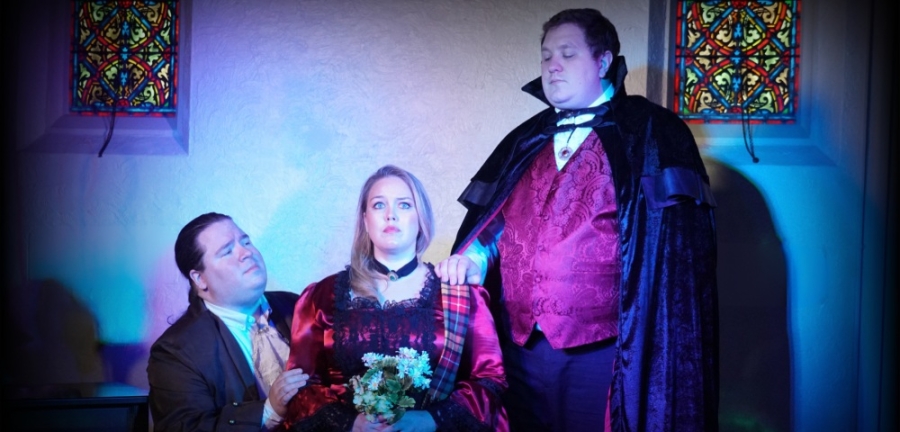
With Halloween creeping closer, there’s something fitting about revisiting one of opera’s earliest flirtations with macabre horror - especially in a production presented and performed by Chicago City Opera (COT). Der Vampyr may not enjoy the mainstream familiarity of later supernatural works, but its mix of moonlit superstition, doomed romance, and aristocratic menace makes it an ideal October offering. As audiences lean into the season’s appetite for the eerie, Marschner’s opera emerges as a surprisingly modern ancestor to everything from Victorian melodrama to contemporary horror musicals.
Though often treated as a standalone curiosity, Der Vampyr has a lineage that begins well outside the opera house. The story originates with John Polidori’s 1819 prose tale The Vampyre, one of the first works to codify the seductive, aristocratic vampire archetype. Polidori’s narrative was adapted into a German stage play by Heinrich Ludwig Ritter, whose dramatization became the direct source for Wilhelm August Wohlbrück’s libretto. Heinrich Marschner’s 1828 opera builds on Ritter’s theatrical version, shaping the material into a darkly romantic, musically driven narrative that blends early Romantic lyricism with gothic theatrics. In short: Polidori’s story inspired Ritter’s play, and Ritter’s play became the foundation for Marschner’s opera.
Set in early 19th century Scotland, the opera follows Lord Ruthven, a charismatic nobleman cursed with vampirism and bound to claim new victims before dawn or face eternal damnation. After surviving a near fatal attack, the young hero Edgar becomes unknowingly entangled in Ruthven’s hunt. Ruthven first targets the innocent Janthe, luring her to a ruined castle under the guise of seduction, and later sets his sights on Malwina, Edgar’s beloved, whose wedding night becomes his final opportunity to fulfill his deadly pact. As Edgar pieces together the truth, the opera accelerates toward a frantic race against sunrise: Ruthven’s identity is exposed, his supernatural bargain collapses, and the community rallies to save Malwina as the vampire is ultimately destroyed. What remains is a blend of gothic suspense, romantic rescue, and early Romantic moral drama - a seasonally perfect slice of operatic horror as Halloween approaches.
Jeremiah Strickler commands the evening as Lord Ruthven, delivering a performance that blends aristocratic charm with a chilling, predatory stillness. His presence anchors the production - vocally assured, theatrically magnetic, and always in control of the opera’s gothic pulse. Opposite him, Jordan Loyd brings a clear, earnest intensity to Edgar Aubry, shaping the role with a bright tenor and a palpable sense of moral urgency. Loyd had some of the most spectacular and heartfelt vocal moments of the evening, particularly toward the end of Act II as he reflects on his past love. Jessie Lyons’ Malwina adds welcome tenderness, her lyrical phrasing and grounded sincerity adding to the opera’s romantic core. Ariel Emma’s Janthe provides one of the night’s most striking early moments, her brief arc handled with vivid color and fearless commitment, and some of the notes she held were genuinely astounding - the kind that stop the room for a beat. Keaton Payne’s Humphrey von Davenaut provides a sturdy, authoritative counterweight, shaped by both his assured delivery and his expressive, sharply drawn presence. Meanwhile, Molly Clementz (also the production’s graphic designer) brings Emmy Perth to life with bright energy and an impressive finesse that lifts every moment she’s given, adding flashes of warmth, wit, and a polished musicality - especially in the way she shapes and sustains her notes with such control and clarity.
Bat Collazo’s George Dibdin and Kevin Wheatle’s John Berkley round out the ensemble with crisp, well-shaped character work that keeps the world of the opera humming with specificity.
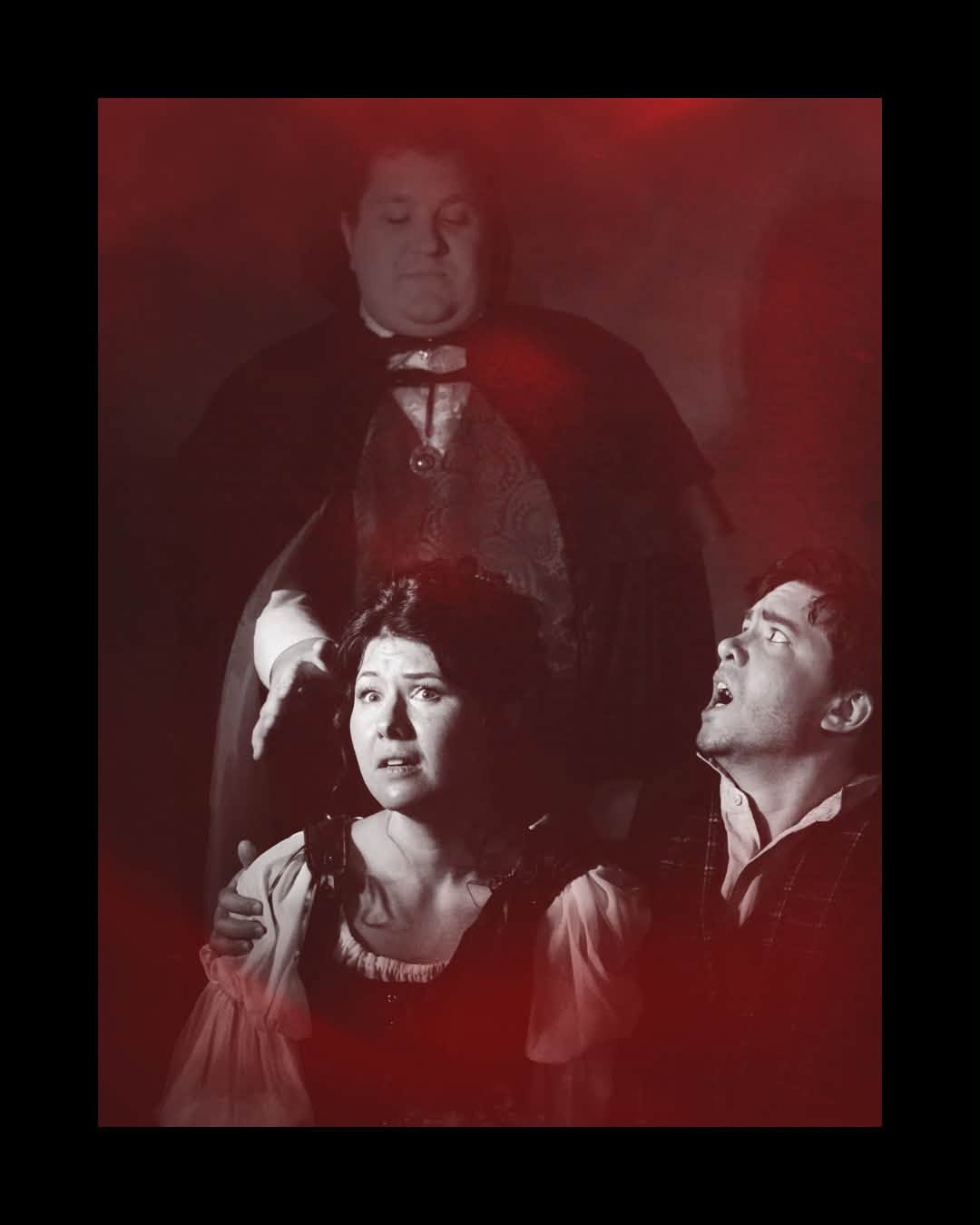
Jerimiah Strickler (rear) Molly Clemenntz (left) and Bat Collazo in Chicago City Opera's Der Vampyr.
One of the unexpected pleasures of the evening was simply hearing each singer on their own - every voice carrying its own color, character, and emotional weight. But when paired, those timbres intertwined with a striking naturalness, and in the moments when all eight sang off one another at once, the result was nothing short of exquisite. The ensemble sound had a richness and immediacy that felt almost architectural, each voice reinforcing the next until the room seemed to vibrate with a unified, resonant force. It was a reminder of how thrilling Marschner’s writing can be when performed by artists who listen as intently as they sing.
Behind the scenes, Alexis Enyart conducts with sharp dramatic instinct, shaping Marschner’s score with clarity and momentum. SarahAnn Sutter’s direction deepens the production’s impact, treating Der Vampyr not merely as gothic spectacle but as a living, breathing psychological drama. She embraces the opera’s supernatural flair with confidence - the shadows, the proximity, the sudden shifts in tone - yet she never lets the human stakes slip away. Sutter has a keen sense for spatial storytelling, using the venue’s architecture to heighten tension and intimacy; she sends performers through the aisles and along the home’s sweeping historic staircase, activating much of the house as part of the dramatic landscape. Her staging choices reveal a director who understands how early Romantic horror works best: not through excess, but through precision, ambience, and emotional clarity. Supported by Jordan Crice’s deft piano work and Adam Nicholson’s distinctive set design, the result is a production where every element feels intentionally placed and dramatically charged. Thanks to this talented cast and creative team, Chicago City Opera builds a world where early Romantic horror feels both stylish and surprisingly immediate.
Although Der Vampyr travels through a handful Chicago area venues during its run, the performance I attended on opening night unfolded inside the storied Colvin House - a location that feels almost predestined for this opera. Colvin House, beautifully placed across the street from Lake Michigan on the corner of Thorndale Avenue and Sheridan Road, proves to be an inspired setting for Der Vampyr, its historic architecture and intimate, richly textured rooms amplifying the opera’s gothic mood in ways a traditional proscenium simply can’t match. The building’s carved woodwork, shadow friendly corners, period furnishings, and old-world elegance create a natural sense of suspense and closeness, allowing the audience to feel almost inside the drama rather than observing it from a distance. The scale of the space heightens the tension - Ruthven’s entrances feel more dangerous, Janthe’s fate more immediate, Malwina’s peril more personal. Colvin House becomes a living extension of the opera’s supernatural world and a perfect match for Marschner’s early Romantic horror.
Despite all its strengths, the evening wasn’t without a minor but noticeable drawback. Although brief stretches of dialogue were exchanged in English, the opera itself is sung in its original German, making the surtitles essential for most. Unfortunately, the monitor displaying those subtitles sat off to the front side and too low to be easily seen by much of the audience; only those in the unobstructed front section had a consistently clear view. Sitting in the third row opposite the monitor side, I was able to catch most of the surtitles when first‑row head movement allowed, but many around me – and further back - were blocked entirely. I’m no set designer, but raising the monitor and centering it - even if it encroached slightly into the stage picture - would make the surtitles far more accessible, a small trade off that would greatly improve audience experience. In the meantime, I strongly recommend that attendees read the Act I and Act II synopsis in the program before the performance begins; with that context in hand, most will have a solid grasp of the unfolding drama even if the surtitles prove difficult to see.
Regardless of that small hiccup, the opera itself remained a beautiful, wonderfully performed experience - rich in mood, artistry, and musical power.
Der Vampyr is recommended as a rare and atmospheric experience - the kind of intimate, site specific opera that feels tailor made for October. For audiences looking to embrace the season with something truly unique, this production offers a gothic thrill you won’t find anywhere else. Upcoming performances include Wednesday, October 7 at Colvin House (7pm), Friday, October 9 at Fulton Street Art Center (7pm), and Sunday, October 11 at Skokie Theatre (3pm).
