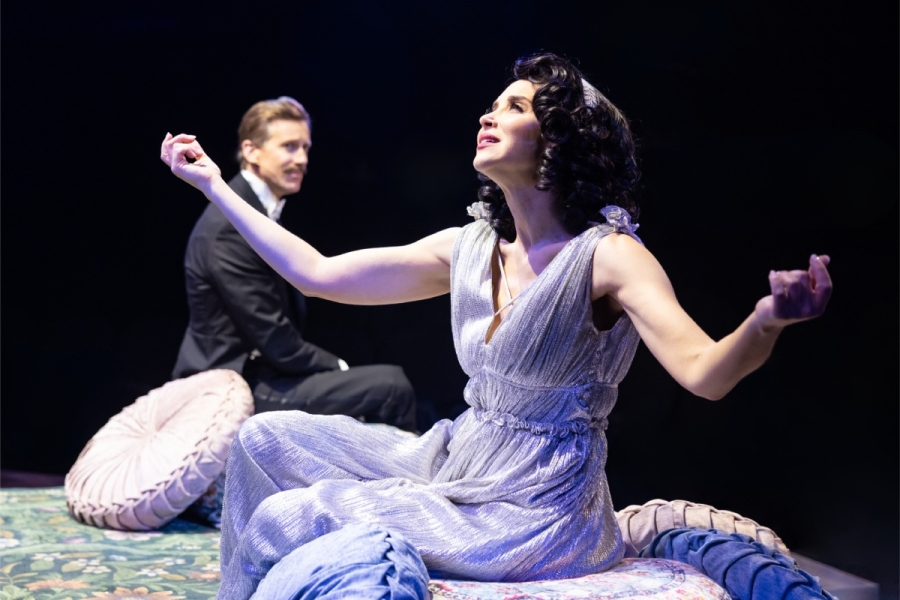
Marriott Theatre’s in‑the‑round intimacy turns A Little Night Music - which premiered on Broadway in 1973 and later became a 1977 film - into a quietly seductive swirl of glances, secrets, and second chances, the kind of production where the waltz feels like its own character. Under the soft glow of perpetual twilight, Sondheim’s lovers and liars circle one another with equal parts longing and restraint, and the space itself heightens every stolen look and half‑spoken truth. It’s a show built on emotional undercurrents, and Marriott’s staging lets those currents ripple right through the audience.
Stephen Sondheim’s A Little Night Music unfolds like a slow-turning dance that keeps tightening its circle, drawing its characters closer to the truths they’ve been avoiding. Set in a turn‑of‑the‑century Sweden where manners are crisp but desires run hot, the story follows lawyer Fredrik Egerman, a man trying to convince himself he’s content. He’s recently married Anne, a porcelain‑delicate young bride who’s still clinging to her innocence, while his son Henrik broods in the corner, nursing both a cello and an unspoken crush.
Everything tilts when Fredrik reconnects with Desiree Armfeldt, the actress he once loved and never quite got over. Desiree, ever the pragmatist, is juggling her own complications - namely Count Carl‑Magnus Malcolm, a swaggering dragoon whose jealousy burns hotter than his intellect. When Desiree attempts to untangle her romantic knots, she invites everyone to her mother’s country estate for a “quiet weekend,” which of course becomes anything but.
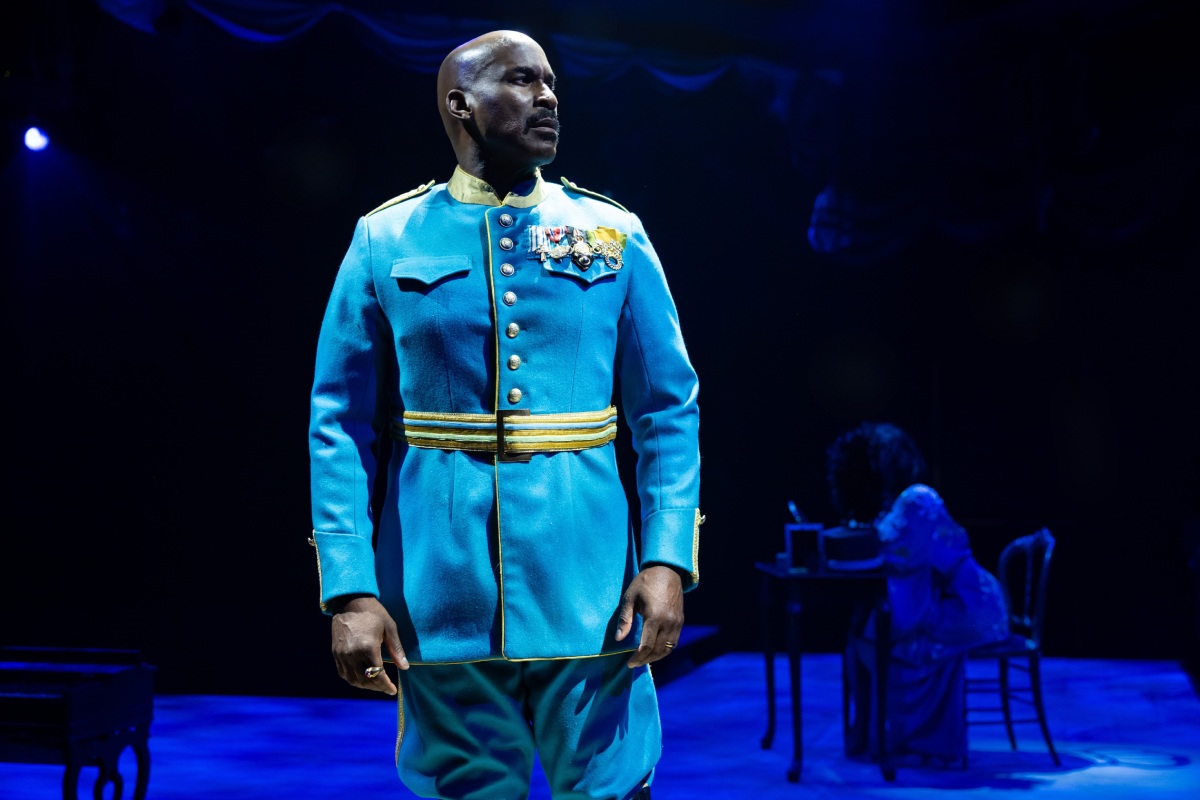
Alan H. Green in Marriott Theatre's A Little Night Music.
What follows is a weekend of mismatched couples, misread signals, and emotional truths finally spoken aloud. Under the glow of the perpetual Nordic twilight, partners shift, illusions crack, and the characters discover that love - in all its foolishness and ache - is rarely tidy but often exactly what they need. By the time the final waltz resolves, hearts have realigned, old wounds have softened, and the night has delivered its promised wisdom.
Sondheim’s score remains the production’s quiet spellbinder - a latticework of turning phrases, reprises, and melodic ironies that reveal as much about the characters as the book does. Songs like “Now,” “Soon,” and “Later” braid together with clockwork precision, exposing the emotional stalemates everyone is too polite to name, while “A Weekend in the Country” bursts with layered wit and rising chaos. And when the music finally slows into the aching simplicity of “Send in the Clowns,” the entire evening seems to exhale. Marriott’s staging lets these songs land not as showpieces but as confessions, each one circling closer to the truths the characters have been dancing around all night.
Under Nick Bowling’s beautifully calibrated direction, A Little Night Music moves with a clarity, elegance, and emotional intelligence that allows every waltz, glance, and confession to land with quiet precision.
Marriott’s production finds its center of gravity in Alexandra Silber, whose Desirée Armfeldt glows with the practiced sparkle of an actress slightly past her prime who knows exactly how she’s perceived and used by the married men who adore her - and the bruised vulnerability of someone who’s finally tired of the performance. Silber calibrates every beat with care: the sly asides, the brittle composure, the ache that flickers just beneath the surface. When she reaches “Send in the Clowns,” it doesn’t arrive as a grand gesture but as something far more intimate - a truth about the “bread crumbing” type of love she’s accepted as a traveling working actress that she’s been circling and battling for years. Opposite her, Andrew Samonsky gives Fredrik Egerman a beautifully worn‑in charm, the kind of man who hides his longing behind polite smiles and a touch of self‑mockery. His Fredrik isn’t a fool; he’s a man quietly unraveling, caught between the mature love he’s built and the young carefree one he still imagines he can achieve with his much younger bride. Samonsky’s performance is both sensual and frustratingly narcissistic. One example of this is when Fredrik apologizes to Desiree - as he leaves her heartbroken yet again - for confessing the tempting truth that her very presence is his safe haven… even though he has no intention of ever being saved by her.
I absolutely adored every delicate moment between lovers, friends, and husbands and wives in this gracefully performed piece, which reveals how men and women are still, even now, navigating the ever‑shifting moods of the partners in their lives in order to sustain lasting relationships.
Alan H. Green makes a vivid impression as Count Carl‑Magnus Malcolm, swaggering through the role with puffed‑up bravado and razor‑sharp comic instinct. Veronica Garza matches him effortlessly as Charlotte, her barbed wit and impeccable comedic timing turning bitterness into something unexpectedly funny and deeply human. Addie Morales gives Anne a shimmering, anxious innocence that feels grounded, while Eldon Warner‑Soriano lets Henrik’s turmoil simmer until it finally breaks open into something raw and affecting.
The singing voices of every single member of this talented and attractive cast are of true opera quality, and paired with the astoundingly modern, lyrical poetry of Sondheim’s evergreen script, I found myself leaning in to catch every word from their lips like a bee sipping nectar from flowers. Across the board, the vocals are rich, expressive, and beautifully attuned to the intricacies of Sondheim’s score.
From there, Carmen Roman anchors the evening with a magnetic, unhurried authority as Madame Armfeldt, delivering Sondheim’s sharpest observations with the cool precision of someone who has cataloged every shade of heartbreak and delicious, luxurious romance from men of great standing throughout her long life. She brings down the house with superbly dry one‑liners like, “Don’t serve them the best champagne - I’m saving that for my funeral!”
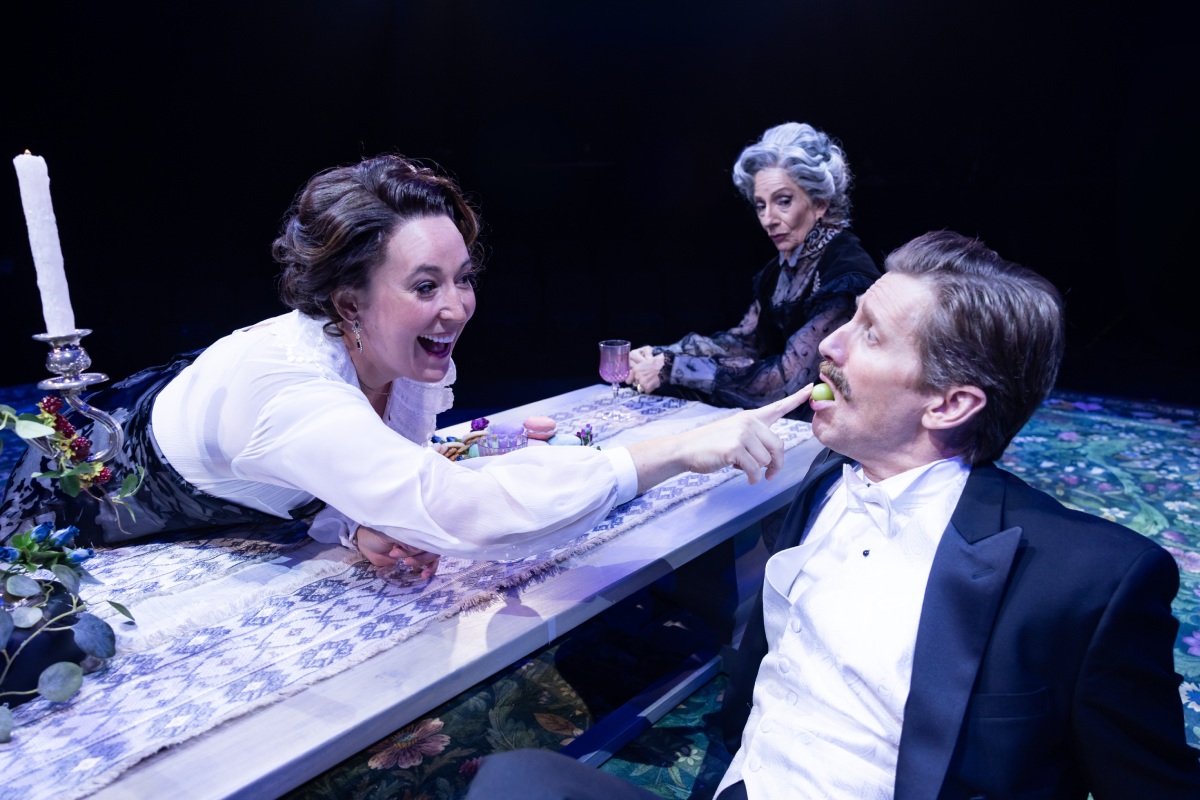
Veronica Garza, Andrew Samonsky and Carmen Roman (rear) in A Little Night Music at Marriott Theatre. Photos by Justin Barbin.
Madison Uphoff brings Petra a bold, earthy vitality - a reminder that desire belongs to everyone, not just the elegantly miserable. Together, this ensemble moves through Sondheim’s bittersweet waltz with nuance, confidence, and a clear understanding of the emotional architecture beneath the score.
Scenic Designer Regina García shapes the evening with a clean, elegant visual world that proves how little is needed to conjure an entire emotional landscape. The stage remains mostly bare - a chaise lounge here, a writing desk there - yet the details she chooses carry real poetic weight: a graceful two‑person swing drifting down from the rafters like a shared memory, a balmy moon casting its soft glow across the space, and strands of hanging lights and flowing ribbon that give the in‑the‑round theatre the feeling of a summer night suspended in time.
Associate Choreographer Katie Johannigman threads movement through this environment with a light, intuitive touch, while under Brad Haak’s baton, Sondheim’s score unfurls with clarity and warmth. Sally Dolembo’s costumes superbly wrap the production in period elegance. Dolembo’s designs resemble modern ballet costumes and express the unique sensuality and sexuality of both the male and female characters in a most tasteful and expressive way that makes your eye want to follow their every move especially the graceful way they make love to one another. The delicate, mostly pastel costumes emote a subtle erotic beauty without overwhelming each character’s emotional and comedic shifts as the night deepens and the whirl tightens its hold.
Marriott Theatre’s A Little Night Music unfolds on the perfectly intimate size of their theatre in the round stage, and the production’s emotional reach is anything but small. What emerges over the course of the evening is a circling dance of sensual longing, unrequited love and unexpected grace - a reminder of how Sondheim’s work can pierce straight through the heart when handled with this level of care. By the time the final notes fade and the lovers step back into the soft glow of twilight, the production has delivered something quietly luminous: a story about desire and forgiveness told with wit, tenderness, and a deep understanding of the ways men and women walk the tightrope of love and pride, playing love like a game of egos until they realize true love is the one thing they truly cannot live without.
Highly recommended.
For tickets and/pr more show information, click here.
