
Displaying items by tag: Kyle Vegter
A Masterwork Reanimated: Manual Cinema's Frankenstein Still Inspires Awe
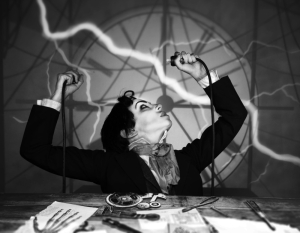
Since premiering at Court Theatre in 2018, Manual Cinema's Frankenstein has stood as one of Chicago's most remarkable theatrical achievements. Returning for just five performances at the Studebaker Theater, the work remains every bit as mesmerizing today as when theatergoers first encountered it. More than an adaptation of Mary Shelley's classic Gothic novel, Frankenstein is a work of brilliant art, a breathtaking fusion of theater, film, music, and visual storytelling that pushes the boundaries of what live performance can accomplish.
Few companies blur the line between theater, cinema, and visual art as completely as Manual Cinema. Through the collective's signature combination of shadow puppetry, miniatures, projected imagery, live acting, original music, and meticulously crafted sound design, Frankenstein unfolds with the wonder of watching a dream take shape in real time. Perhaps most impressive is the dual experience the company creates, allowing audiences to become immersed in the finished cinematic image while simultaneously appreciating the artistry required to produce it.
What makes this version so compelling is its refusal to settle for a straightforward retelling. Rather than focusing solely on Victor Frankenstein and his doomed creation, the piece intertwines the familiar narrative with the life of Mary Shelley herself. Conceived and directed by Drew Dir and devised by Dir, Sarah Fornace, and Julia Miller, the work finds unexpected psychological depth in the parallels between creator and creation. The result is an emotionally resonant exploration of grief, ambition, responsibility, and the mysterious spark behind artistic creation. Shelley's experiences become inseparable from the tale she imagined, giving fresh dimension to a story many may think they know by heart.
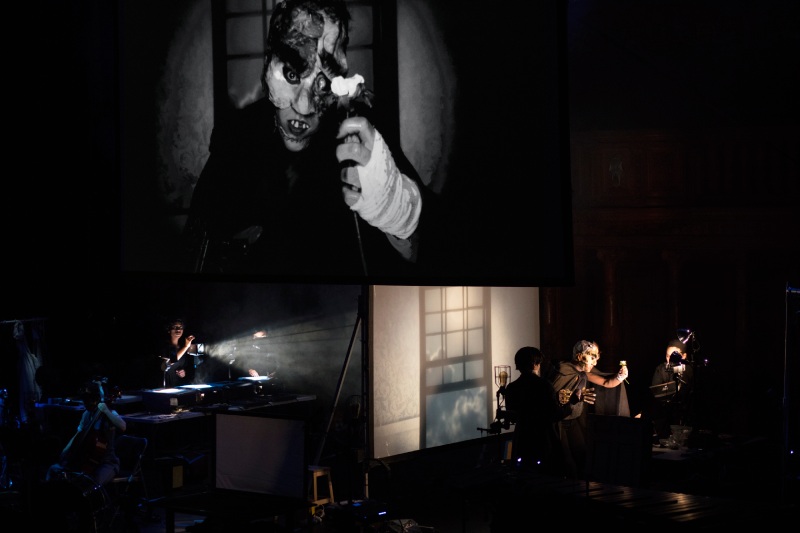
Manual Cinema's Frankenstein. Photo courtesy Elly White.
Manual Cinema's technical accomplishments remain astonishing. The performers serve simultaneously as actors, puppeteers, camera and overhead projection operators, and illusionists, constructing intricate visual worlds before our eyes. Every shadow, every miniature landscape, and every carefully choreographed movement contributes to a cinematic language that feels both innovative and timeless. At times, the work's rich layering of imagery demands careful attention, but the payoff more than justifies the investment. Watching the mechanics at work only deepens one's appreciation for the craftsmanship involved. The production's richly imagined visual language owes much to an exceptional design team. Shadow Puppet Design by Drew Dir and Liza Breit, Projections and Scenic Design by Rasean Davante Johnson, and 3D Puppet Design by Liza Breit provide the foundation for the show's arresting imagery. Lighting Design by Claire Chrzan adds atmosphere and dramatic texture, while Costume and Wig Design by Meka van der Ploeg and Prop Design by Lara Musard enrich the world with thoughtful detail and period character.
Sarah Fornace is a force and anchors the evening with beautifully realized portrayals of both Victor Frankenstein and Mary Shelley, illuminating the parallels between the ambitious scientist and the visionary author who imagined him. Kara Davidson proves equally compelling as both the Creature and Elizabeth Frankenstein, bringing remarkable humanity and quiet complexity to each role. Together, their performances ensure that beneath the show's dazzling technical achievements beats a deeply human heart.
The evocative original score and sound design by Ben Kauffman and Kyle Vegter prove equally vital, transforming every scene into an immersive sensory experience. The music heightens the emotional stakes while the live effects establish an atmosphere that ranges from intimate reflection to Gothic grandeur. There is also something undeniably enjoyable about watching the musicians positioned around the stage assemble the show's haunting sonic landscape in real time, revealing yet another layer of Manual Cinema's theatrical ingenuity. The visual and sonic elements combine to produce an experience that feels as sweeping as a feature film while maintaining the immediacy and vulnerability of live theater.
That artistry was especially evident from our seats directly in front of percussionist Justin Peters (performing the night I attended), whose work became a captivating attraction in its own right. Surrounded by towering xylophones and an eclectic collection of suspended objects that ranged from hubcaps and planters to what appeared to be a kitchen sink, Peters coaxed an astonishing variety of sounds from each piece, his dexterity and precision adding another captivating layer to Manual Cinema's intricate theatrical machinery. The variety of instruments on display is every bit as fascinating as the sounds they produce.
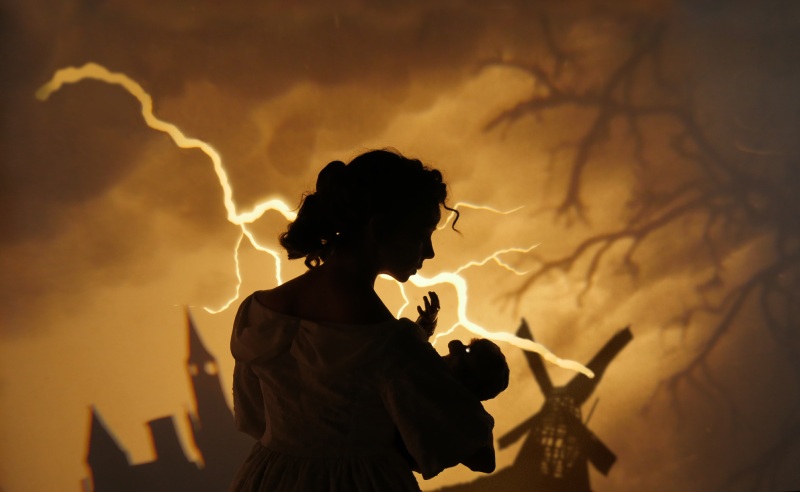
Sarah Fornace as Mary Shelley in Manual Cinema's Frankenstein. Photo by Drew Dir.
One of the evening's greatest delights came after the final curtain. Guests were invited to join the actors, musicians, projectionists, and artistic team onstage to discover firsthand how Manual Cinema brings its signature illusions to life. Visitors could handle puppets, experiment with projectors, appear on camera, and watch their own silhouettes become part of the visual storytelling. Beyond the opportunity to ask questions, take photographs and videos, and interact with the artists, the experience beautifully reinforced one of the company's central ideas: understanding the process does not diminish the magic - it makes it even more extraordinary.
Yet for all its technical and musical wizardry, Frankenstein never loses sight of its humanity. At its heart lies a poignant examination of loneliness, longing, and the desperate need for connection. The Creature emerges not merely as a monster but as a profoundly sympathetic figure whose search for acceptance speaks across centuries. Likewise, the portrayal of Mary Shelley reveals the often-painful relationship between art and life, suggesting that creation itself can be both beautiful and terrifying.
The Halloween season offers no shortage of spooky entertainment, but few works achieve the artistic depth, technical ingenuity, and emotional impact of Manual Cinema's Frankenstein. Years after its debut, it remains a defining achievement of Chicago theater and a shining example of the city's creative excellence. For those fortunate enough to experience one of its five performances only, October 28-November 1, 2026, at the Studebaker Theater, this extraordinary presentation serves as a reminder that great theater can still inspire awe.
Frankenstein is more than a theatrical event. It is a masterwork of visual storytelling, a triumph of imagination and technique, and one of the most distinctive theatrical works to emerge from Chicago in the past decade.
Manual Cinema returns to the Studebaker Theater with A Christmas Carol for a limited engagement December 18-27.
Highly Recommended.
Studebaker Theater in the Fine Arts Building
75 minutes – no intermission
Tickets and information: Fine Arts Building - FrankensteinFrankenstein
Review: Manuel Cinema's 'Frankenstein' at Court Theatre

It’s a rare treat to get to experience anything as unique as Manual Cinema’s production of ‘Frankenstein’ at Court Theatre. With several productions of ‘Frankenstein’ going on this year, one might wonder how they’re each distinguishing themselves. Manual Cinema’s original adaptation is just that, a manual cinema. Told with intricate shadow puppets on classroom overhead projectors, ‘Frankenstein’ is like spending the evening in a toy box.
In a collaboration with Court Theatre as part of their season, Manual Cinema returns to University of Chicago where they started. The company was formed in 2012 by University of Chicago faculty members and has since evolved into an internationally acclaimed performance art troupe. Manual Cinema still resides in Chicago.
This theatrical production of ‘Frankenstein’ is unlike anything you have ever seen. Drew Dir’s concept closely follows Mary Shelley’s novel and even includes an intermittent story arc about how Mary Shelley came to write ‘Frankenstein’. Unlike a traditional play, this production contains no spoken dialogue. Instead, the cast furiously dashes around the set creating a visual splendor on several overhead projectors. Though, there are scenes of more traditional acting or, pantomime, layered into the play as well. The show is projected onto a main screen but it’s nearly impossible not to sneak away glances to the corners where the visuals are being created. A live orchestra beautifully scores the play with original music composed by Kyle Vegter and Ben Kauffman.
This production is riveting. Not only are the projections and music sumptuous but the shadowy atmosphere created by Manual Cinema is haunting. The staging is set up in a way that encourages the audience to watch how the projections are created. The story is somewhat simplified but in that simplicity is an almost pop-up book version of Shelley’s classic horror story. The cinematic score propels the action and provides an emotional component to the piece. The two-hour run time seems to breeze by and you’re left not wanting the excitement to end.
‘Frankenstein’ is Manual Cinema’s sixth full length show but hopefully that means there will be plenty more. If you’re wondering which ‘Frankenstein’ to see this fall, this is the one. There is surely nothing else like it.
Through December 1st at Court Theatre. 5535 S Ellis Avenue. 773-753-4472



Latest Articles
-
 Nov. 23 at the MAC: "An Evening with Gary Sinise" Author of "Graceful Warrior" to Benefit WSFDV
Written by Buzz Center StageWest Suburban Foundation for Disabled Veterans (WSFDV) presents "An Evening with Gary Sinise," Author of "Graceful Warrior" at the McAninch Arts Center (MAC) located on the campus of College of DuPage, 425 Fawell Blvd. Monday, Nov. 23 at 6:30 p.m. Sinise, an…
-
 Remarkable Production Makes 'The Royale" a Knockout Show
Written by Bill EslerWriters Theatre scores a knockout production with Marco Ramirez’s 2013 play, The Royale. Under the direction of Tyrone Phillips, we see this widely-produced script (it played New York’s Lincoln Center a decade ago) executed to perfection. Centered on boxing legend…
-
David Salsbery Fry returns to Chicago Opera Theater for fourth production with company in Chicago Premiere The Importance of Being Earnest - December 2-6
Written by Buzz Center StageDavid Salsbery Fry sings the role of Rev. Canon Chasuble in the Chicago Premiere of Chicago Opera Theater’s (COT) production of Castelnuovo-Tedesco’s humorous and final stage work – a “sparkling operatic adaptation of Oscar Wilde’s beloved play and a joyful tribute to…
-
Rick Bayless, Anthony Rapp, Jeff Tweedy and More Join Goodman Theatre's Holiday Season
Written by Buzz Center StageFrom an internationally renowned chef and the world-famous rock frontman of Wilco, to a Pulitzer Prize-nominated author and a handful of Chicago's nationally decorated actors, holiday theatergoers find two new seasonal offerings at The Goodman this year. Alongside the perennial…
Does your theatre company want to connect with Buzz Center Stage or would you like to reach out and say "hello"? Message us through facebook or shoot us an email at This email address is being protected from spambots. You need JavaScript enabled to view it..
*This disclaimer informs readers that the views, thoughts, and opinions expressed in the text belong solely to the author, and not necessarily to Buzz Center Stage. Buzz Center Stage is a non-profit, volunteer-based platform that enables, and encourages, staff members to post their own honest thoughts on a particular production.