
Displaying items by tag: Zach Kunde
A People: A Sweeping, Soul‑Stirring Journey That Celebrates Jewish Identity
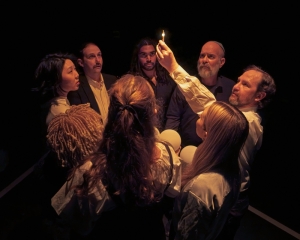
An extraordinary eight-person ensemble fuels the sweeping storytelling of A People - a production presented collaboratively by Arts Judaica and YI Love Jewish - shifting through nearly 80 characters across generations and geographies. Though only one cast member is Jewish, playwright LM Feldman intentionally assembled a diverse ensemble to reflect the many ways Jewish identity manifests - across culture, theology, race, queerness, and lived experience - underscoring that there is no single way to be part of a people.
The performance thrives on the versatility of this cast, featuring standout contributions from Douglas Levin, who provides an authentic and anchoring sincerity, and Charity Schultz, who illuminates her roles with magnetic charm. Daniel Boughton moves with ease between sharp humor and striking emotional depth, and Jin Ai anchors the production’s stillest moments with a quiet power, enriched by her beautifully integrated guitar work. Zach Kunde cuts through the space with sharp intellect and a commanding vocal presence, while Haley Schenk turns a single, piercing glance into some of the production’s most potent dramatic beats, and she even threads in flute playing that adds a surprising, delicate texture. The momentum never falters thanks to Xavier Mattison’s vibrant energy and tenderness, while Freya Churchwell rounds out the ensemble with impressive, wide‑ranging versatility and delivers some of the play’s genuine laugh‑out‑loud exchanges. Together, they weave a unified and deeply affecting tapestry of human survival.
This remarkable stage chemistry is guided by director Avi Hoffman, an acclaimed figure in global Jewish theater who recently directed and starred in a historic Yiddish production of Death of a Salesman in Bucharest, Romania. Having previously earned a Drama Desk nomination for playing Willy Loman in New York, Hoffman injects this local production with masterful artistic insight. Under his careful guidance, the non-linear, fragmented script by L. M. Feldman avoids confusion, gaining immense clarity and striking a perfect balance between epic historical weight and intimate human connection.
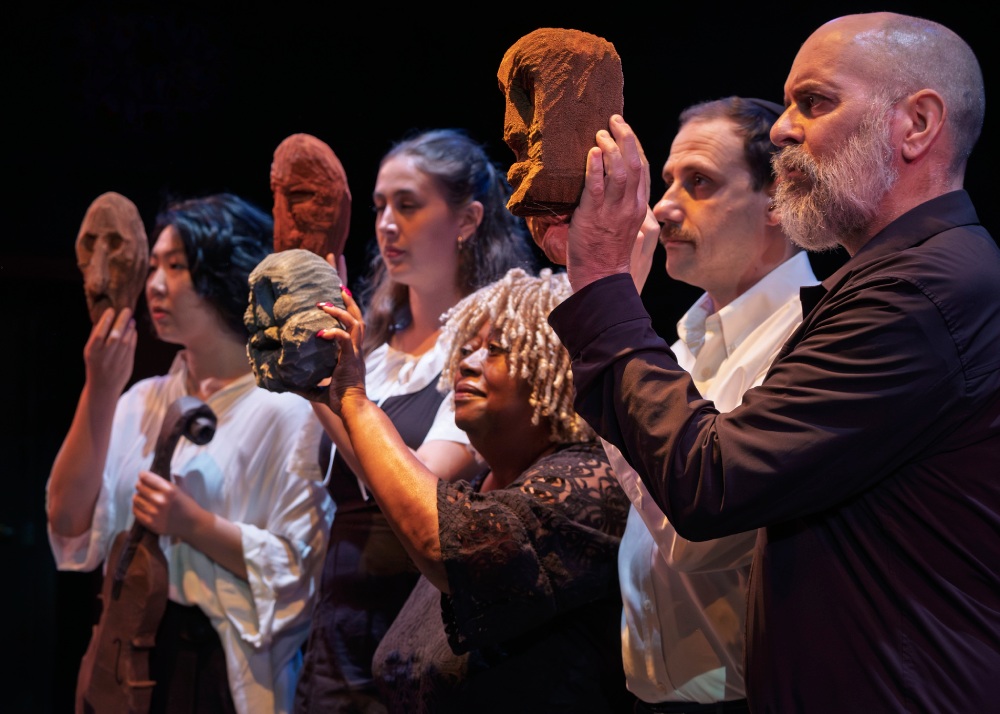
L-R: Jin Ai, Charity Schultz, Freya Churchwell, Zach Kunde, Douglas Levin. Photos by Logan and Candice Conner, Oonphotography.
Starting with the diaspora of the Jewish people that have become scattered throughout the world, the production explores several expressions of Judaism while ultimately reinforcing the idea that, despite their differences, they remain one people - and a remarkable people at that. It touches on beautiful threads of Jewish history, including the teaching that Moses received not only the written Torah referred to as “The Hand” at Mount Sinai but also the Oral Torah referred to as “The Tongue,” which was an interesting fact that I did not ever learn about the Torah in Hebrew school. I was also unaware of another phenomenon that members of the Jewish community called “tonals” actually memorized whole portions of the Torah to recite and sing so that the Torah portion could be performed for groups of students/scholars etc., to discuss and watch. The important thing that came out of this discussion of the Torah and the essential thing that makes Judaism different from other religions is that Jews learned and passed on the teachings of the Torah and the Talmud for the purpose of discussing them and learning from them and interpreting them and re-interpreting them -so as not to force them down anyone’s throat to be followed with blind faith.
As a Jew, I appreciated how the piece pokes gentle fun at our tradition of spirited debate - a trait that can be both energizing and, at times, hilariously counterproductive.
They are so intelligent at debating with each other that sometimes they nitpick each other to the end of a discussion that could otherwise forward the family or community or couple in a more positive way.
One of the production’s most profound scenes comes when a character asks a 90‑year‑old what history lives in the wrinkles of their face - how an entire lifetime, nearly a century of memory, can be held within one fragile human body. Another moment that stayed with me was the gentle but urgent insistence that nurturing future generations is vital to the continuity of the Jewish people.
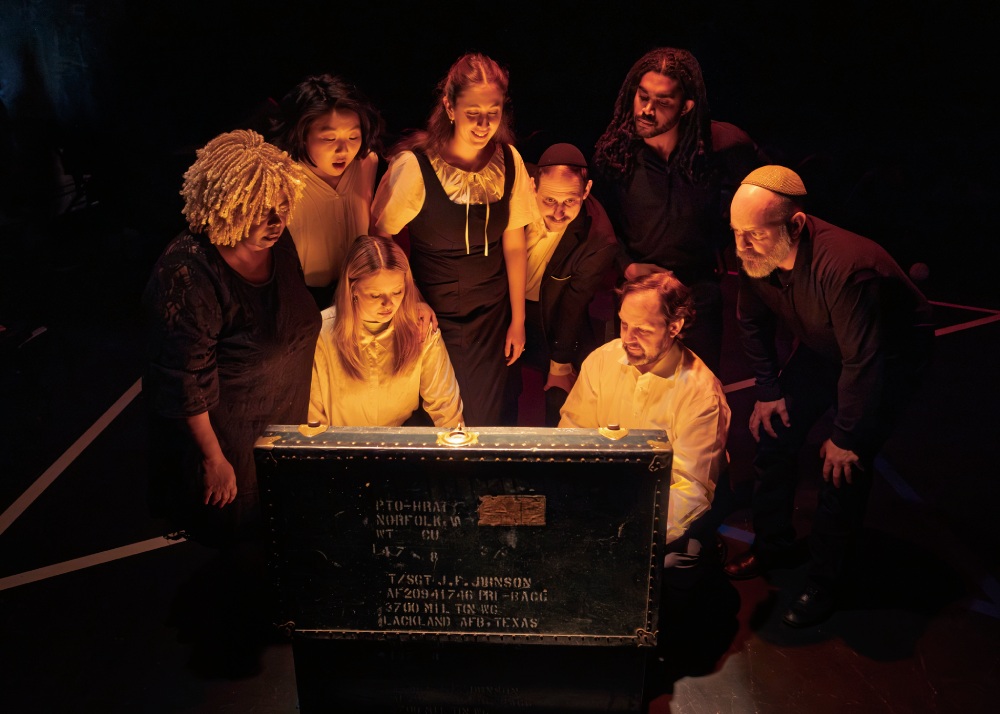
Back row L-R: Freya Churchwell, Jin Ai, Charity Schultz, Xavier Mattison, Zach Kunde, Douglas Levin. Front L-R: Haley Schenk, Daniel Boughton.
The differences among them are many, yet a shared thread still binds them together. One character argues passionately for a two‑state solution, while another hopes her girlfriend will one day be fully embraced by her community. A rabbi even confronts a group of Jewish Christmas carolers, shouting, ‘Why are you doing this?’ as the story considers how and why some Jews celebrate Christmas - a reflection of how the holiday’s overwhelming cultural presence in America can blur the line between religious observance and simple seasonal participation. And still, beneath all these disagreements and divergences, the play returns to the same essential truth: that despite their varied beliefs, identities, and practices, they remain part of one people.
This production was perfect for me as a Reform Jew who has been struggling in recent years with the current rise in antisemitism and my own childhood feelings of being a “self-hating Jew”. I remember being told as a teenager by my talent agent applying for theater roles that I needed to change my last name from Katz to Cates, implying that I would not be cast with a Jewish last name.
The work also reminded me that many young women today - queer and straight alike - continue to push back against the patriarchal elements of Judaism. It echoes the long history of restrictions found in early texts, where girls as young as 12 years old were defined by their childbearing potential and barred from studying sacred writings.
On the plus side, it brought me back to the beauty of the Yiddish language and how I hunger for the sounds of my great grandmother Fanny’s voice and my grandmother Lillian’s voice saying, ‘Have a little nosh!’ and, ‘We love you so much we’re kvelling!’”
The set is intentionally simple: a large Star of David stretches across the floor of Theater Wit’s intimate in‑the‑round space, immediately grounding the production in its cultural and spiritual roots. A few risers punctuate the stage, giving actors elevated platforms for defining moments, while small prop boxes at either end glow when opened, revealing modest but striking items that carry surprising emotional weight. Puppets appear briefly as well, echoing the woodworking projects referenced in the story and adding a tactile, handmade quality to the world. It’s an effective setup for this play - the open space becomes essential as the ensemble moves fluidly around the stage, frequently breaking the fourth wall to bless a volunteering audience member, pass out challah, ask questions, or coax the crowd into clapping along.
By luck, I chose the seat that happened to be in the spotlight for participation, and I was delighted when one actor asked me to be his ‘bubbe’ - his grandmother. When I said, ‘Yes! I will be your grandma!’ He gently took my hand, giving me a grateful squeeze. At another point, one of the actors - dressed as a bride - asked if he could give one of the audience members a blessing. I immediately said, ‘Yes!’ and he came over and placed his hands gently on my head - he was wearing the traditional lace head covering the bride on her wedding day - and he wished me great life blessings of joy and to find a wonderful husband. It was a delightful, intimate moment, and I hope that everyone who sees the show volunteers to experience that.
Throughout much of the play, the actors also wear small placards hanging from their necks, each bearing a single word such as “wrestle,” “struggle,” and “legacy.” These signs become a quiet but potent visual motif, suggesting the burdens, questions, and inheritances each character carries across time. They function almost like distilled themes of Jewish history itself - reminders that to be part of a people is to wrestle with identity, to struggle for continuity, and to consider what legacy one leaves behind. Other words appear as the ensemble shifts through eras, each one offering a compact window into the emotional or spiritual weight of the moment.
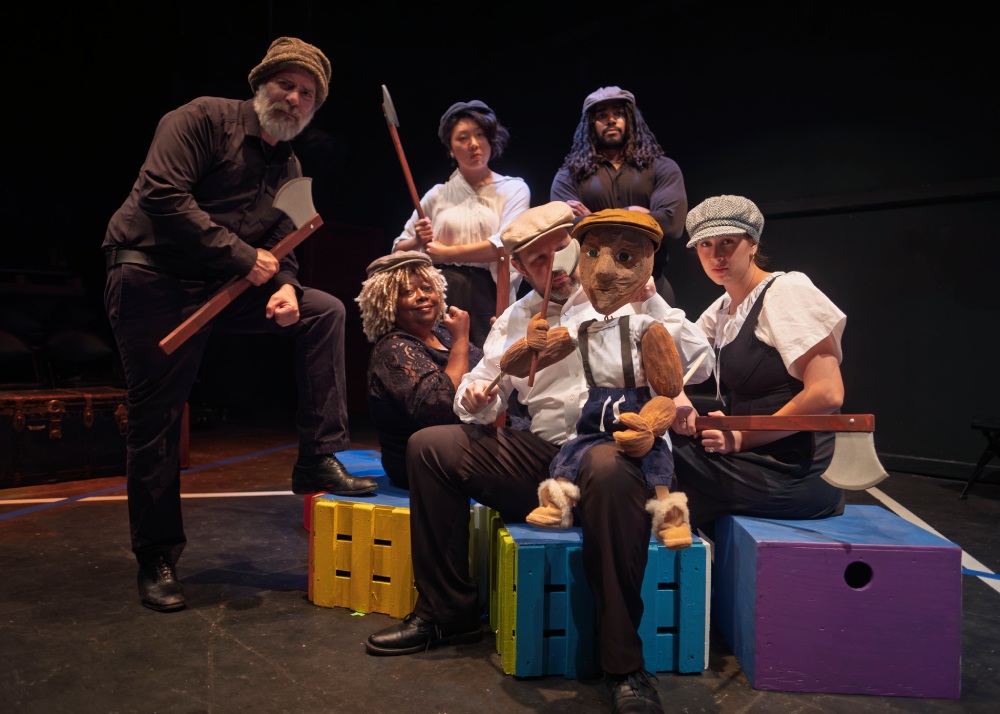
Back row L-R: Douglas Levin, Jin Ai, Xavier Mattison. Front row L-R: Freya Churchwell, Daniel Boughton, Charity Schultz.
My only note - and this is for the author, not the cast or director - is that of all the various types of Jews included in this piece - Reform, Conservative, queer, self‑hating, Orthodox, even atheist - the one type of Jew that was not represented was the Messianic Jew, of which I am one.
Messianic Jews (not to be confused with the organization Jews for Jesus) are Jews who believe that Jesus is the Messiah spoken of in the Old Testament - the ‘Christed One,’ meaning the one anointed with the oil of blessing. In those same scriptures, this figure is described as the blessed one who would be ‘pierced through his hands and feet,’ yet ‘whose bones would not be broken.’
Messianic Jews also believe that, regardless of his lineage - whether Yeshua was a descendant of King David or not - his purpose in allowing himself to be publicly killed, and then healing his own body three days later, was to show that this world is made of spirit, or ‘shimmering motes,’ as he called them. This was long before molecular structure or the effects of consciousness on physical matter were even theorized. All of his miracles were mitzvahs - acts of goodness - centered on healing and feeding the poor, the sick, and the disabled.
At the very least, Jesus was a respected, super advanced, rabbi, rebel and healer who introduced the idea that women were worthy of learning the Torah and receiving healing from his touch whether they were Jewish or not. This Feminist thought alone was a very radical and world changing idea that women of all nations and all religions are eternally grateful for.
Given all that Yeshua represents historically and spiritually to many Jews, I was surprised that his name never surfaced in a piece that explores so many branches of Jewish identity, its factions, and its many splintered paths. I compare his omission from Jewish studies when debating this with my friends to discussing basketball history without mentioning Michael Jordan or discussing physics without ever mentioning Albert Einstein - not a judgment, just an observation about the scope of the narrative.
In any case, author LM Feldman has created a marvelously complex and deliciously enjoyable reminder of all the different expressions of Judaism, and of the lush intelligence and grace of Jewish people around the globe caught up in the current battle to stay alive and well. Le Chaim!
A People was a very deeply inspiring and delightful experience for me, especially at this unprecedented time in history. This heartfelt production of A People helped this Jewish girl from Miami, Florida remember so many of the great things about my Jewish heritage; the sights, the sounds, the heated discussions, the music, the fabulous food, the funny family dinners, my own bat mitzvah… just so many things that make me proud to be a Jew today.
With its blend of live music and rapid-fire storytelling, the production compresses five thousand years of Jewish history and cultural inheritance into a brisk, engaging evening. A People stands out as essential summertime theater, honoring its deep historical foundations while resonating powerfully with contemporary audiences.
Mazel Tov and Highly Recommended!
Running through July 5 at Theater Wit.
Review: Murder in the Cathedral at City Lit Theater

I arrived at City Lit Theater’s MURDER IN THE CATHEDRAL expecting a heavy, serious, doubtless thought-provoking but rather intimidating major work of literature. By the end of the performance, I wanted to rush out, buy the book and read it immediately. Any production that accomplishes this in three hours must be called a success!
At its most basic level T.S. Eliot’s play is a meditation on Christian martyrdom in a time of great political stress. The quotation from Alexai Navalny, “I’m on the very blackest part of the blacklist,” on the program’s front-page links this theme directly to the times we live in today. The script was almost entirely in verse (how else would the Nobel Prize-winning poet write a play?) and at many points the extended alliteration and vivacious rhyme remind one of “Skimbleshanks, the Railway Cat,” or “Macavity’s a Mystery Cat, he’s called the Hidden Paw,” and the other wonderful TS Eliot poems that gave us the lyrics to Cats.
Production operated from many levels. Patti Roeder designed costumes ranging from modern business suits to carefully constructed evocations of medieval garb. The various social classes and estates were delineated, with the Chorus [Sally Olson, Isabel Schmitz, Katarina Bakas, Kara Chandler] representing the working poor of Canterbury while the rich and politically powerful barons were embodied in the Tempters [Sean Harklerode, Varris Holmes, Robert Howard], who doubled as Knights with Fourth Knight Zach Kunde, who also played Messenger. The Priests of the Cathedral were played by John Blick, Stephen Fedo, and Joel Thompson. As a whole the entire cast was splendid and Paul Chakrin’s fight choreography gave us a bloodcurdling assassination.
Which brings us to Becket himself, masterfully played by James Sparling and appareled with consummate attention to detail. I have no idea what vestments a Roman Catholic archbishop of the 12th Century wore or how his acolytes invested him. I do know what a present-day Anglo-Catholic priest wears and how she vests herself, and costume director Patti Roeder nailed it precisely.
The stage was in the sanctuary of Edgewater Presbyterian Church, and Director [and outgoing Producer and Artistic Director] Terry McCabe presented the play in the (semi) round. The central aisle leading to the stage area in front of an altar table and pulpit was, of course, singularly appropriate, and Mike McShane’s lighting through the stained glass behind the altar had a great effect. But the most amazing contribution was that of composer Phillip Seward, who set the verses of the four-member chorus (think Greek chorus, not Chorus Line) to haunting music in his world-premiere score.
The four singer / actresses articulated Eliot’s lines, now lyrics, with great clarity and their four-part harmony was flawless. As in a Greek play, these chorus members were not characterized in the script, yet their acting ability, as well as subtle cues from their costumes, allowed me to imagine the sort of women they were “in real life” as they went about their arduous daily rounds in the 12th Century city of Canterbury.
The role of the chorus is to propel the plot, and the music – pianist Jacob Adams punctuated by hammered chimes – intensified that effect. The first act, while intellectually heavy, sped by, and the composer closed with an allusion to a somber, minor key Advent hymn, “O Come, O Come, Emmanuel” – a falling melody line that carries the lyric, “and ransom captive Israel” – a ransom of martyrs’ blood.
Dialect coach Carrie Hardin’s work with the cast is clearly evident in the British r-lessness, but for the first minutes I wished she’d paid more attention to de-nasalizing the a’s. However, I soon stopped noticing this. I was particularly intrigued by the choice to portray Becket’s internal conflict as a dialog alternating his middle-class British accent with a working class, almost Cockney style of speech.
All the performances were strong, but I was particularly impressed with Sparling somehow managing to make Becket not only compelling but also, for me at least, annoying. Historically, Becket’s assassination was spurred when King Henry II flew into a temper and shouted, “Will no-one rid me of this meddlesome priest?!” Four of his loyalists took him literally, traveled to Canterbury and, indeed, murdered Becket there in the Cathedral. How seriously Henry actually meant the comment is unknowable, but I found myself empathizing with his exasperation.
This reviewer, as it happens, spent 8th grade in England and this period of English history was on that year’s curriculum. Knowing a bit about the politics of that time was helpful in my understanding the speeches of the first act. For anyone lacking a middle school level of familiarity with 12th Century English history, this Wikipedia article covers what Mr. Dowthwaite told us in class.
Highly recommended!
Playing through June 16 at City Lit Theater.
All my gratitude to Elizabeth Vann for her invaluable assistance in composing this review.
Music Theater Works’ ‘The 25th Annual Putnam County Spelling Bee’ a sparkling and witty production

Who will the best speller be? Who will be able to withstand the pressures of competition? Who wants it the most? I’m sure these are among the questions you must be asking yourselves once the play begins. Well, without giving the ending of the story away, I’ll just say that it’s the audience that has the most F-U-N, FUN.
I thoroughly enjoyed watching this bright, funny and talented cast in Music Theater Works’ brand new production of the Tony Award-Winning musical, The 25th Annual Putnam County Spelling Bee, now being performed in the North Theatre at North Shore Center for the Performing Arts in Skokie. The hit musical, conceived by the mind of Rebecca Feldman is superbly executed thanks to its fine direction and choreography by Christopher Pazdernik, Keeley Vasquez who assists in both said areas, and with music direction by Michal McBride.
The Putnam County Spelling Bee is exactly what you would imagine happens every year when a collection of the nerdiest, most sensitive and intelligent students from the local county schools come together to face their fears on the big stage to take home the first place trophy for best speller. And, to add a little more fun to this particular spelling bee, it also requires a good amount of improvisational participation from audience members who might just be called down to compete with the students. Even if you’ve seen this play before, there will always be new “cast members“ chosen from the crowd that create unpredictable comedy performed on the spot each night making every experience unique.
The musical, while on one hand provides so many humorous moments, also brings to light the very real pressures of student competition. We see the occasional tears and panic attacks while students compete against each other for a small prize (literally a 12” high trophy and $200 that goes toward future education). We see that winning or not can have big consequences at home and/or in their own psyche. But we also see how competition can bring people together and how it can help us learn about ourselves.
Neala Barron who plays the zealous, rule-following spelling bee supervisor (and one-time winner), Rona Lisa Perretti, pairs up with Zach Kunde who takes on the role of Vice Principal Douglas Panch to conduct the competition. Kunde and Barron have great chemistry together and draw lots of laughs from the audience as they provide the words for the students to spell, along with their definitions, use in a sentence and countries of origin. Michael Davis Arnold plays Mitch Mahoney, the assigned “comfort counselor” who is ready with both a hug and a juice box for the next eliminated student. Arnold and Barron both have tremendous singing voices that stun the audience with their solos in this mostly ensemble piece.
Will Koski, who plays William Barfee’ has stand-out comic and physical timing comedy as his character finds it necessary to spell out each word with his “magic foot” on the floor. Jamie Dillon Grossman is terrific in her role as the adorable, super intelligent, activist, future Congress-bound Logainne Schwartzandgrubeniere, who is under a tremendous amount of pressure to win because her dads “hate losers”.
Mai Hartwich is a perfect fit as Marcy Park, the student who is capable of speaking “six languages” but is under a great deal of inner pressure to be perfect in everything she does, which includes winning every spelling bee she enters. Hartwich has a great aha moment during the song “Marcy’s Epiphany,” where Marcy realizes that by deliberately spelling a word wrong and losing the spelling bee on purpose, she’s, in many ways, actually taking back her own power so she relax, have fun and return to pursuing what she really wants to wants to do with her life.
This is a production where truly the entire cast delivers. Joe Lewis is well cast as cape-wearing Leaf Coneybear while Brandon Acosta tackles his role as Chip Tolentino and shines in his performance of “Chip’s Lament,” a whimsical number about how he was distracted by his “unfortunate erection”. Rachel Guth is a pleasure to watch as she plays the sweet and anxious Olive Ostrosky, an only child whose father does not show up for the spelling bee. With her parents on the go so often, Olive has spent most of her lonely childhood at home alone reading the ancient family dictionary because there was no one around to talk to. During the competition she repeatedly looks to row eight to see if her father has arrived to take the seat she reserves for him. Guth has a strong singing voice and especially displays her vocal talent, along with Barron and Arnold, when they team up for the number “The I Love You Song.”
Director, Christopher Pazdernik does a great job with the pacing and movement of this bright and breezy production. Pazdernik mentions in the program the life lessons that this play should remind us of - to work hard and be proud of ourselves, but that winning isn’t everything! Also, be kind to others and don’t take life so seriously! The 25th Annual Putnam County Spelling Bee points out that as children and adults we put way too much pressure on ourselves to be perfect - to WIN first place and to impress ourselves and others in our family, and by doing so miss out on the joy of the moments completely.
I wasn’t a spelling bee kid, but I was a thespian competitor in high school and, as one spelling bee student after another had to be eliminated, I couldn’t help but relive my own memories of intense anxiety arising before, after, and during our national thespian competitions - which had no cash prize at all. That being the case, I really related to Michael Davis Arnold’s “Prayer of the Comfort Counselor,” which he knocks out of the park vocally.
I highly recommend this Music Theater Works production of The 25th Annual Putnam County Spelling Bee staged in the lovely and intimate North Stage in the North Shore Center for the Performing Arts for audiences of all ages.
It's delightful, it's funny, it's Oil Lamp's 'Almost, Maine'!

Have you ever fallen in love – or out of love? Have you ever lost the love of your life only to find the new love is waiting for you right around the corner at just the perfect moment? Have you ever found love when you weren’t even looking for it? In John Cariani’s play, Almost Maine, the audience follows a series of several vignettes that revolves around these questions, each taking place in a small out of the way Maine town that sits under the Northern Lights. Skillfully directed by Susan Gorman, the stories we are presented with are touching, charming and often very funny. While some scenes are more direct in their nature a few are intended for the audience to interpret – leaving myself in a healthy conversation on the way home on where we felt the writer was going. The nice thing about this play is that it relates to just about everyone who has been in a relationship in one way or another, so throughout the performance it was easy to say to myself on a few occasions, yep, I’ve been there…
To successfully pull off its nine heartfelt sketches, this talented cast of four take on the daunting task of playing five-plus roles each – and they absolutely nail it. Cast members, Eileen Dixon, Zach Kunde, Whitney Minarik and Rio Ragazzone each get to show off their wide ranges, particularly impressing with their spot-on comedic timing. The casting couldn’t have been more perfect as all four leave notable performances – and to be fair, I caught the final preview just before opening night.
The creative team does a fine job in staging this production. The set is simple – not much more than a few pine trees thoughtfully moved around a home or establishment entrance for each scene – but it works well thanks to an engaging script that really keeps our focus on each actor so that the set works more as a subtle background that leaves the actors with a wide open, nearly blank canvas, leaving the deeper details of its scenes up to the imagination of the audience.
In all, I found Almost, Maine an irresistible collection of quaint love stories that touched on every end of the spectrum. Delightful and often laugh out loud funny, Oil Lamp Theater kicks off 2023 with a sure-fire winner that is sure to capture the hearts of so many. Almost, Maine runs through February 26th. For tickets and/or more show information, click HERE.
Recommended!
*On a side note, it was my first time attending an Oil Lamp production in their Glenview home. Just a short (and easy) drive from Chicago, I found the theater space perfectly sized for an intimate, yet roomy, experience and there isn’t a bad seat in the house. I’d suggest arriving to a show early to check out the charming bar/lounge area that includes loads of comfy seating and the added nice touch of providing cookies for its guests. And with parking just next to the theater, it couldn’t have been a better all-around experience.




Latest Articles
-
 In Sisters, Barrie Turns an AI Fable into an Impressive Character Study
Written by Angelo CamposThe rise of artificial intelligence raises many questions about its effect on humanity. What does it mean if we become increasingly reliant on AI to think for us, create for us, and entertain us? What happens if this tool encroaches…
In Sisters, Barrie Turns an AI Fable into an Impressive Character Study
Written by Angelo CamposThe rise of artificial intelligence raises many questions about its effect on humanity. What does it mean if we become increasingly reliant on AI to think for us, create for us, and entertain us? What happens if this tool encroaches… -
 Buddy Holly’s Brilliance, Reawakened on the Drury Lane Stage
Written by Kimberly KatzDrury Lane Theatre opens its latest musical with a warm jolt of rock ’n’ roll energy as Buddy – The Buddy Holly Story, by Alan James, returns to the stage, decades after its 1989 debut at the Plymouth Theatre Royal…
Buddy Holly’s Brilliance, Reawakened on the Drury Lane Stage
Written by Kimberly KatzDrury Lane Theatre opens its latest musical with a warm jolt of rock ’n’ roll energy as Buddy – The Buddy Holly Story, by Alan James, returns to the stage, decades after its 1989 debut at the Plymouth Theatre Royal… -
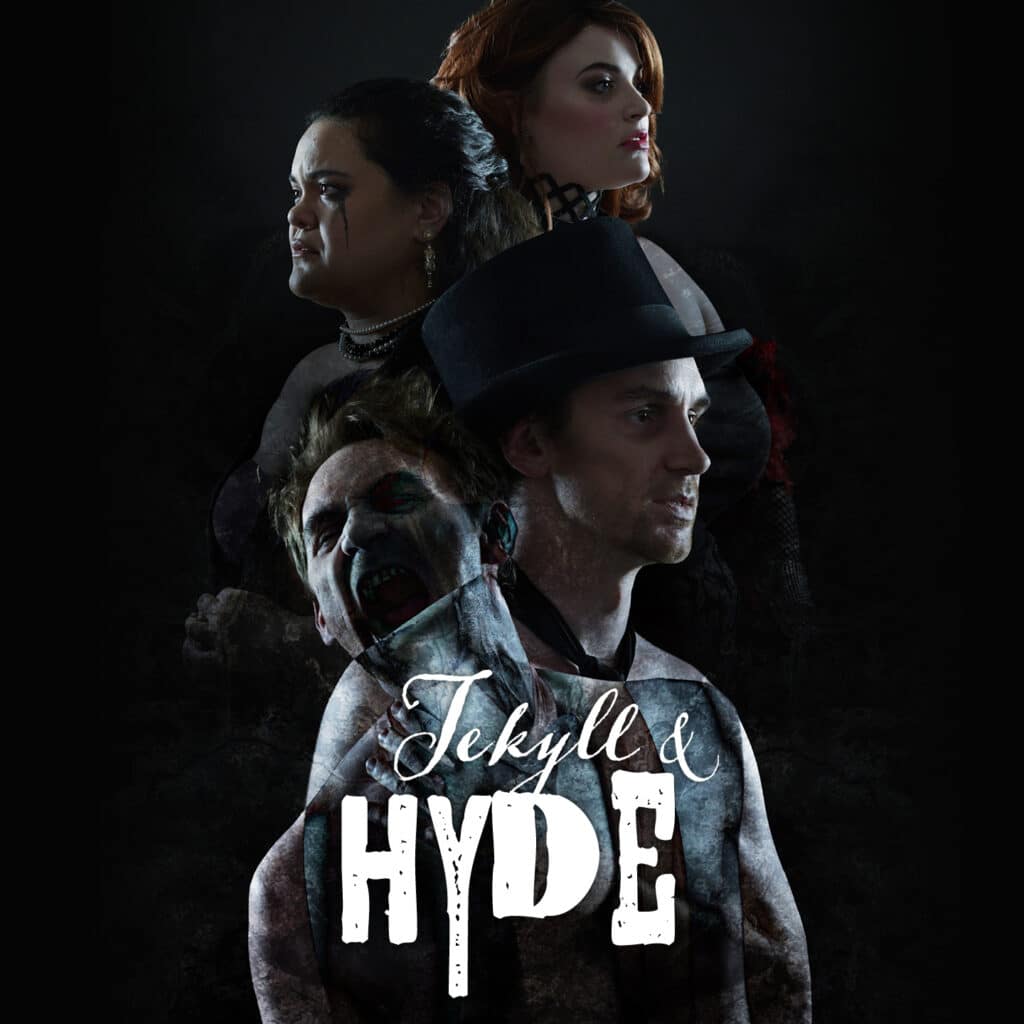
 Kokandy's JEKYLL & HYDE Extended by Popular Demand
Written by Buzz Center StageBroadway In Chicago is pleased to announce a darkly delicious Halloween surprise: Kokandy Productions’ critically acclaimed revival of JEKYLL & HYDE will be extended by popular demand through November 8. For a frightfully good group night, discounted group rates for parties of 10 or more may…
Kokandy's JEKYLL & HYDE Extended by Popular Demand
Written by Buzz Center StageBroadway In Chicago is pleased to announce a darkly delicious Halloween surprise: Kokandy Productions’ critically acclaimed revival of JEKYLL & HYDE will be extended by popular demand through November 8. For a frightfully good group night, discounted group rates for parties of 10 or more may… -
Following Obama Center premiere, Manual Cinema's acclaimed productions return to Chicago's Studebaker Theater
Written by Buzz Center StageChicago-based Emmy Award-winning performance collective and film/video production company Manual Cinema premiered two new hand-animated films at the Obama Presidential Center Museum earlier this year. Now, the company is bringing two of its acclaimed live-action productions back to Chicago's historic Studebaker Theater at the Fine…
Does your theatre company want to connect with Buzz Center Stage or would you like to reach out and say "hello"? Message us through facebook or shoot us an email at This email address is being protected from spambots. You need JavaScript enabled to view it..
*This disclaimer informs readers that the views, thoughts, and opinions expressed in the text belong solely to the author, and not necessarily to Buzz Center Stage. Buzz Center Stage is a non-profit, volunteer-based platform that enables, and encourages, staff members to post their own honest thoughts on a particular production.