
Displaying items by tag: CATCH AS CATCH CAN
Where Identity Slides: Steppenwolf’s Mesmerizing Catch as Catch Can

Mia Chung’s Catch as Catch Can, which premiered with Page 73 in New York in 2018, arrives at Steppenwolf Theatre - one of Chicago’s most dynamic and daring artistic institutions - with a production that immediately embraces the play’s slippery, shape-shifting nature. Chung’s script thrives on emotional volatility and fractured identity, and Steppenwolf’s staging taps into that energy from the outset, preparing the audience for a world where the familiar can tilt, distort, and reassemble without warning.
Catch as Catch Can begins with the familiar comfort of kitchen-table talk between two New England mothers, Roberta Lavecchia and Theresa Phelan. Under Amy Morton’s direction, those early scenes feel lived-in and deceptively ordinary - two longtime friends trading stories, worries, and family updates with the shorthand of people who have known each other for decades. But as the play unfolds, that everyday warmth becomes the launching point for a story that veers into far more disorienting territory. The return of Tim Phelan unsettles the delicate balance between the Lavecchias and the Phelans, stirring up old assumptions, unspoken resentments, and long-dormant family myths. What begins as a simple homecoming slowly reveals itself as a catalyst for emotional slippage, where memories blur, loyalties shift, and the characters’ sense of who they are - and who they have been to each other - starts to fracture. Morton guides this progression from domestic realism to psychological unraveling with remarkable control, allowing the play’s humor, tension, and creeping dread to coexist in the same breath.
The production’s boldest device - three actors portraying all six characters - becomes the heartbeat of the evening. Gary Cole (as Roberta and Robbie Lavecchia), Audrey Francis (as Lon and Daniela Lavecchia), and Tim Hopper (as Theresa Phelan and Tim Phelan) deliver performances that are nothing short of remarkable. Morton directs them with a sculptor’s precision, shaping each transformation through voice, posture, and energy rather than costume changes or props. The actors rarely add so much as an apron, a pair of glasses, or a purse to differentiate roles; instead, they rely on the smallest shifts in breath, cadence, or physical weight. Even the simplest physical actions - threading a needle, folding laundry, lifting a heavy picture onto a wall, or a mother rolling out her famous meatballs - become character markers, subtle cues that signal who is speaking without ever breaking the flow of the scene. At times, it feels as though six fully realized people are occupying the room, even though only three bodies ever stand onstage.
After the opening scene, it took me a few minutes to recalibrate to the production’s rhythm, especially as the actors began switching characters with such speed and minimal visual cues. But that adjustment period is brief. Before long, the doubling feels not only natural but essential, a kind of theatrical language the production teaches you how to read. Once you settle into its cadence, the transformations become thrilling rather than disorienting, sharpening the play’s emotional stakes and deepening its sense of unease.
The rapid-fire switching becomes its own kind of theatrical whiplash. An actor may leap from one character to another every other sentence, often without a single visual clue, and Morton ensures each pivot lands cleanly without losing an ounce of emotional clarity. The play becomes a fault line in constant motion, where identities slide, collide, and splinter beneath the surface.

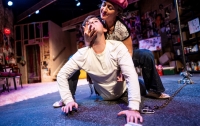
Gary Cole, Tim Hopper and Audrey Francis (L-R) in Steppenwolf Theatre's Catch As Catch Can. Photo by Michael Brosilow.
All three performers - Gary Cole, Audrey Francis, and Tim Hopper - are longtime Steppenwolf ensemble members, bringing a shared artistic vocabulary that sharpens every transformation onstage.
Cole toggles between Roberta’s brittle warmth and Robbie’s restless bravado with astonishing finesse. This production marks his first return to a Chicago stage in more than 25 years, and it is a triumphant homecoming. He is known to many for Office Space, Talladega Nights, HBO’s Veep, NCIS, and one of my favorite roles - Mike Brady in The Brady Bunch Movie and its sequel. Cole reminds audiences that his stage roots run deep. As Roberta, he carries a soft, fluttering concern that sits right behind the eyes; as Robbie, that same gaze sharpens into something quicker, hotter, and more impulsive. His ability to pivot between those energies with nothing more than a shift in breath or a recalibrated stance makes each transition feel both seamless and startling. It is a performance built on precision, but it never feels mechanical.
Francis brings an equally impressive duality to Lon and Daniela. In addition to being a Steppenwolf ensemble member, she now serves as the company’s artistic director alongside Glenn Davis, a role that underscores her influence on Chicago’s theatrical landscape. Known for standout performances in The Herd, Dance Nation, her work on Chicago Med, and directorial skill in You Will Get Sick, she grounds Lon with a quiet, blue-collar steadiness, a man who absorbs the world before reacting to it. Daniela, by contrast, is all edges and alertness, her movements tighter and her voice pitched with a nervous brightness that hints at deeper cracks. Francis masterfully switches entire gravitational centers. The clarity of her physical vocabulary makes each character instantly legible without a single costume change.
Hopper’s pairing may be the most haunting of the three. With Steppenwolf credits that include The Crucible, The Flick, and Buried Child, he brings a raw, unsettling honesty to both Theresa and Tim. His Theresa is a portrait of unraveling vulnerability, a woman whose emotional seams are beginning to split in ways she can barely articulate. His Tim, meanwhile, carries the quiet desperation of someone trying to hold himself together even as the ground shifts beneath him. Hopper plays both roles with a volatility that feels almost dangerous. The characters mirror and distort one another, creating an emotional echo that deepens the play’s sense of unease. Watching him slip between them is like watching a reflection break apart and reassemble in real time.
Together, these performances form the core of the production’s power. With Morton’s direction guiding every pivot, the trio creates the uncanny sensation that the stage is populated by twice as many people as are physically present. Their transformations are so quick and so clean that the audience must stay alert, tracking identities as they slide, collide, and reform. It is a feat of acting that is both technically dazzling and emotionally resonant, and it is the reason the play’s unstable world feels so alive.
As the story darkens - touching on mental health, racism, cultural tension, and the fragile scaffolding that holds families together - the doubling amplifies the instability. Chung threads moments of racial bias and coded language into the fabric of these families’ interactions, revealing how prejudice can hide inside the most casual exchanges and how easily it can rupture long-standing bonds. Morton understands that the play’s power lies in this slippage, and she allows the actors to push into the unsteady terrain without ever losing emotional truth. The result is a production that feels intimate yet vertiginous, a domestic drama that slowly cracks open into a haunting exploration of identity and the roles we inherit, perform, and sometimes cannot escape.

Andrew Boyce’s scenic design is a quiet marvel, giving the production a sense of dimensionality that feels both naturalistic and subtly disorienting. The main playing space is an open living room, flanked on one side by an entryway and a partial view into the kitchen, and on the other by a long hallway that suggests the deeper interior of the house. Just beyond the living room, another room is visible past a second hallway, creating the impression of a home that extends well beyond the edges of the stage. Boyce’s layout allows the audience to feel as though they’re peering into a fully lived-in environment, one with corners, thresholds, and unseen rooms that hold their own histories. Yuki Nakase Link’s lighting deepens this effect, subtly sculpting each corridor and doorway so the house seems to breathe with possibility - sometimes warm and inviting, sometimes shadowed with tension. It is a multidimensional design that grounds the play’s domestic realism while subtly reinforcing the sense that something inside this home - and inside these families - is evolving.
In their Artistic Director note, Glenn Davis and Audrey Francis frame Catch as Catch Can as a rare convergence of timing, artistry, and ensemble history - a production long delayed, now finally realized with the team that first set out to make it in 2020. They speak to the play’s uncanny pull, describing how Chung’s story has embedded itself in the company’s imagination, refusing to loosen its grip. For them, the doubling is not just a theatrical device but a test of the ensemble’s virtuosity, a chance for Steppenwolf to stretch its actors toward the edges of what performance can hold. And at the heart of their message is the idea that the play’s exploration of identity, home, and the selves we construct makes it a fitting capstone to the theatre’s 50th anniversary season - a reminder of how Steppenwolf’s long-standing commitment to family drama, artistic risk, and shared storytelling continues to shape its legacy.
Catch as Catch Can ultimately lands with the force of a quiet detonation, its emotional aftershocks lingering long after the final blackout. Morton and her trio of actors craft a world that feels both intimate and treacherous, a place where identity slips, refracts, and reforms in ways that are as unsettling as they are compelling. It is the kind of production that rewards close attention and invites conversation long after you’ve left the theatre - about family, perception, and the narratives we inherit without realizing it. Catch as Catch Can runs at Steppenwolf through July 12, with performances throughout the week, and it is very highly recommended for anyone who craves theatre that challenges, unsettles, and stays with you.
For tickets and/ or more show information, click here.
This review is proudly shared with our friends at www.TheatreInChicago.com.
Chicago City Opera Delivers a Rare Operatic Haunting with Der Vampyr
08 October 2026 in Theatre in ReviewWith Halloween creeping closer, there’s something fitting about revisiting one of opera’s earliest flirtations with macabre horror - especially in…

Avalanche Theatre stages the world premiere of They Broke Up by Skyler Tarnas November 6–22, 2026
08 October 2026 in Upcoming TheatreAvalanche Theatre announces the world premiere production of They Broke Up by Chicago playwright Skyler Tarnas, November 6–22, 2026. Opening…

Celebrate 100 Years of the Cadillac Palace and James M. Nederlander Theatres
08 October 2026 in Theatre BuzzGrab your party hats — Broadway In Chicago ’s Cadillac Palace and James M. Nederlander Theatres are turning 100! The…

Oil Lamp Theater Announces the cast and creative team for the return of IT'S A WONDERFUL LIFE: A LIVE RADIO PLAY, Nov. 20 - Dec. 27
08 October 2026 in Upcoming TheatreOil Lamp Theater is proud to announce the cast and creative team for its next production and the final production…
Adults-only holiday fun: Who's Holiday! brings R-rated Cindy-Lou Who back to Theater Wit for her sixth year, Nov. 27-Dec. 27
08 October 2026 in Upcoming TheatreChristmas Day is in our grasp. Why the vodka? Glad you asked! Who's Holiday! brings R-rated Cindy-Lou Who back to…

Two-Time Tony Award-Winning Actress Victoria Clark To Receive the Sarah Siddons Society Award at Annual Benefit on Monday, November 9, 2026
08 October 2026 in Theatre BuzzThe Sarah Siddons Society is pleased to present its 2026 Award to actress and director Victoria Clark, who recently starred…
Goodman's Dead Girl’s Quinceañera: When Fifteen Meets the Adult World
07 October 2026 in Theatre in ReviewAt fifteen, the world can feel like a television show you haven't quite figured out how to turn off. For…

Steppenwolf Theatre's ADIRONDACK CHAIR CIRCLE In Rehearsal – Playing October 22 – December 6, 2026 – World Premiere!
07 October 2026 in Upcoming TheatreSteppenwolf Theatre Company, the nation's premier ensemble theater company, is pleased to launch its 51st Season with the world premiere of…

Hell in a Handbag Productions Announces 25th Anniversary Season!
07 October 2026 in Upcoming TheatreHell in a Handbag Productions is thrilled to announce its 25th Anniversary Season, featuring three "camptacular" shows guaranteed to delight lovers of…
Chicago’s Theater Wit introduces new Watchword closed captioning system, dramatically improving access in all three of its theaters
07 October 2026 in Theatre BuzzChicago’s Theater Wit is now offering new, state-of-the-art closed captioning service, marking a dramatic improvement in making live theater more…

Paramount Theatre’s reimagined A Christmas Carol promises to be a dazzling new, all-ages spectacle for Chicago’s holiday theater season, November 11-January 3
07 October 2026 in Upcoming Theatre“God bless us, everyone,” because there’s a fresh, new, reimagined version of Charles Dickens’ classic tale A Christmas Carol debuting…
"John C. Reilly is Mister Romantic" Returns to Steppenwolf Theatre - December 10 – 13, 2026
06 October 2026 in Upcoming TheatreFollowing last year's critically acclaimed, sell-out engagement, Steppenwolf Theatre Company is pleased to announce the return of John C. Reilly…

Saint Sebastian Players Open 45th Season With A Murder Is Announced by Agatha Christie Classic Miss Marple Mystery Runs Oct. 23–Nov. 15
06 October 2026 in Upcoming TheatreThe Saint Sebastian Players open their 45th season of travels to different places with A Murder is Announced, a classic Miss Marple mystery…

Announcing "The Goodman, For Good" Campaign
06 October 2026 in Theatre BuzzToday, Goodman Theatre raises the curtain on its future as leadership and artists share a vision for its next century…

Two Edge Theater Company to stage A VIEW FROM THE BRIDGE as its inaugural Chicago production, December 4 through January 10
05 October 2026 in Upcoming TheatreTwo Edge Theater, a reincarnation of the Edge Theater Company that enjoyed eight successful seasons in the Denver, Colorado area,…
Frankenstein at Studebaker Theater adds performances for Halloween run
05 October 2026 in Upcoming TheatreChicago's historic Fine Arts Building and Studebaker Theater are thrilled to announce their Halloween co-production of Manual Cinema's acclaimed Frankenstein…

Chicago-Area World Premiere of Liana Sonenclar's The Years Between Us - October 15-18
05 October 2026 in Upcoming TheatreJonathan James Productions presents the world premiere of The Years Between Us, a new play by Liana Sonenclar, directed by…

Oil Lamp Theater Announces its 2027 Season
05 October 2026 in Upcoming TheatreOil Lamp Theater, currently presenting the highly recommended Dial M for Murder, through November 1, is proud to announce its…
Dial M for Mastery: Oil Lamp’s Thriller Tightens the Screws
04 October 2026 in Theatre in ReviewAs a lifelong Hitchcock fan, Dial M for Murder has always been one of my comfort film thrillers - the…

ARTEMISIA REVEALS PLAYWRIGHTS AND DIRECTORS FOR THE 2026 WEWOMEN PLAY FESTIVAL At Bramble Arts Loft from Nov 16 - 18th
03 October 2026 in Upcoming TheatreArtemisia Theatre is proud to announce the return of the WeWomen Play Festival, its annual celebration of new feminist work.…
Operation Mincemeat: A Smart, Scrappy Musical That Shines When Its Cast Takes the Wheel
01 October 2026 in Theatre in ReviewIn the 2019 film Yesterday, a struggling musician wakes up in a world where The Beatles never existed. A similar…
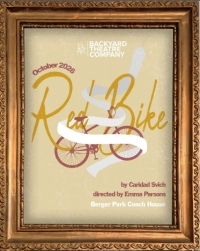
Backyard Theatre Company’s Red Bike - Berger Park Coach House Theatre - Through October 24th
30 September 2026 in Now PlayingRed Bike is an intimate, movement‑driven play that follows a young person navigating a town transforming faster than they can…

Red Theater presents the world premiere of CHURCH HURT October 24 - November 21, 2026
30 September 2026 in Upcoming TheatreRed Theater is thrilled to announce the cast and production team of the world premiere of Church Hurt by Brynne…
Ballets Jazz Montréal Makes Chicago debut at THE AUDITORIUM Saturday, November 7th
30 September 2026 in Upcoming DanceThe Auditorium (Chicago's landmark stage at 50 E. Ida B. Wells Drive) continues its 2026-27 Dance Season titled North American…

A Red Orchid Theatre Opens 34th Season with Chicago Premiere of HEROES OF THE FOURTH TURNING October 29 – December 6, 2026
29 September 2026 in Upcoming TheatreA Red Orchid Theatre is pleased open its 34th Season, exploring the theme of "world on fire," with the Chicago…
Lookingglass announces new leadership team
29 September 2026 in Theatre BuzzLookingglass Theatre Company today announced a new leadership structure that brings together four longtime members of its acclaimed ensemble and…
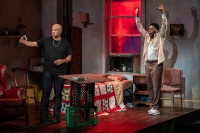
Steppenwolf’s Topdog/Underdog: When History Deals the Cards
28 September 2026 in Theatre in ReviewSusan-Lori Parks’ Topdog/Underdog, the Pulitzer Prize-winning masterpiece, is the kind of play that changes depending on when—and how many times—you…

MAMMA MIA! and HADESTOWN Return to Chicago in Spring 2027
28 September 2026 in Upcoming TheatreBroadway In Chicago is excited to announce two fan-favorite shows are returning to our stages this year: MAMMA MIA! and…

Collaboraction to premiere Mud Life, drawn from Willie Round’s experience as a writer and rapper on Chicago’s west side, October 21-November 15
27 September 2026 in Upcoming TheatreMud Life, a world premiere drama by Chicago writing duo G. Riley Mills and Willie Round, drawn from Round’s life…
'I’m Going to Marry You Tobey Maguire,' Full of Laughs, Ends With a Fizzle
25 September 2026 in Theatre in ReviewHere’s a play that should be really good, based on its reputation alone. Written by Chicago comedy writer Samantha Hurley,…





Latest Articles
-
 Avalanche Theatre stages the world premiere of They Broke Up by Skyler Tarnas November 6–22, 2026
Written by Buzz Center StageAvalanche Theatre announces the world premiere production of They Broke Up by Chicago playwright Skyler Tarnas, November 6–22, 2026. Opening November 7 at 7:30pm) at Rivendell Theatre Ensemble, 5779 Ridge Ave. They Broke Up is Avalanche's first world premiere presented…
Avalanche Theatre stages the world premiere of They Broke Up by Skyler Tarnas November 6–22, 2026
Written by Buzz Center StageAvalanche Theatre announces the world premiere production of They Broke Up by Chicago playwright Skyler Tarnas, November 6–22, 2026. Opening November 7 at 7:30pm) at Rivendell Theatre Ensemble, 5779 Ridge Ave. They Broke Up is Avalanche's first world premiere presented… -
Celebrate 100 Years of the Cadillac Palace and James M. Nederlander Theatres
Written by Buzz Center StageGrab your party hats — Broadway In Chicago ’s Cadillac Palace and James M. Nederlander Theatres are turning 100! The festivities will kick off with a birthday celebration at the Cadillac Palace Theatre (151 W. Randolph St.) on Saturday, October…
-
Oil Lamp Theater Announces the cast and creative team for the return of IT'S A WONDERFUL LIFE: A LIVE RADIO PLAY, Nov. 20 - Dec. 27
Written by Buzz Center StageOil Lamp Theater is proud to announce the cast and creative team for its next production and the final production in its 2026 season, It’s A Wonderful Life: A Live Radio Play, November 20 - December 27, adapted by Joe…
-
Adults-only holiday fun: Who's Holiday! brings R-rated Cindy-Lou Who back to Theater Wit for her sixth year, Nov. 27-Dec. 27
Written by Buzz Center StageChristmas Day is in our grasp. Why the vodka? Glad you asked! Who's Holiday! brings R-rated Cindy-Lou Who back to Theater Wit for her sixth consecutive year of adults-only holiday fun. Step inside Chicago’s #1 holiday bedazzled mobile home to…


Does your theatre company want to connect with Buzz Center Stage or would you like to reach out and say "hello"? Message us through facebook or shoot us an email at This email address is being protected from spambots. You need JavaScript enabled to view it..
*This disclaimer informs readers that the views, thoughts, and opinions expressed in the text belong solely to the author, and not necessarily to Buzz Center Stage. Buzz Center Stage is a non-profit, volunteer-based platform that enables, and encourages, staff members to post their own honest thoughts on a particular production.