
Displaying items by tag: Chicago stage
Kokandy Productions Presents SUNDAY IN THE PARK WITH GEORGE - August 13 – November 1, 2026 at The Chopin Theatre
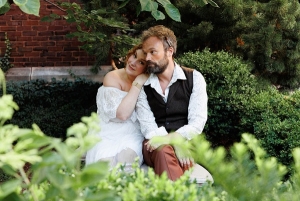
Following its critically acclaimed productions of Sweeney Todd and Into the Woods, Kokandy Productions once again celebrates the great Stephen Sondheim with a revival of his stunning masterpiece Sunday in the Park with George, playing August 13 – November 1, 2026 in the intimate Chopin Downstairs Studio, 1543 W. Division St. in Chicago. Tickets are on sale now at kokandyproductions.com or bit.ly/SundayChicago.
This beloved musical will feature Kevin Webb (Sweeney Todd, Into the Woods) as George and Missy Wise Vanderzee (Bonnie & Clyde) as Dot/Marie with an ensemble including Nick Arceo as Boatman, Danny Andrew Bennett as Jules, Rachel Carreras as Nurse, Ella Carson as Louise, Emily Holland as Celeste 1, Lauren Miller as Old Lady, Z Moore as Franz, Samantha Ringor as Celeste 2, KyraJo Petit-Walla as Frieda, Nathe Rowbotham as Yvonne, Jack Saunders as Soldier and Abraham Shaw as Louis. Swings include Brittney Brown, David Gordon-Johnson, Gabriel Levi, Brady Magruder, Halli Morgan, Sarah Seidler and Elexis Selmon.
The first Chicago storefront production Sunday in the Park with George in over 15 years is directed and choreographed by Producing Artistic Director Derek Van Barham with music direction by Nick Sul, book by James Lapine and music and lyrics by Stephen Sondheim.
About the Production
Inspired by the painting, "A Sunday Afternoon on the Island of La Grande Jatte" by Georges Seurat, Sunday in the Park with George merges past and present into beautiful, poignant truths about life, love and the creation of art. One of the most acclaimed musicals of our time, this moving study of the enigmatic painter, Georges Seurat, won a Pulitzer Prize and was nominated for an astounding ten Tony Awards, including Best Musical.
"Sunday in the Park with George was one of the first shows I pitched to direct when interviewing to join the company back in 2018," says Producing Artistic Director Derek Van Barham. "It's almost a decade later and we're finally visiting this astonishing masterpiece. It feels like the right time. The show offers us a chance to reflect on what we've been creating and to look forward at what we still hope to achieve – both as a company and as individual artists. Sunday reminds us not to linger too much on the future or the past, but to focus on the present moment, to connect with each other in real space and time. What a gift that will be. What a gift it is to be together in a room, taking in a piece of art, having communal and singular experiences at the same time."
The production team includes G "Max" Maxin IV (Scenic and Lighting Design), Rachel Sypniewski (Costume Design), Matt Reich (Sound Design), Julian Weslander (Properties Design), Syd Genco (Makeup Design), Keith Ryan (Wig and Hair Design), Stone TeSelle (Associate Scenic Design), Shane Roberie (Casting Director), Nicholas Reinhart (Production Manager), Amelia Osborn (Associate Production Manager), Kendyl Meyer (Stage Manager), Ethan Colish (Assistant Stage Manager), Michael Coppola (Stage Management Intern), Scot Kokandy (Executive Producer) and Derek Van Barham (Producing Artistic Director).
PRODUCTION DETAILS:
Title: Sunday in the Park with George
Book: James Lapine
Music & Lyrics: Stephen Sondheim
Director and Choreographer: Producing Artistic Director Derek Van Barham
Music Director: Nick Sula
Cast (in alphabetical order): Nick Arceo (Boatman), Danny Andrew Bennett (Jules), Ella Carson (Louise), Rachel Carreras (Nurse), Emily Holland (Celeste 1), Lauren Miller (Old Lady), Z Moore (Franz), KyraJo Petit-Walla (Frieda), Samantha Ringor (Celeste 2), Nathe Rowbotham (Yvonne), Jack Saunders (Soldier), Abraham Shaw (Louis), Kevin Webb (George) and Missy Wise Vanderzee (Dot/Marie).
Swings: Brittney Brown, David Gordon-Johnson, Gabriel Levi, Brady Magruder, Halli Morgan, Sarah Seidler and Elexis Selmon
Location: Chopin Downstairs Studio, 1543 W. Division St., Chicago
Dates: Previews: Thursday, August 13 – Friday, August 28, 2026
Regular run: Sunday, August 30 – Sunday, November 1, 2026
Curtain Times: Thursdays, Fridays and Saturdays at 7 pm; Sundays at 5 pm.
Tickets: Previews $28.52* general admission, $39.19* reserved seating. Regular run $55.20* general admission, $65.87* reserved seating. Students/seniors $44.52*. There will be a limited number of lower-priced tickets (with code ARTIST) available to artists for each performance. Tickets are on sale now at kokandyproductions.com or bit.ly/SundayChicago. *Ticket prices include processing fees
Sunday in the Park with George is presented through
special arrangement with Music Theatre International (MTI).
About the Artists
Derek Van Barham (Director and Choreographer) is the Producing Artistic Director of Kokandy Productions. Directing credits include Children of Eden in Concert (Broadway In Chicago), Jekyll & Hyde (BIC/Kokandy), Amélie, Into the Woods, Alice by Heart, Sweeney Todd, American Psycho, Head Over Heels (4 Jeff Awards and 3 Jeff nominations, Kokandy); Spring Awakening (Flint Rep); Rock of Ages (Metropolis); The View Upstairs (Circle Theatre); Miracle by Dan Savage, Poseidon (Hell in a Handbag) Natasha Pierre and the Great Comet of 1812, Carrie, Bat Boy, Merrily We Roll Along (CCPA/Roosevelt University). Choreography credits include Evil Dead (Jeff nomination), Coraline the Musical, Ghost Quartet and Shockheaded Peter (Black Button Eyes). He was previously named one of Windy City Times' 30 Under 30, and one of Newcity Magazine's 50 Players 2024 and 2026. MFA: CCPA/Roosevelt University. IG: @dvbarham
Nick Sula (Music Director) is an award-winning pianist and music director, proud to return to Kokandy Productions and the Chopin Theatre where he served as music director for the Jeff Award-winning productions of Jekyll & Hyde (Jeff Award for Outstanding Music Direction), Sweeney Todd (Jeff Award for Outstanding Music Direction), Into the Woods (Jeff Awards for Outstanding Music Direction and Orchestrations) and the Chicago Musical Theatre Festival. Other Chicago theatre music direction credits include: Octet (Raven Theatre); Anything Goes (Porchlight Music Theatre); Ghost Quartet (Black Button Eyes Productions). As a professor of musical theatre he serves as a music director, instructor and vocal coach at the Chicago College of Performing Arts at Roosevelt University.
About Kokandy Productions
Founded in 2010, Kokandy Productions seeks to leverage the heightened reality of musical theatre to tell complex and challenging stories, with a focus on contributing to the development of Chicago-based musical theatre artists, and raising the profile of Chicago's non-Equity musical theatre community.
The company's artistic staff is comprised of Derek Van Barham (Producing Artistic Director), Scot Kokandy (Executive Producer) and Adrian Abel Azevedo & Leda Hoffman (Artistic Associates). The Board of Directors includes Preston Cropp, Scot T. Kokandy, Danielle Sparklin and Katie Svaicer.
For additional information, visit kokandyproductions.com.
OPERATION MINCEMEAT: A NEW MUSICAL coming to CIBC Theatre September 29 – October 11
Broadway In Chicago is thrilled to announce that single tickets for Tony® and Olivier Award®-winning OPERATION MINCEMEAT: A NEW MUSICAL, Entertainment Weekly’s #1 Broadway Show of 2025, are now on sale. OPERATION MINCEMEAT: A NEW MUSICAL will play Broadway In Chicago’s CIBC Theatre (18 W. Monroe St.) for a limited two-week engagement, September 29 – October 11, on its North American leg of its World Tour.
In OPERATION MINCEMEAT: A NEW MUSICAL, it’s 1943, and the Allied Forces are on the ropes. Luckily, they’ve got a trick up their sleeve. Well, not up their sleeve, per se, but rather inside the pocket of a stolen corpse. Equal parts farce, thriller, and Ian Fleming-style spy caper (with an assist from Mr. Fleming himself), OPERATION MINCEMEAT tells the wildly improbable and hilarious true story of the covert operation that turned the tide of WWII.
Written by triple Tony Award nominees SpitLip (comprised of David Cumming, Felix Hagan, Natasha Hodgson, and Zoë Roberts), OPERATION MINCEMEAT began performances on Broadway on February 15, 2025, and continues to play at the historic Golden Theatre (252 West 45th Street), where it has been extended eight times and will soon celebrate its 500th performance. The West End production, which has been playing at the Fortune Theatre since March 29, 2023, is widely recognized as one of the best-reviewed shows in West End history, holding the record for the most five-star reviews for a new musical, with a tally of 131. OPERATION MINCEMEAT has just launched its world tour, beginning with a UK leg before heading across the pond.
Olivier Award nominated Robert Hastie (Standing at the Sky’s Edge, National Theatre – Best New Musical Olivier Award winner) will reprise his work for the tour, while Olivier Award nominated Jenny Arnold (Jerry Springer: The Opera, National Theatre) continues as Choreographer. The creative team will include Olivier nominated Set and Costume Designer Ben Stones (Standing at the Sky’s Edge), Tony and Olivier winning Lighting Designer Mark Henderson (The History Boys), Tony nominated Sound Designer Mike Walker (Charlie & The Chocolate Factory), Tony nominated Orchestrator Steve Sidwell (Beautiful: The Carole King Musical), and Olivier nominated Music Supervisor Joe Bunker (Spring Awakening). Georgie Staight is Associate Director and Paul Isaiah Isles is Associate Choreographer. Production Stage Management is by Geoff Maus, Casting is by Carrie Gardner, CSA, and General Management is by TT Partners.
OPERATION MINCEMEAT has been nominated for 64 awards since opening at the 77-seat New Diorama Theatre in 2019, winning 13, including Best Musical three times, from the Olivier Awards®, WhatsOnStage Awards, and Off-West End Awards. On Broadway, the show was nominated for four Tony Awards® in 2025, including Best Musical. The production won Best Featured Actor in a Musical for Jak Malone ’s portrayal of Hester Leggatt, who previously won the Olivier Award® in the same category. The production has also received nominations for Outstanding Production of a Musical at the Drama League Awards, Outstanding New Broadway Musical at the Outer Critics Circle Awards, Best Musical at the BroadwayWorld Theater Fans’ Choice Awards, and Favorite New Musical at the Broadway.com Audience Choice Awards.
Over 2,000 performances – from its origins on the London Fringe to the West End, to Broadway, OPERATION MINCEMEAT has cultivated a fervent fanbase, affectionately dubbed “Mincefluencers.” On Broadway alone, more than 2,000 audience members – roughly one in fifty – have bought tickets for multiple performances, including 53 superfans who have purchased tickets for ten or more shows.
OPERATION MINCEMEAT is produced on Broadway, in the West End and on its world tour by Avalon (in association with SpitLip). The show was commissioned by New Diorama Theatre, co-commissioned by The Lowry, and also supported by the Rhinebeck Writers Retreat.
For more information, visit operationmincemeat.com/tour/us
Follow OPERATION MINCEMEAT on TikTok, X, and Instagram.
TICKET INFORMATION (As of July 17, based on availability and subject to change)
Individual tickets for OPERATION MINCEMEAT: A NEW MUSICAL are on sale now and range from $40.00 - $135.00 with a select number of premium tickets available. Ticket price listed is when purchased in person at the box office. Additional fees apply for online purchases. Tickets are available now for groups of 10 or more by calling Broadway In Chicago Group Sales at (312) 977-1710 or emailing This email address is being protected from spambots. You need JavaScript enabled to view it.. For more information, visit www.BroadwayInChicago.com.
ABOUT BROADWAY IN CHICAGO
Broadway In Chicago was created in July 2000 and over the past 26 years has grown to be one of the largest commercial touring homes in the country. A Nederlander Presentation, Broadway In Chicago lights up the Chicago Theater District entertaining up to 1.7 million people annually in five theatres. Broadway In Chicago presents a full range of entertainment, including musicals and plays, on the stages of five of the finest theatres in Chicago’s Loop including the Cadillac Palace Theatre, CIBC Theatre, James M. Nederlander Theatre, The Auditorium, and just off the Magnificent Mile, the Broadway Playhouse at Water Tower Place.
For more information and tickets, visit www.BroadwayInChicago.com.
Follow @BroadwayInChicago on
Facebook ● Instagram ● TikTok ● Bluesky ● YouTube
#broadwayinchicago
Hell in a Handbag Productions Presents JOAN CRAWFORD GOES TO HELL
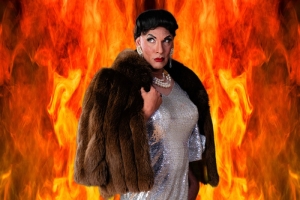
Hell in a Handbag Productions, now celebrating its 25th year, is pleased to present a revival of the fan favorite Joan Crawford Goes To Hell, written by Artistic Director David Cerda* and directed by Cheryl Snodgrass, playing August 21 – September 27, 2026 at The Clutch, Handbag's boutique performance space at 4335 N. Western Ave. in Chicago. Tickets are currently on sale at handbagproductions.org and buytickets.at/hellinahandbagproductions/2276662.
The cast includes ensemble members David Cerda*, Lori Lee*, TJ O'Brien* and Michael Rashid* with Tyler Calhoun, Nick Dorado, Jennifer Engstrom, Haley Gillman, Gretchen Greear, Nicholas Ian, Ryan Kenny and Coco Sho-Nell.
About the Production:
Originally produced in 1999 with Sweetback Productions, Joan Crawford Goes To Hell is a roller coaster ride that explores the life of the legendary Hollywood star.
The premise? Joan Crawford (David Cerda*) dies, goes to hell and is forced to view her life through the eyes of her daughter, Christina (TJ O'Brien*) in a tale so big it needs three Joans! Part Mommie Dearest, part biography with a dash of Joan's lifestyle book, My Way of Life, Joan Crawford Goes to Hell is the perfect summer cocktail for those with a taste for camp.
The production team includes Marcus Klein* (Scenic Design), Ben Kress (Costume Designer), Liz Cooper (Lighting Design), Danny Rockett (Sound Design), Maggie O'Brien (Prop Design), DJ Douglass (Video & Projection Design), Syd Genco** (Makeup Design), Keith Ryan* (Wig Design), Matt Tenny (Fight & Intimacy Coordinator), Carol Kelleher (Production Manager), Jason Pikscher (Technical Director), Francis Brenner (Stage Manager), Rick Aguilar* (Photography) and Michael S. Miller* (Graphics).
*Denotes Handbag Ensemble Member | **Denotes Handbag Associate Member
PRODUCTION DETAILS:
Title: Joan Crawford Goes To Hell
Playwright: Artistic Director David Cerda*
Director: Cheryl Snodgrass
Cast (in alphabetical order): Tyler Calhoun (Various/Carol Ann u/s), David Cerda* (Joan #1), Nick Dorado (Mr. Deville/Various), Jennifer Engstrom (Celluloid Joan), Haley Gillman (Child Christina/Various), Gretchen Greear (Joan #2), Nicholas Ian (Various/Joan #2 & 3 u/s), Ryan Kenny (Carol Ann/Various), Lori Lee* (Helga/Various), TJ O'Brien* (Teen/Adult Christina), Michael Rashid* (Greg/Various) and Coco Sho-Nell (Joan #3).
Location: The Clutch, 4335 N. Western Ave., Chicago
Previews: Friday, August 21 at 7:30 pm, Saturday, August 22 at 7:30 pm, Sunday, August 23 at 3 pm and Thursday, August 27 at 7:30 pm.
Opening/Press performance: Friday, August 28 at 7:30 pm
Regular run: Saturday, August 29 – Sunday, September 27, 2026.
Curtain Times: Fridays and Saturday at 7:30 pm; Sundays at 3 pm and 7 pm. Please note: There will be an added Industry Night performance on Monday, September 14 at 7:30 pm.
Tickets: $29* previews, $40 VIP previews*, $39* advanced general admission, $52* VIP/reserved seating. Group rates $35* for 10 or more. VIP tickets include a refreshment and reserved premium seating. Tickets are currently on sale at handbagproductions.org and https://buytickets.at/hellinahandbagproductions/2276662. *Ticket prices include processing fees.
About the Artists
David Cerda (Playwright) is a founding member and Artistic Director of Hell in a Handbag Productions, now celebrating its 25th anniversary. As resident playwright, he has written many Handbag productions as well as acted in them. His play, The Drag Seed was produced at LaMaMa Experimental Theater and his Golden Girls Lost Episodes parody shows have been produced around the country and featured in Golden Con: Thank you for being a Fan, the world's first fan convention dedicated to all things Golden Girls at Chicago's Navy Pier. Cerda is a proud inductee into the Chicago LGBT Hall of Fame and recipient of a Jeff Award for lifetime achievement for his body of work and service to the community. He lives in Chicago with his partner, Christopher and Walter the Wonder Dog..
Cheryl Snodgrass (Director) is an alumnus ensemble member of HIAH and is back to direct her 11th production at her artistic home. She directed Die Mommie! Die!, Haywire, Rip Nelson's Halloween Spooktacular, SCARRIE: The Musical, L'Imitation of Life, The Birds, The Drag Seed (at Mary's Attic, Chopin Theatre and LaMama in NYC), A Fine Feathered Murder and Scary Town. She's worked extensively as a visiting artist at Mill Mountain Theatre, Studio Roanoke and Hollins University (Roanoke, VA). Cheryl has directed for Sweetback, Glass Apple, Trap Door, The Foundlings, Tellin' Tales, Jonny Staxx Presents, Filet of Solo and Larkspur Productions. Most recently, Cheryl directed the pre-publishing premier of John Cariani's new play Darker the Night Brighter the Stars at the Penobscot Theatre Company in Bangor, ME and the world premiere of The Posthumous Trial of Giulia Tofana at The Den. Next up, Cheryl will be returning to Penobscot Theatre Company to direct The Book Club.
About Hell in a Handbag Productions
Hell in a Handbag is dedicated to the preservation, exploration, and celebration of works ingrained in the realm of popular culture via theatrical productions through parody, music and homage. Handbag is a 501(c)(3) Not for Profit. For additional information, visit handbagproductions.org.
Kokandy’s HAIR Revival Finds a Modern Footing
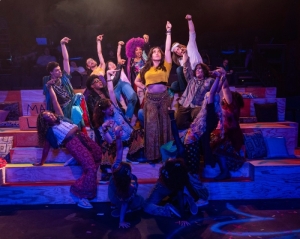
Kokandy Productions’ HAIR revival lets the sunshine in this summer at the Chopin Theatre. Directed and choreographed by Brennan Urbi, this remount is a fresh, funky and poignant riff on the classic 1960s tribal love-rock musical by Galt MacDermot. The large cast of new and returning Kokandy faces bring this musical out of its time capsule and into the 21st century with incredible vocals and unwieldy energy. In short, this cast is having a blast and so will you.
HAIR is one of the rare musicals whose songs actually crossed over into mainstream pop/rock. Perhaps most notably by way of The 5th Dimension’s iconic medley of ‘Aquarius’ and ‘Let the Sunshine In’ from 1969. However, one doesn’t have to look far to find songs like ‘Good Morning, Starshine’ and the title track ‘Hair’ used throughout pop culture. Re: Simpsons did it. Most people who have never seen HAIR the stage musical, or its film adaptation are at least somewhat familiar with its refraining choruses.
That said, by now HAIR has been lampooned as a shallow hippie fever dream known for simulated pot smoking and full-frontal nudity. Some elements of the musical might support the stereotype, but Urbi digs deeper into the lyrics and book by Gerome Rangi and James Rado and creates a much more cohesive and contemporary production than even the renowned 2009 Broadway revival.
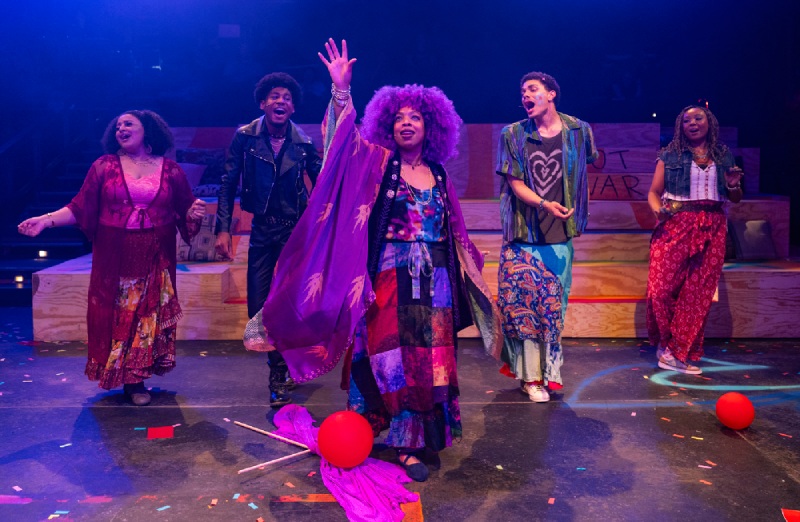
(left to right) Diana Marilyn Alvarez, Joshua Emmanuel, Chosen Mitchell, Kijani Xand Caitlin Dobbins in Kokandy Productions’ revival of HAIR. Photo by Michael Brosilow.
While HAIR might lack an immediate plotline, it instead spends the first third of the show exploring the themes of the 1960s counterculture through conceptual songs that don’t quite further the action but are incredibly catchy. Claude, Berger and Sheila emerge as the show’s main protagonists, which is where things get more interesting.
Berger is the tribe’s ringleader, a young sexually charged dropout played by Zac Richey. His main concern is certainly the “free love” element of hippy culture and not much else. Claude serves as the show’s moral compass–another dropout who questions the ethics of dodging the draft and whether hippie culture is as altruistic as it claims. Sheila, played by Catherine Rodriguez O’Connor, is an activist caught between the two male leads. Her voice is showstopping throughout, especially during the arresting finale.
Style is an essential component of HAIR. While it’s impossible to stray far from the 1960s given its direct references to the Vietnam War, costume designer Rachel Sypniewski and lighting designer G “Max” Maxin IV, bring a certain modern rave aesthetic to Kokandy’s production. Those who choose to sit on scenic designer Eleanor Kahn’s conversation pit-flavored set will be richly rewarded by all the trippy lights and wild action happening around them.
HAIR is a largely ensemble-driven show and they’re doing their job well here. The character Dionne begins the show with a stirring version of ‘Aquarius’ impeccably sung by Chosen Mitchell. Honestly, any production of HAIR is only as good as its Dionne. You won’t be able to take your eyes off Mitchell whose vocal gymnastics throughout the show will make the hair on your arms stand up. Styled perfectly against the club lighting, Mitchell proves to be the show’s hidden gem. It’s a hard bar to clear as this ensemble is giving some of the tightest harmonies Kokandy has ever produced.
This revival of HAIR is one for the Chicago books. It captures the spirit of the 1960s, but with the frustrations of 2026 youth culture it begs the question, how on Earth are we still singing about more or less the same societal ills?
Through September 13 at Kokandy Productions at the Chopin Theatre. 1543 W Division St. 773-278-1500
Pure Vocal Magic: Goodman’s Octet Redefines Musical Innovation
Dave Malloy’s Octet is a musical with daring aspirations, currently gracing the stage in a powerhouse co-production between the Raven Theatre and the Goodman Theatre. This staging, directed by Keira Fromm, first debuted at the intimate Raven Theatre, where it enjoyed a highly successful run before its move to the Goodman - a transition that proves the project is as robust as it is ambitious. Octet stands apart as a completely a cappella experience, relying entirely on the human voice to build its intricate, immersive, and haunting soundscape.
Malloy’s imprint is everywhere in this piece. He wrote the music, lyrics, book, and even the intricate vocal arrangements, crafting a score constructed without a single instrument to generate its tension, beauty, and emotional architecture.
Set in a sparse, church-basement style meeting room, the play introduces us to the “Friends of Saul,” a support group for people struggling with internet addiction. Their relationship to the online world is so fraught that they refuse to say its name, calling it only “the monster” to avoid giving it more power. Throughout their time together, the eight participants take turns sharing fears of being canceled, pornography, gaming, the pull of incel communities, and the inability to connect with others. Their discussions are brutally honest, darkly comedic, laced with expletives, and at one point offer an especially disturbing illustration of just how grotesque the monster can be. It’s unlike anything before.
The show threads each character’s intimate, emotionally charged account into sweeping ensemble passages that rise like contemporary hymns, the group joining voices to confront and grieve the “monster” that binds them. The interplay creates a pulse that feels communal and ritualistic, as though every personal admission is carried forward and reshaped by the collective.
The performances are nothing short of a whirlwind. The talent onstage is beyond belief. The ensemble showcases astonishing vocal mastery, blending with precision to create rich, enveloping music.
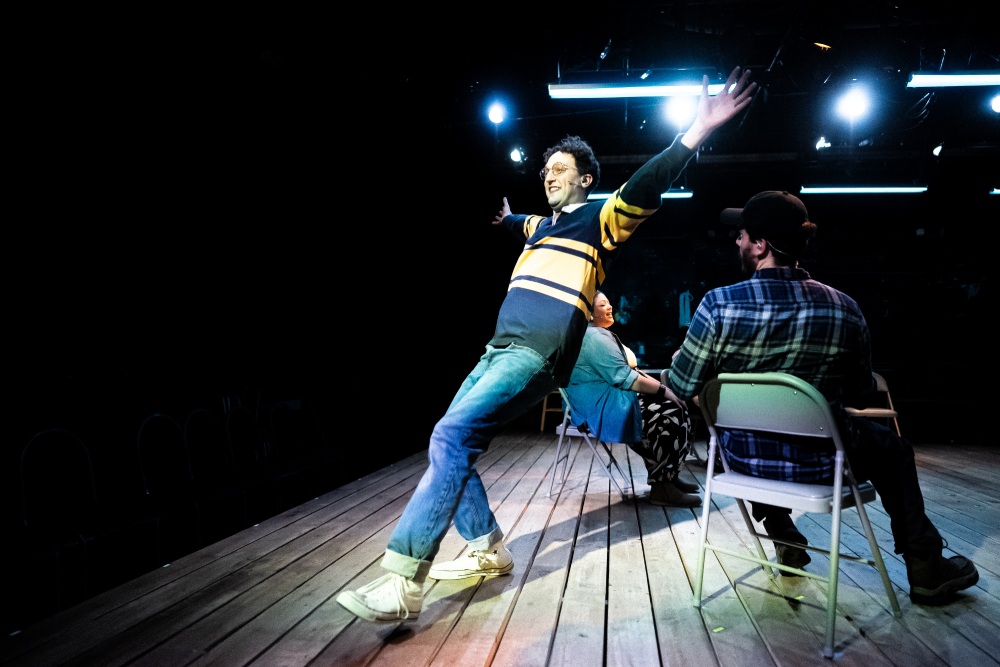
Sam Shankman in Dave Malloy's Octet at Goodman THeatre in collaboration with Raven Theatre. Photo by Joe Mazza.
Neala Barron, as Jessica, is phenomenal with powerhouse vocals and a dynamic stage presence. Her rendition of “Refresh” is delivered with the intensity of a tiger trapped in a cage, perfectly capturing the visceral feeling of being humiliated online and the subsequent rage against the world. Along with dramatic chops, she makes her comedic lines sizzle.
Sam Shankman plays the comedy perfectly as Henry. His portrayal of a tone-deaf, slightly dorky addict is both identifiable and deeply empathetic. His song “Candy” is a standout that demonstrates how this ensemble can craft story using only a cappella sound and how their movement reinforces the narrative.
Teressa La Gamba, as Paula, the group’s moderator, brings a gentle strength and compassion that helps root the show. But when she sings, it feels as if the roof will fly off. She commands the stage with perfect vocal precision, whether in a solo or complex ensemble passages.
The set is intentionally sparse and open, which functions perfectly for the show’s focused format, a choice scenic designer Milo Bue shapes with thoughtful restraint. The lighting design, crafted by Maximo Grano de Oro, is similarly impressive. Overhead lights shift deftly from the feel of a bland meeting room to the vibrant, chaotic interior of a Candy Crush interface or the dark corners of a character’s mind. In an instant, you can be transported to an entirely different plane and lost in its overwhelming atmosphere.
As the plot unravels, the staging seems intent on exploring where hope can or cannot be found, and it makes clear that faith-based religion is not where it looks. The script often approaches Christian belief with a skeptical edge, sketching certain “believer” archetypes in broad, unflattering strokes. The structure of “Friends of Saul” reinforces this orientation, lightly echoing the format of Alcoholics Anonymous. AA, one of the most widely recognized recovery communities, is often described as spiritual in nature, while many participants experience it as rooted in a faith-guided model, as it was originally intended. “Friends of Saul,” by contrast, operates with a more nonreligious bent, occasionally running out of pamphlets for “Steps for Agnostics and Atheists,” a detail made all the more ironic given that their meetings take place in a church basement - a space that pointedly distances itself from the faith‑oriented tradition AA is often associated with.
That contrast deepens in “Little God,” one of the staging’s more unusual songs. Here, Marvin (Jordan Golding), a committed atheist, describes an encounter with an all-powerful being represented onstage by a small girl and reflects on his compulsion to debate creationists about evolution. The moment is very much Malloy’s choice, framing Marvin’s fixation as a kind of intellectual loop: the irresistible pull of trying to reason through the idea that something as vast as existence might emerge from nothing at all, a purposeful artistic angle that shapes the show’s worldview.
Given these choices, the staging’s perspective may not resonate as strongly with audiences who hold traditional Christian views, which seems intentional, reflecting a deliberate direction in Malloy’s overall vision. In contrast, the show places greater emphasis on new age spirituality and tarot, treating these elements with notable sincerity. Each character has direct parallels to tarot cards, and Velma (Joryhebel Ginorio) finds her spiritual awakening through them. In fact, she is the only member of the group who speaks the monster’s true name, “internet,” throughout the night. Ultimately, the musical suggests that a blend of new age spirituality and human connection is the most viable path to inner peace.
Although these elements may pose challenges for certain audiences, Octet remains a triumph of vocal performance. These actors represent the highest caliber of Chicago talent, and when their voices come together, the result is breathtaking and inspiring. If you are looking for choral artistry, Octet delivers. For some audiences, Octet’s philosophical stance may feel more contemplative than corrective, raising more questions than answers about our relationship to the online world - but its musical brilliance makes the journey more than worthwhile.
Recommended.
Venue: The Goodman Theatre – The Owen 170 N. Dearborn Street, Chicago
Run Dates: Through August 2
Performance Schedule:
- Wednesdays: 7:30 p.m.
- Thursdays: 2:00 p.m. & 7:30 p.m. (No evening performance on July 30)
- Fridays: 7:30 p.m.
- Saturdays: 1:00 p.m. & 7:30 p.m.
- Sundays: 2:00 p.m. (Additional 7:30 p.m. performance on August 2)
Running Time: 1 hour, 35 minutes (no intermission)
Box Office: 312-443-3800
Tickets: https://www.goodmantheatre.org
Nothing Without a Company presents The Trouble With My Hair: Coloring, Cutting, and Coming into Who I Am - Five Performances across Chicago, August 21st-30th
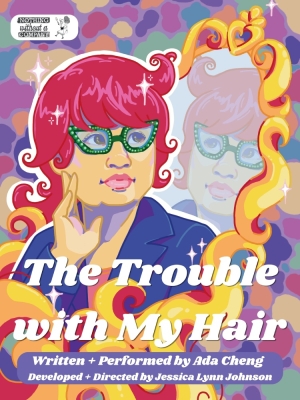
Nothing Without a Company (NWaC) is proud to announce five performances of The Trouble With My Hair: Coloring, Cutting, and Coming into Who I Am. This is a solo performance, written and performed by award-winning storyteller Ada Cheng, which intimately explores gender, sexual identity, and boundary-making through her evolving relationship with her hairstylist and her hair. The production will have five performances across Chicago. Friday August 21st, 7:30 PM at Scissor & Fork, 3968 North Elston Ave. Saturday August 22nd, 7:30 PM at Visceral Adventure Lounge, 3638 W Grand Ave. Sunday August 23rd, 7:30 PM at REM Salon, 3035 W Fullerton Ave. Saturday August 29th, 7:30 PM at Haibayo, 1132 W Argyle St. Sunday August 30th, 1:00 PM at The Center on Halsted, 3656 N Halsted St. Each performance will be followed by a Q&A discussion. August 30th performance will end with a reaction piece by Stir Friday Night, along with a reception catered by Krung Thep Thai Cuisine, 3205 N Halsted St, Tickets range from $15.00 - $50.00 and are available at NothingWithoutaCompany.org.
This production is supported by Crossroads Fund.
NWaC is accepting submissions for Chicago-based Guest Artists through July 19, 2026.
History of The Trouble With My Hair: Coloring, Cutting, and Coming into Who I Am.
The performance is developed with and directed by Jessica Lynn Johnson, an award-winning director and solo show development expert known for shaping compelling, authentic solo works. "Ada is a brilliant and gifted storyteller. Gentle, perfectly paced and warmly welcoming in her sweetly sarcastic way. The writing is magical. Evocative, sensual and human." -Samantha Simmonds-Ronceros of NoHo Arts District. Ada has performed The Trouble With My Hair nation-wide, including the Asheville Fringe Art Festival, was an official selection of the Soaring Solo Studios Stars Series 2025, and she continues to have more shows throughout the year in and out of the country.
Synopsis:
The Trouble With My Hair: Coloring, Cutting, and Coming into Who I Am, is an intimate exploration of gender, sexual identity, and boundary-making through Ada's evolving relationship with her hairstylist and her hair. Blending narrative art and theatrical storytelling, Ada Cheng playfully brings her audience on a journey of self-discovery and self-love through her struggles with hair. From early memories of negotiating belonging to courageous acts of boundary-making in adulthood, Cheng uses her changing hairstyles and haircolors as milestones marking her path toward self-definition. Each cut, color, and conversation becomes a metaphor for reclaiming voice and visibility in a world eager to define her first.
"Hair is never just hair, It holds our histories, our rebellions, our identities, our desires to belong, and our declarations of independence. This show is about coming home to oneself and learning to love the person underneath it all." - Ada Cheng
Writer and Performer Bio
Dr. Ada Cheng is an award-winning storyteller, solo performer, and producer. Committed to amplifying and uplifting marginalized voices, she has created numerous storytelling platforms for BIPOC and LGBTQIA community members to tell difficult and vulnerable stories. She has consistently engaged in public education and public outreach through the use of storytelling and performance arts. Since 2016, she has toured her solo performances Not Quite and Loving Across Borders nationwide, presenting at universities, theaters, and conferences. She premiered her third solo performance, The Trouble with My Hair, in Los Angeles in October 2025 as part of Soaring Solo Studios' Stars Series. She has been a speaker with the Illinois Humanities Road Scholars Speakers Bureau since 2019. Dr. Cheng was named the 2023–24 Lund-Gill Endowed Chair at Dominican University and was a recipient of the 2024 Public Humanities Award from Illinois Humanities.
Artistic Director's Note
Hannah Ii-Epstein "My relationship to my hair is personal. I come from mixed lineages, and it has always felt like hair-itage, something that carries different parts of me at once. It holds memories of family, culture, identity, and how I have grown into myself over time. What I appreciate about Ada Cheng's work is how honest it is, and how it leaves room for people to recognize themselves.
We are bringing the performance into five hair salons and gathering places because I want people who might not usually see theatre to be able to walk into it easily, and to leave room for conversation in each neighborhood. This is Ada's personal story, but I also see it reflecting experiences shared across the area. It feels rooted in places where those stories already live. I also wanted each of these gatherings to feel like a conversation, so NWaC has invited artists whose work sits with memory and lived experience to be part of it. For the closing performance, we're really glad to be in conversation with Stir Friday Night, the longest running AAPI improv team in Chicago."
Nothing Without a Company has also updated their mission & vision statements.
New Mission: "Nothing Without a Company (NWaC) utilizes theatre and film to amplify culturally inclusive stories by immersing audiences in site-specific environments."
New Vision: "To create a safe space where everyone feels welcome, highlighting authentic stories about LGBTQIA+, Women, Trans and Gender Nonbinary/GNC, AANHPI and BIPOC communities."
Website: www.nothingwithoutacompany.org
Facebook: www.facebook.com/NothingWithoutACompanyChicago
Instagram: www.instagram.com/nothingwithoutacompany
A People: A Sweeping, Soul‑Stirring Journey That Celebrates Jewish Identity
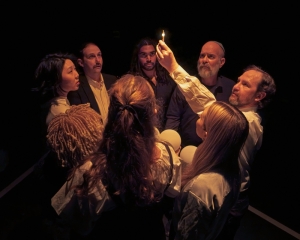
An extraordinary eight-person ensemble fuels the sweeping storytelling of A People - a production presented collaboratively by Arts Judaica and YI Love Jewish - shifting through nearly 80 characters across generations and geographies. Though only one cast member is Jewish, playwright LM Feldman intentionally assembled a diverse ensemble to reflect the many ways Jewish identity manifests - across culture, theology, race, queerness, and lived experience - underscoring that there is no single way to be part of a people.
The performance thrives on the versatility of this cast, featuring standout contributions from Douglas Levin, who provides an authentic and anchoring sincerity, and Charity Schultz, who illuminates her roles with magnetic charm. Daniel Boughton moves with ease between sharp humor and striking emotional depth, and Jin Ai anchors the production’s stillest moments with a quiet power, enriched by her beautifully integrated guitar work. Zach Kunde cuts through the space with sharp intellect and a commanding vocal presence, while Haley Schenk turns a single, piercing glance into some of the production’s most potent dramatic beats, and she even threads in flute playing that adds a surprising, delicate texture. The momentum never falters thanks to Xavier Mattison’s vibrant energy and tenderness, while Freya Churchwell rounds out the ensemble with impressive, wide‑ranging versatility and delivers some of the play’s genuine laugh‑out‑loud exchanges. Together, they weave a unified and deeply affecting tapestry of human survival.
This remarkable stage chemistry is guided by director Avi Hoffman, an acclaimed figure in global Jewish theater who recently directed and starred in a historic Yiddish production of Death of a Salesman in Bucharest, Romania. Having previously earned a Drama Desk nomination for playing Willy Loman in New York, Hoffman injects this local production with masterful artistic insight. Under his careful guidance, the non-linear, fragmented script by L. M. Feldman avoids confusion, gaining immense clarity and striking a perfect balance between epic historical weight and intimate human connection.
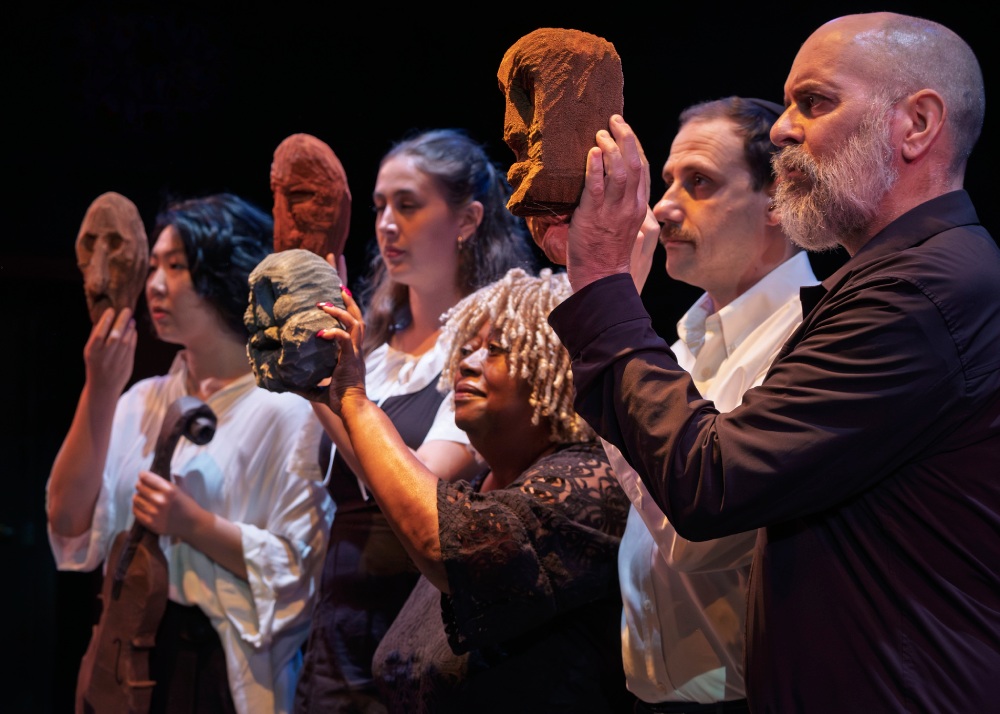
L-R: Jin Ai, Charity Schultz, Freya Churchwell, Zach Kunde, Douglas Levin. Photos by Logan and Candice Conner, Oonphotography.
Starting with the diaspora of the Jewish people that have become scattered throughout the world, the production explores several expressions of Judaism while ultimately reinforcing the idea that, despite their differences, they remain one people - and a remarkable people at that. It touches on beautiful threads of Jewish history, including the teaching that Moses received not only the written Torah referred to as “The Hand” at Mount Sinai but also the Oral Torah referred to as “The Tongue,” which was an interesting fact that I did not ever learn about the Torah in Hebrew school. I was also unaware of another phenomenon that members of the Jewish community called “tonals” actually memorized whole portions of the Torah to recite and sing so that the Torah portion could be performed for groups of students/scholars etc., to discuss and watch. The important thing that came out of this discussion of the Torah and the essential thing that makes Judaism different from other religions is that Jews learned and passed on the teachings of the Torah and the Talmud for the purpose of discussing them and learning from them and interpreting them and re-interpreting them -so as not to force them down anyone’s throat to be followed with blind faith.
As a Jew, I appreciated how the piece pokes gentle fun at our tradition of spirited debate - a trait that can be both energizing and, at times, hilariously counterproductive.
They are so intelligent at debating with each other that sometimes they nitpick each other to the end of a discussion that could otherwise forward the family or community or couple in a more positive way.
One of the production’s most profound scenes comes when a character asks a 90‑year‑old what history lives in the wrinkles of their face - how an entire lifetime, nearly a century of memory, can be held within one fragile human body. Another moment that stayed with me was the gentle but urgent insistence that nurturing future generations is vital to the continuity of the Jewish people.
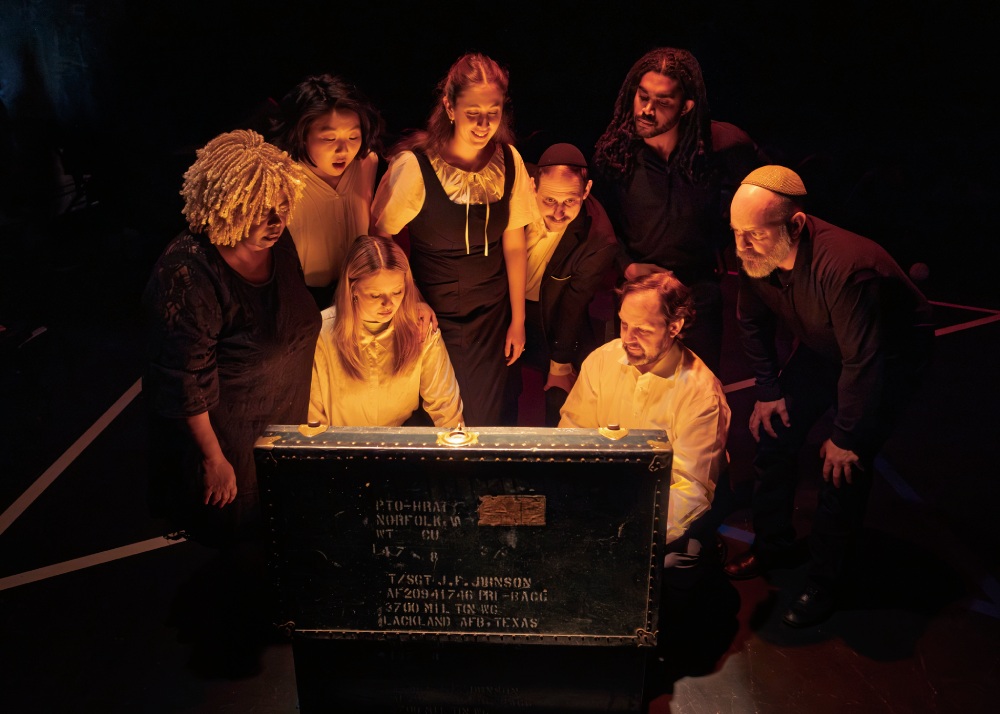
Back row L-R: Freya Churchwell, Jin Ai, Charity Schultz, Xavier Mattison, Zach Kunde, Douglas Levin. Front L-R: Haley Schenk, Daniel Boughton.
The differences among them are many, yet a shared thread still binds them together. One character argues passionately for a two‑state solution, while another hopes her girlfriend will one day be fully embraced by her community. A rabbi even confronts a group of Jewish Christmas carolers, shouting, ‘Why are you doing this?’ as the story considers how and why some Jews celebrate Christmas - a reflection of how the holiday’s overwhelming cultural presence in America can blur the line between religious observance and simple seasonal participation. And still, beneath all these disagreements and divergences, the play returns to the same essential truth: that despite their varied beliefs, identities, and practices, they remain part of one people.
This production was perfect for me as a Reform Jew who has been struggling in recent years with the current rise in antisemitism and my own childhood feelings of being a “self-hating Jew”. I remember being told as a teenager by my talent agent applying for theater roles that I needed to change my last name from Katz to Cates, implying that I would not be cast with a Jewish last name.
The work also reminded me that many young women today - queer and straight alike - continue to push back against the patriarchal elements of Judaism. It echoes the long history of restrictions found in early texts, where girls as young as 12 years old were defined by their childbearing potential and barred from studying sacred writings.
On the plus side, it brought me back to the beauty of the Yiddish language and how I hunger for the sounds of my great grandmother Fanny’s voice and my grandmother Lillian’s voice saying, ‘Have a little nosh!’ and, ‘We love you so much we’re kvelling!’”
The set is intentionally simple: a large Star of David stretches across the floor of Theater Wit’s intimate in‑the‑round space, immediately grounding the production in its cultural and spiritual roots. A few risers punctuate the stage, giving actors elevated platforms for defining moments, while small prop boxes at either end glow when opened, revealing modest but striking items that carry surprising emotional weight. Puppets appear briefly as well, echoing the woodworking projects referenced in the story and adding a tactile, handmade quality to the world. It’s an effective setup for this play - the open space becomes essential as the ensemble moves fluidly around the stage, frequently breaking the fourth wall to bless a volunteering audience member, pass out challah, ask questions, or coax the crowd into clapping along.
By luck, I chose the seat that happened to be in the spotlight for participation, and I was delighted when one actor asked me to be his ‘bubbe’ - his grandmother. When I said, ‘Yes! I will be your grandma!’ He gently took my hand, giving me a grateful squeeze. At another point, one of the actors - dressed as a bride - asked if he could give one of the audience members a blessing. I immediately said, ‘Yes!’ and he came over and placed his hands gently on my head - he was wearing the traditional lace head covering the bride on her wedding day - and he wished me great life blessings of joy and to find a wonderful husband. It was a delightful, intimate moment, and I hope that everyone who sees the show volunteers to experience that.
Throughout much of the play, the actors also wear small placards hanging from their necks, each bearing a single word such as “wrestle,” “struggle,” and “legacy.” These signs become a quiet but potent visual motif, suggesting the burdens, questions, and inheritances each character carries across time. They function almost like distilled themes of Jewish history itself - reminders that to be part of a people is to wrestle with identity, to struggle for continuity, and to consider what legacy one leaves behind. Other words appear as the ensemble shifts through eras, each one offering a compact window into the emotional or spiritual weight of the moment.
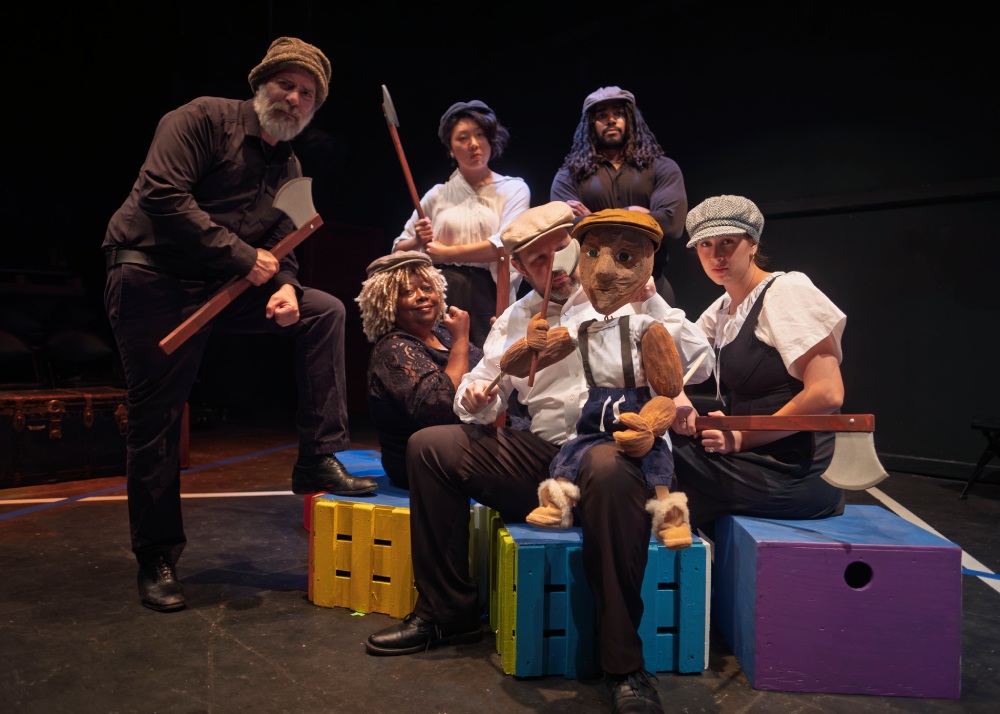
Back row L-R: Douglas Levin, Jin Ai, Xavier Mattison. Front row L-R: Freya Churchwell, Daniel Boughton, Charity Schultz.
My only note - and this is for the author, not the cast or director - is that of all the various types of Jews included in this piece - Reform, Conservative, queer, self‑hating, Orthodox, even atheist - the one type of Jew that was not represented was the Messianic Jew, of which I am one.
Messianic Jews (not to be confused with the organization Jews for Jesus) are Jews who believe that Jesus is the Messiah spoken of in the Old Testament - the ‘Christed One,’ meaning the one anointed with the oil of blessing. In those same scriptures, this figure is described as the blessed one who would be ‘pierced through his hands and feet,’ yet ‘whose bones would not be broken.’
Messianic Jews also believe that, regardless of his lineage - whether Yeshua was a descendant of King David or not - his purpose in allowing himself to be publicly killed, and then healing his own body three days later, was to show that this world is made of spirit, or ‘shimmering motes,’ as he called them. This was long before molecular structure or the effects of consciousness on physical matter were even theorized. All of his miracles were mitzvahs - acts of goodness - centered on healing and feeding the poor, the sick, and the disabled.
At the very least, Jesus was a respected, super advanced, rabbi, rebel and healer who introduced the idea that women were worthy of learning the Torah and receiving healing from his touch whether they were Jewish or not. This Feminist thought alone was a very radical and world changing idea that women of all nations and all religions are eternally grateful for.
Given all that Yeshua represents historically and spiritually to many Jews, I was surprised that his name never surfaced in a piece that explores so many branches of Jewish identity, its factions, and its many splintered paths. I compare his omission from Jewish studies when debating this with my friends to discussing basketball history without mentioning Michael Jordan or discussing physics without ever mentioning Albert Einstein - not a judgment, just an observation about the scope of the narrative.
In any case, author LM Feldman has created a marvelously complex and deliciously enjoyable reminder of all the different expressions of Judaism, and of the lush intelligence and grace of Jewish people around the globe caught up in the current battle to stay alive and well. Le Chaim!
A People was a very deeply inspiring and delightful experience for me, especially at this unprecedented time in history. This heartfelt production of A People helped this Jewish girl from Miami, Florida remember so many of the great things about my Jewish heritage; the sights, the sounds, the heated discussions, the music, the fabulous food, the funny family dinners, my own bat mitzvah… just so many things that make me proud to be a Jew today.
With its blend of live music and rapid-fire storytelling, the production compresses five thousand years of Jewish history and cultural inheritance into a brisk, engaging evening. A People stands out as essential summertime theater, honoring its deep historical foundations while resonating powerfully with contemporary audiences.
Mazel Tov and Highly Recommended!
Running through July 5 at Theater Wit.
Couch Penny Ensemble’s An Oak Tree: A Raw, Unrehearsed Descent Into Grief
Couch Penny Ensemble, in association with Theatre Arcana, presents the ambitious and experimental An Oak Tree, a raw, unconventional approach to theater that is sure to spark conversations on the nature of grief and the experience itself.
In writing An Oak Tree, playwright Tim Crouch wanted to replicate the disorienting nature of grief. The play features two actors - one who has rehearsed the script (the Hypnotist) and another who has neither seen nor read it (the Father). The Hypnotist acts as a dual guide both for the actor playing the Father and the audience, as this one-of-a-kind experience comes to life.
For each performance, a new, different actor takes on the role of the Father, and it’s their job to live in the moment, breathing life into this character through the use of real-time instructions (given via headphones) and script lines given to them on the spot. The result is an unpolished, raw theater experience. The format is intriguing and innovative - a reflection on grief itself. When tragedy happens, you aren’t prepared for it, and you suddenly find yourself wrestling with a script that is unrehearsed.
Under Bryce Lederer’s direction, the production leans into the play’s shifting dynamics, shaping its unpredictability into something sharply focused and theatrically alive.
Riles August Holiday anchors the evening as the Hypnotist, delivering a technically demanding and well-acted performance. Holiday does a fantastic job of drawing a sharp line between his moments in character - playing a defensive, fragile man - and his moments acting as an administrative guide, calmly steering both his co-star and the audience through the mechanics of the script.
On this evening, Suzy Krueckeberg played the Father, and one can only imagine the excitement and the nerves of taking on such a role. As the Father, she was required to relive the trauma of losing a daughter and process the deterioration of her family without rehearsing - no small task. Krueckeberg did a good job finding the part and taking the audience on the journey with her.
For all its ingenuity, An Oak Tree serves a very specific appetite. This is avant-garde, experimental theater through and through. If you are an audience member searching for that specific brand of rule-breaking performance art, there is plenty to analyze here. Personally, I felt the script left something to be desired. In an examination of grief, I felt at times it was too simplistic or trod ground others had covered more effectively.
That said, it was a unique and interesting experience to see an actor walk a tightrope, constructing a character in front of the audience’s eyes. Holiday’s emotional depth on stage was a treat as well.
An Oak Tree runs at Greenhouse Theater Center until July 5th.
This review is proudly shared with our friends at www.TheatreInChicago.com.
Where Identity Slides: Steppenwolf’s Mesmerizing Catch as Catch Can

Mia Chung’s Catch as Catch Can, which premiered with Page 73 in New York in 2018, arrives at Steppenwolf Theatre - one of Chicago’s most dynamic and daring artistic institutions - with a production that immediately embraces the play’s slippery, shape-shifting nature. Chung’s script thrives on emotional volatility and fractured identity, and Steppenwolf’s staging taps into that energy from the outset, preparing the audience for a world where the familiar can tilt, distort, and reassemble without warning.
Catch as Catch Can begins with the familiar comfort of kitchen-table talk between two New England mothers, Roberta Lavecchia and Theresa Phelan. Under Amy Morton’s direction, those early scenes feel lived-in and deceptively ordinary - two longtime friends trading stories, worries, and family updates with the shorthand of people who have known each other for decades. But as the play unfolds, that everyday warmth becomes the launching point for a story that veers into far more disorienting territory. The return of Tim Phelan unsettles the delicate balance between the Lavecchias and the Phelans, stirring up old assumptions, unspoken resentments, and long-dormant family myths. What begins as a simple homecoming slowly reveals itself as a catalyst for emotional slippage, where memories blur, loyalties shift, and the characters’ sense of who they are - and who they have been to each other - starts to fracture. Morton guides this progression from domestic realism to psychological unraveling with remarkable control, allowing the play’s humor, tension, and creeping dread to coexist in the same breath.
The production’s boldest device - three actors portraying all six characters - becomes the heartbeat of the evening. Gary Cole (as Roberta and Robbie Lavecchia), Audrey Francis (as Lon and Daniela Lavecchia), and Tim Hopper (as Theresa Phelan and Tim Phelan) deliver performances that are nothing short of remarkable. Morton directs them with a sculptor’s precision, shaping each transformation through voice, posture, and energy rather than costume changes or props. The actors rarely add so much as an apron, a pair of glasses, or a purse to differentiate roles; instead, they rely on the smallest shifts in breath, cadence, or physical weight. Even the simplest physical actions - threading a needle, folding laundry, lifting a heavy picture onto a wall, or a mother rolling out her famous meatballs - become character markers, subtle cues that signal who is speaking without ever breaking the flow of the scene. At times, it feels as though six fully realized people are occupying the room, even though only three bodies ever stand onstage.
After the opening scene, it took me a few minutes to recalibrate to the production’s rhythm, especially as the actors began switching characters with such speed and minimal visual cues. But that adjustment period is brief. Before long, the doubling feels not only natural but essential, a kind of theatrical language the production teaches you how to read. Once you settle into its cadence, the transformations become thrilling rather than disorienting, sharpening the play’s emotional stakes and deepening its sense of unease.
The rapid-fire switching becomes its own kind of theatrical whiplash. An actor may leap from one character to another every other sentence, often without a single visual clue, and Morton ensures each pivot lands cleanly without losing an ounce of emotional clarity. The play becomes a fault line in constant motion, where identities slide, collide, and splinter beneath the surface.

Gary Cole, Tim Hopper and Audrey Francis (L-R) in Steppenwolf Theatre's Catch As Catch Can. Photo by Michael Brosilow.
All three performers - Gary Cole, Audrey Francis, and Tim Hopper - are longtime Steppenwolf ensemble members, bringing a shared artistic vocabulary that sharpens every transformation onstage.
Cole toggles between Roberta’s brittle warmth and Robbie’s restless bravado with astonishing finesse. This production marks his first return to a Chicago stage in more than 25 years, and it is a triumphant homecoming. He is known to many for Office Space, Talladega Nights, HBO’s Veep, NCIS, and one of my favorite roles - Mike Brady in The Brady Bunch Movie and its sequel. Cole reminds audiences that his stage roots run deep. As Roberta, he carries a soft, fluttering concern that sits right behind the eyes; as Robbie, that same gaze sharpens into something quicker, hotter, and more impulsive. His ability to pivot between those energies with nothing more than a shift in breath or a recalibrated stance makes each transition feel both seamless and startling. It is a performance built on precision, but it never feels mechanical.
Francis brings an equally impressive duality to Lon and Daniela. In addition to being a Steppenwolf ensemble member, she now serves as the company’s artistic director alongside Glenn Davis, a role that underscores her influence on Chicago’s theatrical landscape. Known for standout performances in The Herd, Dance Nation, her work on Chicago Med, and directorial skill in You Will Get Sick, she grounds Lon with a quiet, blue-collar steadiness, a man who absorbs the world before reacting to it. Daniela, by contrast, is all edges and alertness, her movements tighter and her voice pitched with a nervous brightness that hints at deeper cracks. Francis masterfully switches entire gravitational centers. The clarity of her physical vocabulary makes each character instantly legible without a single costume change.
Hopper’s pairing may be the most haunting of the three. With Steppenwolf credits that include The Crucible, The Flick, and Buried Child, he brings a raw, unsettling honesty to both Theresa and Tim. His Theresa is a portrait of unraveling vulnerability, a woman whose emotional seams are beginning to split in ways she can barely articulate. His Tim, meanwhile, carries the quiet desperation of someone trying to hold himself together even as the ground shifts beneath him. Hopper plays both roles with a volatility that feels almost dangerous. The characters mirror and distort one another, creating an emotional echo that deepens the play’s sense of unease. Watching him slip between them is like watching a reflection break apart and reassemble in real time.
Together, these performances form the core of the production’s power. With Morton’s direction guiding every pivot, the trio creates the uncanny sensation that the stage is populated by twice as many people as are physically present. Their transformations are so quick and so clean that the audience must stay alert, tracking identities as they slide, collide, and reform. It is a feat of acting that is both technically dazzling and emotionally resonant, and it is the reason the play’s unstable world feels so alive.
As the story darkens - touching on mental health, racism, cultural tension, and the fragile scaffolding that holds families together - the doubling amplifies the instability. Chung threads moments of racial bias and coded language into the fabric of these families’ interactions, revealing how prejudice can hide inside the most casual exchanges and how easily it can rupture long-standing bonds. Morton understands that the play’s power lies in this slippage, and she allows the actors to push into the unsteady terrain without ever losing emotional truth. The result is a production that feels intimate yet vertiginous, a domestic drama that slowly cracks open into a haunting exploration of identity and the roles we inherit, perform, and sometimes cannot escape.

Andrew Boyce’s scenic design is a quiet marvel, giving the production a sense of dimensionality that feels both naturalistic and subtly disorienting. The main playing space is an open living room, flanked on one side by an entryway and a partial view into the kitchen, and on the other by a long hallway that suggests the deeper interior of the house. Just beyond the living room, another room is visible past a second hallway, creating the impression of a home that extends well beyond the edges of the stage. Boyce’s layout allows the audience to feel as though they’re peering into a fully lived-in environment, one with corners, thresholds, and unseen rooms that hold their own histories. Yuki Nakase Link’s lighting deepens this effect, subtly sculpting each corridor and doorway so the house seems to breathe with possibility - sometimes warm and inviting, sometimes shadowed with tension. It is a multidimensional design that grounds the play’s domestic realism while subtly reinforcing the sense that something inside this home - and inside these families - is evolving.
In their Artistic Director note, Glenn Davis and Audrey Francis frame Catch as Catch Can as a rare convergence of timing, artistry, and ensemble history - a production long delayed, now finally realized with the team that first set out to make it in 2020. They speak to the play’s uncanny pull, describing how Chung’s story has embedded itself in the company’s imagination, refusing to loosen its grip. For them, the doubling is not just a theatrical device but a test of the ensemble’s virtuosity, a chance for Steppenwolf to stretch its actors toward the edges of what performance can hold. And at the heart of their message is the idea that the play’s exploration of identity, home, and the selves we construct makes it a fitting capstone to the theatre’s 50th anniversary season - a reminder of how Steppenwolf’s long-standing commitment to family drama, artistic risk, and shared storytelling continues to shape its legacy.
Catch as Catch Can ultimately lands with the force of a quiet detonation, its emotional aftershocks lingering long after the final blackout. Morton and her trio of actors craft a world that feels both intimate and treacherous, a place where identity slips, refracts, and reforms in ways that are as unsettling as they are compelling. It is the kind of production that rewards close attention and invites conversation long after you’ve left the theatre - about family, perception, and the narratives we inherit without realizing it. Catch as Catch Can runs at Steppenwolf through July 12, with performances throughout the week, and it is very highly recommended for anyone who craves theatre that challenges, unsettles, and stays with you.
For tickets and/ or more show information, click here.
This review is proudly shared with our friends at www.TheatreInChicago.com.
About Face Theatre announces 2026-2027 season

About Face Theatre is proud to announce its 32nd season featuring the Pulitzer Prize winning musical A Strange Loop and the Midwest Premiere of i never asked for a gofundme by Jayne Deely, directed by About Face Theatre Producing Artistic Director Megan Carney. In addition, the company continues its innovative touring performances and education programs throughout the region.
"About Face Theatre has always been a home for stories that challenge and affirm. The season ahead is no exception," states Megan Carney, Producing Artistic Director for About Face Theatre. "With these groundbreaking and exuberant works, we are continuing our legacy of centering fearless, joyful, and necessary LGBTQ+ voices. I can't wait to share these productions with Chicago audiences."
Overview of the Season
All performances will take place on the Johnson Stage at Raven Theatre, 6157 N Clark St in Chicago. Tickets for individual shows go on sale one month before previews at https://aboutfacetheatre.com. Secure your spot early by joining the About Face Futurists. To find out more about this monthly donor program, please visit aboutfacetheatre.com/support-us.
Showtimes are Thursday, Friday, Saturday at 7:30pm, and Sun at 3:00pm.
A Strange Loop
book, music, and lyrics by Michael R. Jackson
directed by About Face Theatre Artistic Associate Mikael Burke
In a co-production with Raven Theatre
October 8-November 8, 2026
Up first in October, About Face Theatre proudly presents the Chicago premiere of the Broadway smash hit A Strange Loop with book, music, and lyrics by Michael R. Jackson and Directed by About Face Theatre Artistic Associate Mikael Burke. This groundbreaking show won Best Musical and Best Book of a Musical at the 2022 Tony Awards. This is a co-production with Raven Theatre.
Usher is a Black, queer playwright who spends his days working as an usher on Broadway. He spends his nights struggling to write an original musical about a Black, queer playwright who spends his days working as an usher on Broadway. Lines blur, thoughts intrude, and soon he finds himself wrestling to break free from a very strange creative loop.This blistering, groundbreaking, Pulitzer Prize winning musical explores identity, race and sexuality through the lens of a young artist at war with a chorus of his own demons and inner voices on a journey towards understanding and self love.
i never asked for a gofundme
by Jayne Deely
directed by About Face Theatre Producing Artistic Director Megan Carney
March 18 – April 17, 2027
Thursday, March 25, 2027 at 7:30pm
Millie and Avery return to Millie's hometown in Alabama seeking a quiet refuge for Avery's recovery from gender-affirming top surgery. One big misunderstanding spirals into a full-blown small-town spectacle in this hilarious and heartfelt comedy. Set against the backdrop of March Madness and the electric energy of WNBA season, the stakes keep rising. As the donations pile up and the pressure mounts, the couple is forced to confront what they truly stand to lose by telling the truth.
This remarkable new play was featured at La Jolla Latinx New Play Festival and the Distillery New Works Festival with Seattle Public Theater. The play was a Finalist at the National Playwrights Conference Eugene O'Neill Theater Center.
Mikael Burke (he/him), director of A Strange Loop, is a Chicago-based director, deviser, and educator. A Princess Grace Award-winner in Theatre and Jeff Award-winning director, his recent credits include: Oak by Terry Guest (Urbanite Theatre, World Premiere); Othello by William Shakespeare (Theatreworks Colorado Springs); Short Shakes! Romeo & Juliet (Chicago Shakespeare Theatre); Notes from the Field by Anna Deveare Smith (TimeLine Theatre, Chicago Premiere); The Salvagers by Harrison David Rivers (Yale Repertory Theatre, World Premiere); Tambo & Bones by Dave Harris (Refracted Theatre Company, Chicago Premiere, winner of 8 Jeff Awards); Blues for an Alabama Sky by Pearl Cleage (Remy Bumppo Theatre Company); The Magnolia Ballet by Terry Guest (About Face Theatre, Chicago Premiere, winner of 2 Jeff Awards); Clyde's by Lynn Nottage (Theaterworks Hartford). Mikael is also an adjunct faculty member at DePaul University and Roosevelt University. MFA, The Theatre School at DePaul University | mklburke.com
Megan Carney (she/her), director of i never asked for a gofundme, is the Producing Artistic Director of About Face Theater in Chicago, a company dedicated to advancing LGBTQ+ equity through community building, education, and performance. She has worked extensively as a director, playwright, and teaching artist. Megan's work as a director and playwright has premiered in Chicago, New York, and through touring productions around the country including Audrey Cefaly's The Gulf (About Face Theatre) Danielle Pinnock's Body/Courage (Rivendell), Lisa Dillman's The Walls (Rivendell at Steppenwolf), and Holly Hughes' Let Them Eat Cake (Dixon Place, NYC) among many others. Megan served as the Director of the Gender and Sexuality Center, one of the Centers for Cultural Understanding and Social Change, at the University of Illinois at Chicago where she produced cultural programs and advanced inclusive policies. Carney is a certified mediator with the Center for Conflict Resolution and has a MFA in Theatre Arts from Virginia Tech with a focus on Directing and Public Dialogue. Her work has been recognized with theatre industry awards, the GLSEN Pathfinder Award, an APA Presidential Citation, and induction in Chicago's LGBT Hall of Fame.
Jayne Deely (they/them), writer of i never asked for a gofundme, is a Queens, NY born and bred boricua playwright and performer. Selected works: Legacy, When Pluto was a planet, I never asked for a gofundme, Walter Mercado Presents: A Queer Puerto Rican (Not Just) Christmxs Spectacular, and unqle play. Their plays have been developed with Seattle Public Theatre, the New Harmony Project, Breaking the Binary, Fresh Ground Pepper, theatre b, American Stage, Renaissance Theaterworks, and others. They were recently named to the Kilroy's Web 25-26 (for I never asked for a gofundme) and are currently under commission with a Sloan grant from EST. Jayne is a proud member of AEA, SAG-AFTRA, and the Dramatists Guild, and is based in Queens, NY. MFA, IU Bloomington.
Michael R. Jackson, writer of A Strange Loop, Pulitzer Prize-winning playwright, composer, and lyricist is the creator of A Strange Loop, which the New York Times has called a "bravura meta-musical." The piece – which took Jackson eighteen years to create – won the Pulitzer Prize for Drama in 2020, eleven Tony Award nominations, a New York Drama Critics Circle Award, and two Tony Awards – for Best New Musical and Best Book. Jackson has been named one of TIME Magazine's "100 Most Influential People" (2022) and has received numerous awards including a New Professional Theatre Festival Award, a Jonathan Larson Grant, a Lincoln Center Emerging Artist Award, an ASCAP Foundation Harold Adamson Award, a Whiting Award, the Helen Merrill Award for Playwriting, the Windham-Campbell Prize, and a Dramatist Guild Fellowship. He has appeared on The Daily Show with Trevor Noah, CBS Sunday Morning, and Late Night with Seth Meyers, to name a few. He wrote book, music, and lyrics for the musicals White Girl In Danger and A Strange Loop (2019 world premiere at Playwrights Horizons in co-production with Page 73 Productions). Jackson holds a BFA and MFA in playwriting and musical theatre writing from the NYU Tisch School of the Arts.
RAVEN THEATRE is proud to be a cultural cornerstone of Chicago's north side, where its artistic excellence is known among theatergoers and artists alike. Long acclaimed for its revivals of classic plays, Raven also gives voice to emerging playwrights whose work will help to shape the theatrical canon for years to come. Founded in 1983, Raven moved into its current home in 2002 with its 85-seat Johnson Stage and its 56-seat Schwartz Stage.
ABOUT FACE THEATRE advances LGBTQ+ equity through community building, education, and performance. Since our founding in 1995, we've been a national leader in producing groundbreaking theater throughout Chicago that centers and affirms people who identify as LGBTQ+ and other intersecting identities. Working with nationally recognized and emerging artists of all ages, our programs include award-winning productions, touring shows, a Youth Ensemble, and new work development through Re/Generation Studio. Learn more and get involved at aboutfacetheatre.com.


Latest Articles
-
 Kokandy Productions Presents SUNDAY IN THE PARK WITH GEORGE - August 13 – November 1, 2026 at The Chopin Theatre
Written by Buzz Center StageFollowing its critically acclaimed productions of Sweeney Todd and Into the Woods, Kokandy Productions once again celebrates the great Stephen Sondheim with a revival of his stunning masterpiece Sunday in the Park with George, playing August 13 – November 1, 2026 in the intimate Chopin Downstairs Studio, 1543 W. Division St.…
Kokandy Productions Presents SUNDAY IN THE PARK WITH GEORGE - August 13 – November 1, 2026 at The Chopin Theatre
Written by Buzz Center StageFollowing its critically acclaimed productions of Sweeney Todd and Into the Woods, Kokandy Productions once again celebrates the great Stephen Sondheim with a revival of his stunning masterpiece Sunday in the Park with George, playing August 13 – November 1, 2026 in the intimate Chopin Downstairs Studio, 1543 W. Division St.… -
Steppenwolf Theatre Names Stage Manager Laura D. Glenn Newest Ensemble Member
Written by Buzz Center StageSteppenwolf Theatre Company Artistic Directors Glenn Davis and Audrey Francis are thrilled to welcome veteran Production Stage Manager Laura D. Glenn into the company's world-renowned ensemble. Glenn, whose journey with Steppenwolf began as a summer intern in 1988, has worked on more than 100 Steppenwolf productions over…
-
The Lizard y El Sol Returns to Chicago Parks Through August 9th
Written by Buzz Center StageThe whole family can enjoy The Lizard y El Sol, returning by popular demand to 12 public spaces citywide this summer. Co-Directors Jamal Howard (Splish Splash: A Day on the Lake) and Raquel Torre (BOOK UP!) again take the reins of this beloved "Theater for…
-
Chicago Tap Theatre Founder, Mark Yonally, Receives HOOFER AWARD from AMERICAN TAP DANCE FOUNDATION
Written by Buzz Center StageChicago Tap Theatre (CTT) is proud to announce its Founder and Artistic Director Mark Yonally has been selected by the Preservation Committee for the American Tap Dance Foundation to receive the 2026 Hoofer Award. Yonally will accept the honor at the Tap City Awards, Friday, Sept. 11 at…


Does your theatre company want to connect with Buzz Center Stage or would you like to reach out and say "hello"? Message us through facebook or shoot us an email at This email address is being protected from spambots. You need JavaScript enabled to view it..
*This disclaimer informs readers that the views, thoughts, and opinions expressed in the text belong solely to the author, and not necessarily to Buzz Center Stage. Buzz Center Stage is a non-profit, volunteer-based platform that enables, and encourages, staff members to post their own honest thoughts on a particular production.