
Displaying items by tag: experimental theatre
A Masterwork Reanimated: Manual Cinema's Frankenstein Still Inspires Awe
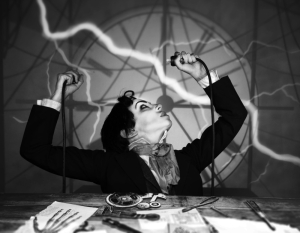
Since premiering at Court Theatre in 2018, Manual Cinema's Frankenstein has stood as one of Chicago's most remarkable theatrical achievements. Returning for just five performances at the Studebaker Theater, the work remains every bit as mesmerizing today as when theatergoers first encountered it. More than an adaptation of Mary Shelley's classic Gothic novel, Frankenstein is a work of brilliant art, a breathtaking fusion of theater, film, music, and visual storytelling that pushes the boundaries of what live performance can accomplish.
Few companies blur the line between theater, cinema, and visual art as completely as Manual Cinema. Through the collective's signature combination of shadow puppetry, miniatures, projected imagery, live acting, original music, and meticulously crafted sound design, Frankenstein unfolds with the wonder of watching a dream take shape in real time. Perhaps most impressive is the dual experience the company creates, allowing audiences to become immersed in the finished cinematic image while simultaneously appreciating the artistry required to produce it.
What makes this version so compelling is its refusal to settle for a straightforward retelling. Rather than focusing solely on Victor Frankenstein and his doomed creation, the piece intertwines the familiar narrative with the life of Mary Shelley herself. Conceived and directed by Drew Dir and devised by Dir, Sarah Fornace, and Julia Miller, the work finds unexpected psychological depth in the parallels between creator and creation. The result is an emotionally resonant exploration of grief, ambition, responsibility, and the mysterious spark behind artistic creation. Shelley's experiences become inseparable from the tale she imagined, giving fresh dimension to a story many may think they know by heart.
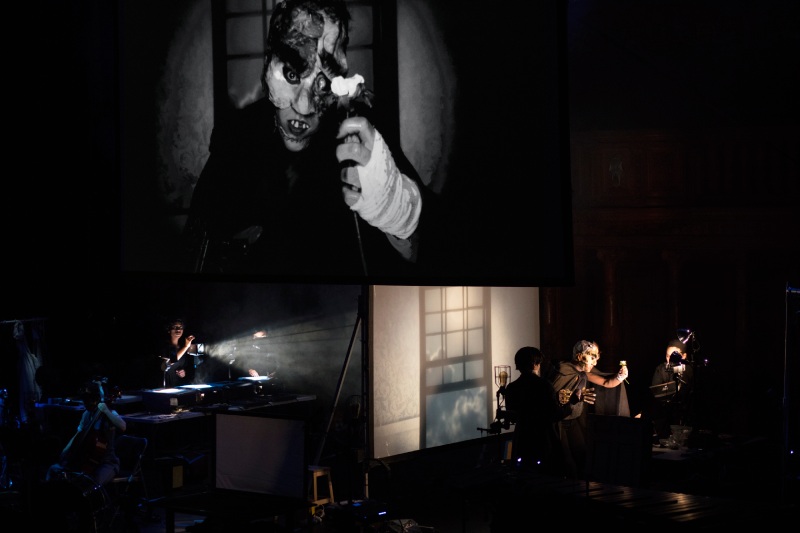
Manual Cinema's Frankenstein. Photo courtesy Elly White.
Manual Cinema's technical accomplishments remain astonishing. The performers serve simultaneously as actors, puppeteers, camera and overhead projection operators, and illusionists, constructing intricate visual worlds before our eyes. Every shadow, every miniature landscape, and every carefully choreographed movement contributes to a cinematic language that feels both innovative and timeless. At times, the work's rich layering of imagery demands careful attention, but the payoff more than justifies the investment. Watching the mechanics at work only deepens one's appreciation for the craftsmanship involved. The production's richly imagined visual language owes much to an exceptional design team. Shadow Puppet Design by Drew Dir and Liza Breit, Projections and Scenic Design by Rasean Davante Johnson, and 3D Puppet Design by Liza Breit provide the foundation for the show's arresting imagery. Lighting Design by Claire Chrzan adds atmosphere and dramatic texture, while Costume and Wig Design by Meka van der Ploeg and Prop Design by Lara Musard enrich the world with thoughtful detail and period character.
Sarah Fornace is a force and anchors the evening with beautifully realized portrayals of both Victor Frankenstein and Mary Shelley, illuminating the parallels between the ambitious scientist and the visionary author who imagined him. Kara Davidson proves equally compelling as both the Creature and Elizabeth Frankenstein, bringing remarkable humanity and quiet complexity to each role. Together, their performances ensure that beneath the show's dazzling technical achievements beats a deeply human heart.
The evocative original score and sound design by Ben Kauffman and Kyle Vegter prove equally vital, transforming every scene into an immersive sensory experience. The music heightens the emotional stakes while the live effects establish an atmosphere that ranges from intimate reflection to Gothic grandeur. There is also something undeniably enjoyable about watching the musicians positioned around the stage assemble the show's haunting sonic landscape in real time, revealing yet another layer of Manual Cinema's theatrical ingenuity. The visual and sonic elements combine to produce an experience that feels as sweeping as a feature film while maintaining the immediacy and vulnerability of live theater.
That artistry was especially evident from our seats directly in front of percussionist Justin Peters (performing the night I attended), whose work became a captivating attraction in its own right. Surrounded by towering xylophones and an eclectic collection of suspended objects that ranged from hubcaps and planters to what appeared to be a kitchen sink, Peters coaxed an astonishing variety of sounds from each piece, his dexterity and precision adding another captivating layer to Manual Cinema's intricate theatrical machinery. The variety of instruments on display is every bit as fascinating as the sounds they produce.

Sarah Fornace as Mary Shelley in Manual Cinema's Frankenstein. Photo by Drew Dir.
One of the evening's greatest delights came after the final curtain. Guests were invited to join the actors, musicians, projectionists, and artistic team onstage to discover firsthand how Manual Cinema brings its signature illusions to life. Visitors could handle puppets, experiment with projectors, appear on camera, and watch their own silhouettes become part of the visual storytelling. Beyond the opportunity to ask questions, take photographs and videos, and interact with the artists, the experience beautifully reinforced one of the company's central ideas: understanding the process does not diminish the magic - it makes it even more extraordinary.
Yet for all its technical and musical wizardry, Frankenstein never loses sight of its humanity. At its heart lies a poignant examination of loneliness, longing, and the desperate need for connection. The Creature emerges not merely as a monster but as a profoundly sympathetic figure whose search for acceptance speaks across centuries. Likewise, the portrayal of Mary Shelley reveals the often-painful relationship between art and life, suggesting that creation itself can be both beautiful and terrifying.
The Halloween season offers no shortage of spooky entertainment, but few works achieve the artistic depth, technical ingenuity, and emotional impact of Manual Cinema's Frankenstein. Years after its debut, it remains a defining achievement of Chicago theater and a shining example of the city's creative excellence. For those fortunate enough to experience one of its five performances only, October 28-November 1, 2026, at the Studebaker Theater, this extraordinary presentation serves as a reminder that great theater can still inspire awe.
Frankenstein is more than a theatrical event. It is a masterwork of visual storytelling, a triumph of imagination and technique, and one of the most distinctive theatrical works to emerge from Chicago in the past decade.
Manual Cinema returns to the Studebaker Theater with A Christmas Carol for a limited engagement December 18-27.
Highly Recommended.
Studebaker Theater in the Fine Arts Building
75 minutes – no intermission
Tickets and information: Fine Arts Building - FrankensteinFrankenstein
The Attic at Goodman Theatre Redefines Memoir Through Breathtaking Physical Storytelling
At intermission, I sent Ken, Buzz Center Stage’s managing editor, a text: “So thankful I made it!! It’s intermission, and if there’s one show anyone sees it should be this.” By the time the lights came up at the end of The Attic, I couldn’t have agreed with intermission-me more.
The idea behind lifelong circus artist Shana Carroll’s autobiographical play began inside a CT scanner. Watching its bridge move in and out of sight above her, Carroll realized how much of her life could be told through the things she had seen while lying on her back. From her childhood bed to her mother’s and her child’s, from motel rooms to hospital rooms, each view from below held another piece of the story she now wanted to tell.
That story became The Attic: Things I’ve Seen While Lying on My Back, Carroll’s onstage memoir now receiving its world premiere in Goodman Theatre’s Albert Theatre. Carroll, a cofounder of Montreal circus collective The 7 Fingers, the company behind the production, also serves as its writer, director and choreographer.
The Attic perfectly walks the line between abstract and concrete storytelling. The pivotal events and overarching themes of Carroll’s life remain clear and accessible, while circus arts and contemporary dance explore the smaller details and dynamics that traditional narration could never fully capture. This is not a play with circus tricks added to it; it is a singular piece of theatre that replaces conventional blocking with a breathtaking physical language.
Tyler Meredith serves as Carroll’s onstage stand-in, carrying nearly the entire narration while moving alongside – and frequently flying among – the rest of the ensemble. Even within such a heavily collaborative production, Meredith deserves special recognition for the sheer feat of guiding the audience through Carroll’s life with such emotional depth, physical precision, and clarity, all while taking part in the circus work herself.
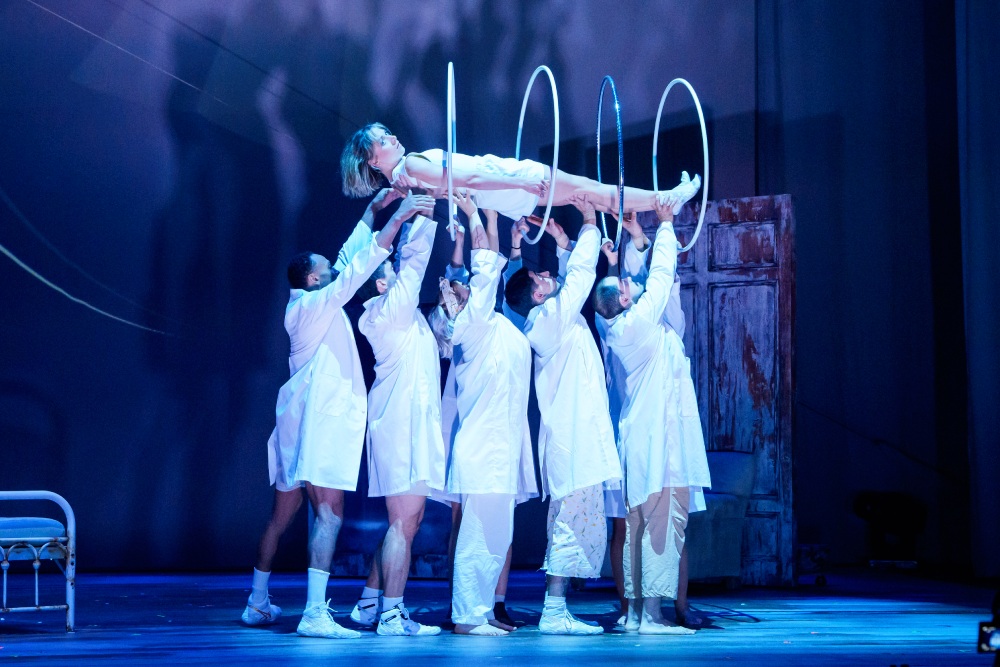
(Top) Anna Kichtchenko. (L-R, bottom) Melvin Diggs, FranAlvarez, Lucy Tan, Santiago Rivera Laugerud and Eduardo De Azevedo Grillo in The Attic at Goodman Theatre.
Still, The Attic cannot have only one star. Every one of its ten performers is essential to creating the world onstage. The remaining nine rarely leave the audience’s sight, and I defy you to find a moment when any of them is truly still. Rather than waiting at the edges of a scene, they continually ebb and flow with Carroll’s memories, moving like a single current that stretches across the entire stage while remaining connected at every point.
Nothing feels like a transition or choreographed scene change, even though every minute contains (no exaggeration) hundreds of precise decisions, from the subtlest shift in focus to a death-defying catch. If every movement executed by just one performer over ten minutes were written down, the resulting document would be longer than this entire review. The level of detail, polish, and commitment is staggering. Live theatre constantly reaches toward the seemingly impossible goal of appearing this intricate and effortless; The Attic achieves it.
Among an ensemble overflowing with talent, Nancy Luna is especially impossible to look away from. A fearless and mesmerizing flyer, she repeatedly launches herself – or is effortlessly launched by Fran Alvarez – into the air with a freedom that makes even the production’s most difficult feats feel instinctive.
The technical elements are equally precise. Projections, lighting and scenic movement distinguish and layer Carroll’s memories without overwhelming the physical storytelling. Even as performers soar and tumble in the background, the production carefully directs the audience’s focus, allowing the spectacle to strengthen the story rather than distract from it.
Although its explorations of illness, motherhood and mortality are geared more toward adults, The Attic offers enough acrobatics, movement and theatrical imagination to captivate nearly anyone. Carroll’s memoir is the beautiful thread connecting each mesmerizing scene, but every individual sequence is remarkable enough to stand on its own.
Plenty of shows claim to keep audiences on the edge of their seats. Shana Carroll’s The Attic earns that phrase in nearly every possible sense. The Attic: Things I’ve Seen While Lying on My Back runs at Goodman Theatre through October 4. Tickets are available at goodmantheatre.org/show/the-attic.
*Extended through October 11th
Couch Penny Ensemble’s An Oak Tree: A Raw, Unrehearsed Descent Into Grief
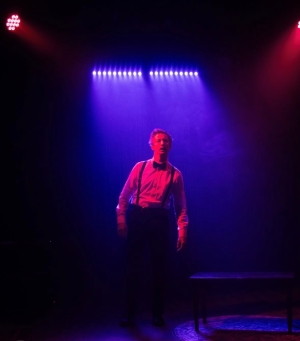
Couch Penny Ensemble, in association with Theatre Arcana, presents the ambitious and experimental An Oak Tree, a raw, unconventional approach to theater that is sure to spark conversations on the nature of grief and the experience itself.
In writing An Oak Tree, playwright Tim Crouch wanted to replicate the disorienting nature of grief. The play features two actors - one who has rehearsed the script (the Hypnotist) and another who has neither seen nor read it (the Father). The Hypnotist acts as a dual guide both for the actor playing the Father and the audience, as this one-of-a-kind experience comes to life.
For each performance, a new, different actor takes on the role of the Father, and it’s their job to live in the moment, breathing life into this character through the use of real-time instructions (given via headphones) and script lines given to them on the spot. The result is an unpolished, raw theater experience. The format is intriguing and innovative - a reflection on grief itself. When tragedy happens, you aren’t prepared for it, and you suddenly find yourself wrestling with a script that is unrehearsed.
Under Bryce Lederer’s direction, the production leans into the play’s shifting dynamics, shaping its unpredictability into something sharply focused and theatrically alive.
Riles August Holiday anchors the evening as the Hypnotist, delivering a technically demanding and well-acted performance. Holiday does a fantastic job of drawing a sharp line between his moments in character - playing a defensive, fragile man - and his moments acting as an administrative guide, calmly steering both his co-star and the audience through the mechanics of the script.
On this evening, Suzy Krueckeberg played the Father, and one can only imagine the excitement and the nerves of taking on such a role. As the Father, she was required to relive the trauma of losing a daughter and process the deterioration of her family without rehearsing - no small task. Krueckeberg did a good job finding the part and taking the audience on the journey with her.
For all its ingenuity, An Oak Tree serves a very specific appetite. This is avant-garde, experimental theater through and through. If you are an audience member searching for that specific brand of rule-breaking performance art, there is plenty to analyze here. Personally, I felt the script left something to be desired. In an examination of grief, I felt at times it was too simplistic or trod ground others had covered more effectively.
That said, it was a unique and interesting experience to see an actor walk a tightrope, constructing a character in front of the audience’s eyes. Holiday’s emotional depth on stage was a treat as well.
An Oak Tree runs at Greenhouse Theater Center until July 5th.
This review is proudly shared with our friends at www.TheatreInChicago.com.
"The Brink or Nobody's Ever Kissed Me like That" A Stunning work of Surrealism Overflowing with Sensual and Romantic Images of Modern Love

Each week as I sort through the invitations to theater and concert events taking place in Chicago, it’s rare that I find a title as intriguing and inviting as this one - "The Brink or Nobody's Ever Kissed Me like That".
Walkabout Theater Company described this show in their press release as "experimental cabaret" set in "a cafe at the edge of the world." And that would be a very accurate description.
“The Brink” contains a variety of beautiful, recognizable songs, like “Sunshine, Lollipops, and Rainbows,” "Beyond the Sea” and "You Don't Own me," along with some classic Jazz and Motown standards. Colorful, erotic and avant-garde, each number is performed with a uniqueness that makes this play a true original. What the company does with some of the songs is quite amazing and sometimes a little scary to watch. Many of the songs are slowed down or sped up mid-number, as one of the ensemble members appears to control the delivery of each song with an old radio tuner.
“The Brink’s” talented cast includes Nigel Brown, McCambridge Dowd-Whipple, Cooper Forsman, Dana Murphy, Katie Mazzini, Thom Pasculli, Alex Rodriguez. The three women in the cast have accomplished singing voices, yet each of these standards is sung with the most interesting variety of twists and turns. For example, "You Don't Own Me" is sung by a female ensemble member who begins by standing in a tin water tub while another male member of the troupe pours water over her head from a tin garden watering can until her long, shiny black hair is wet and her beautifully applied makeup and mascara are running down her face like black tears. She then dance/ crawls her way over to a piano and sings the rest of the song in halting bits to an invisible suitor warning him not to try and change her with the following lyrics, but then tells him to kiss her over and over again.
You don't own me
I'm not just one of your many toys
You don't own me
Don't say I can't go with other boys
Don't tell me what to do
And don't tell me what to say
Please, when I go out with you
Don't put me on display
You don't own me
Don't try to change me in any way
The full effect of this number is stunning and sexy, yet sad and lonely all at the same time.
The play is fair to both sexes when it comes to describing how hearts are easily toyed with and broken, yet there is a decidedly feminist and therefore humanist bent to the whole piece which I enjoyed immensely. With original text by Nigel Brown, quotes from renowned feminists Gertrude Stein and Ann Carson are scattered about like prose poetry and fall off the lips of the ensemble like rose petals off a dying rose instead of being shouted at the audience rally style.
At one point a female cast member says something to the effect of: All men lie, they cannot stop telling lies. I must leave this place as I am becoming bitter and hard from the thought that the basis of a woman's entire life is only about enduring humiliation. I will run and skip to find a new place to escape this one.
This is a feminist statement that really rings true with many women and got a lot of sympathetic nods of recognition from women and men in the audience.
I really enjoyed studying the delicately made and cut costumes and makeup in this show. Each costume is fitted to each ensemble member to perfection and is made of a variety of beautifully colored silks and linen, which grace the whole show with a decidedly French couture or, at times, Italian couture feeling. The brilliant costumes by Myron Elliott-Cisneros undoubtedly enhance the many, many beautiful images created by the cast in each scene or vignette.
I highly recommend this bewitching and enchanting ensemble production for anyone seeking a night of thought provoking romantic idealism, dance and song in a surrealistic atmosphere that will allow you to explore new places in your own minds memories of love you have lost or found with new insight.
The production is coming off previews in Cricoteka Centre in Krakow, Poland, and continue its journey to India for the 8th International Theatre Olympics in Mumbai and New Delhi following its three-week Chicago run.
"The Brink or Nobody’s Ever Kissed Me Like That" is being performed at Links Hall through March 31st. More information on this amazing show can be found at http://walkabouttheater.org.




Latest Articles
-
 Finding Light in Winter: The Snow Queen at The Den Theatre
Written by Kimberly KatzFirst published by Hans Christian Andersen in 1844, The Snow Queen has captivated readers for nearly two centuries. Now, The Impostors Theatre Company brings the cherished fairy tale to life at The Den Theatre, reimagining the story as a theatrical…
-
 Dear Rhoda, a new play set at Chicago’s Dil Pickle Club, opens January 7 at Theater Wit
Written by Buzz Center StageDear Rhoda invites audiences into the chaotic world of 1920s Chicago, where love refuses to surrender to fear. Inspired by the letters of Chicago bookseller Jerry Nedwick, found locked in a trunk for more than 90 years, this timeless love…
-
9th Chicago International Puppet Theater Festival Brings Global Artists to Chicago, January 20-31, 2027
Written by Buzz Center StageThe puppets are coming!The Chicago International Puppet Theater Festival, the largest of its kind in North America, has announced the line-up for its 9th edition, January 20-31, 2027.As before, the Festival will run 12 consecutive days, with shows and events…
-
Broadway In Chicago presents MAYBE HAPPY ENDING at CIBC Theatre January 5 – 17
Written by Buzz Center StageBroadway In Chicago is thrilled to announce that single tickets for the critically and widely acclaimed Tony Award winning Best Musical, Broadway In Chicago by Tony Award winners and Grammy Award nominees Will Aronson and Hue Park ; and directed by…
Does your theatre company want to connect with Buzz Center Stage or would you like to reach out and say "hello"? Message us through facebook or shoot us an email at This email address is being protected from spambots. You need JavaScript enabled to view it..
*This disclaimer informs readers that the views, thoughts, and opinions expressed in the text belong solely to the author, and not necessarily to Buzz Center Stage. Buzz Center Stage is a non-profit, volunteer-based platform that enables, and encourages, staff members to post their own honest thoughts on a particular production.