
Displaying items by tag: Biograph Theater
Porchlight’s Out of This World “Little Shop of Horrors” lands at Biograph Theater
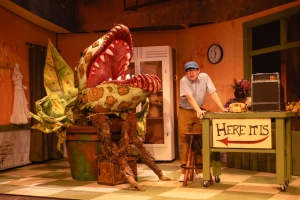
Few musicals are as fun to sing (and watch) as “Little Shop of Horrors”. It’s not a huge surprise that Porchlight Music Theatre is christening their new home at the Biograph with a sure-fire crowd pleaser. Even better news is that their production directed by longtime Porchlight associate Michael Weber, lives up to the high standards they’ve always set for themselves.
Aside from the recent Halloweekend, why “Little Shop”? Why now? For starters, a revival of “Little Shop” has been running off-Broadway since 2019 and has endured the COVID-19 lockdowns and other obstacles. It’s hard to discount the demand, but if New York isn’t your bag, Chicago has something just as mean and green to offer.
Man-eating plant Audrey II is an unlikely allegory for AI, but somehow, it works seamlessly. When viewing “Little Shop” through the lens of capitalism, it’s more than B-movie flavored musical about an alien plant and more of a story about people choosing profit over extinction. In fact, the stage musical has a notably more nihilistic ending than the beloved 1986 film version.
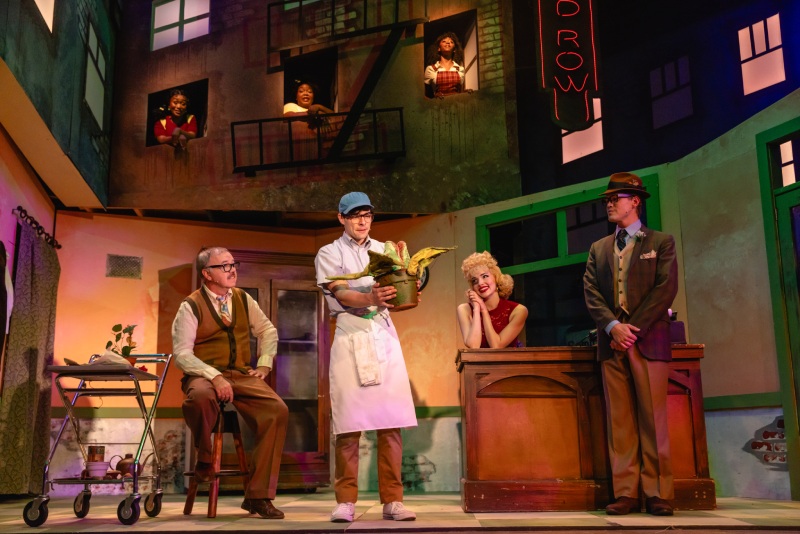
Members of Porchlight's cast of Little Shop of Horrors at Biograph Theater. Photo by Kyle Flubacker.
“Little Shop” has always offered companies an exciting challenge, and that is how to bring the talking, murderous plant to life. The puppets created by Jonathan Berg-Einhorn are animated hilariously by Josh Bernaski and Juwon Tyrel Perry. Let’s just say the puppet budget is noticeable and appreciated.
Porchlight isn’t just relying on staging alone, a talented cast of both non-equity and equity performers round out this glossy production. Alina Taber as Audrey brings a sort of Sarah Sherman of SNL vibe to the flighty floral assistant originated by Ellen Greene. Her quirky sense of comedic timing brings a new angle that makes some of the goofy humor seem fresh. Plus, she has the pipes to bring down the house with her soaring duet "Suddenly Seymour" alongside co-star Andrew Linden, whose earnest portrayal of Seymour Krelborn makes the number all the more affecting.
Linden is another great talent in this casts’ small but mighty arsenal. “Grow for Me” is always an ear worm, but Linden’s powerful voice ensures you won’t forget it. Though, he shines best in the choreo segments. Really though, the entire cast makes Ashman and Menken’s pre-Disney musical numbers leap off the stage.
If it’s been a while, or you’ve never seen a stage production of “Little Shop”, it would be hard to beat Porchlight’s production without boarding a flight to New York. The change of scenery feels like a big step up for one of Chicago’s foremost storefront musical theatre companies. The historic Biograph Theater in Lincoln Park is a space more fitting to the caliber of work Porchlight is known for. And it’s nice to see lights on again at the Biograph which was temporarily shuddered. Halloween might be over, but the AI era, spooky season is now forever, so it’s the perfect time to revisit the 1950s doo-wop fun of “Little Shop of Horrors”.
Through December 13 at Porchlight Music Theatre at Biograph Theater. 2433 N. Lincoln Avenue. 773-777-9884
'Bill W. and Dr. Bob' Tells About AA Founders, and What It Was Really Like to be their Wives

“Bill W. and Dr. Bob,” in its Chicago premiere at the Biograph Theater, tells the exciting story of the 1935 origins of Alcoholics Anonymous, or AA.
Ubiquitous (though by its own traditions it doesn’t advertise), AA has spawned some 200 similar addictive behavior treatment programs (for drugs, compulsive sex and gambling, overeating and more). All use variations on the 12 steps of recovery and structure laid down by its founder, Bill Wilson, a New York Stock broker, and co-founder Dr. Bob Smith, an Ohio surgeon.
With a spare set—a few chairs and a table—“Bill W. and Dr. Bob” delivers a series of quick-cut scenes that carry the exposition on Wilson and Smith as they descend into the depths of alcoholism, treading the same path but driven by different demons. Many of us active in recovery programs rooted in AA know these tales well. The play by Samuel Shem and Janet Surrey brings these stories to vibrant life, unfiltered from the official recovery version.
For one thing, it represents their wives. Known only in AA’s Big Book through the lens of Dr. Bob’s voice, the domestic turbulence in both households related by AA's "Big Book" is from the men’s perspectives.

On stage, see it lived, and find real women with agency. Though they are patient, loyal and long suffering, they are not helpless.
We watch Wilson (played remarkably well by Ronnie Marmo, who also directs) repeatedly struggle to stop drinking. Frequently fired, he continuously heads out to work on his latest venture, sober for the moment—only to return, sometimes days later, to his wife Lois (Katherine Wettermann) with a sob story, hungover, penniless, and filled with more grandiose dreams of how he will escape this latest reversal.
Wetterman gives a great performance as Lois, who challenges Wilson on his dreams, and his drunkenness. Lois harangues her husband when she finds out he has stolen money for drink from her purse—a common experience in the life of those co-habiting with substance abusers—money hard won as Lois works single handedly to keep their home afloat. Angry with Lois about this dressing down, Wilson lifts a chair to strike her, then arrests himself. Even Bill realizes he has gone too far and must find a way out of his alcoholism.
Dr. Bob (Steve Gelder turns in a great performance) is a different kind of drunk, happier, playful—but as a surgeon he is playing with fire every time he operates either hungover, or possibly under the influence. His wife Anne Smith (Elizabeth Rude is excellent) turns to religion, and attends services at the Oxford Group, which had some success helping alcoholics. There she befriends Ebby Thatcher, a recovering alcoholic who reaches out to Dr. Bob. His atheism makes Oxford Group repellant, but eventually Bill Wilson shows up at Dr. Bob’s doorstep in Ohio, in his own quest for a solution to his alcoholism. Wilson sobers up with Oxford, and is introduced to Dr. Bob to see if he can help him.

Wilson’s credibility as a fellow drunk works. He even pours Dr. Bob a drink to calm him enough to listen. When Wilson cites “God” as an aid, Dr. Bob bristles.
“Let’s leave God out of it,” says Wilson, ever the salesman, and they talk. Dr. Bob has agreed to a fifteen-minute chat. But the two end up talking for six hours, and in this connection the seeds of the AA movement are born. We see that Dr. Bob's healing skills as a doctor, and Bill Wilson's formidibale salesmanship, are a perfect combination for the creation of AA.
The second act traces the foundation of the AA organization, and Wilson and Smith’s excitement and conviction that the mutual support of fellow alcoholics is a key to recovery. Dr. Bob and Wilson learn as they go, and there are missteps.
“What we need is a steady supply of stable alcoholics,” Wilson declares.
On stage we meet a second Bill (Phil Aman in the role of Man), an alcoholic hospitalized for treatment. Later his wife (Marla Seidell in the role of Woman) meets up with Lois Wilson and Anne Smith, and this trio of wives creates Alanon, a mutual support group for those living with alcoholics. It can be plausibly argued that AA is the foundation of today’s many, many peer-to-peer support groups rooted in grass-roots action.
Once word spreads about AA, they get them in spades. The organization forms: no dues or membership fees, just a willingness to stop drinking to join. And it spreads rapidly across the U.S., and soon, around the world.
When AA formed, the world was in the throes of the Great Depression, and millions of men lost their jobs, putting their families under duress as well. Bill Wilson was among the many executives whose high flying careers were dashed. Wilson turned to alcohol for solace and escape. As scheme after scheme failed to salvage his career, Wilson found he was more and more dependent on alcohol for relief. Soon enough the balance shifted, as his dependency on alcohol tripped him up just as he seemed set for a successful comeback.
It’s hard to imagine that before this time, there was no methodical, effective program for treating alcoholics, though for centuries charities operated homes for inebriates to sober up. Alcoholism and drug addiction were regarded as moral failings; willpower to stop drinking was seen as the solution. Wilson and Smith offered a different approach: surrender to the understanding substance abusers were powerless to stop, and that they needed some power outside themselves to control the urge to drink or use, and to support them when they were tempted.
At the time of the play, psychotherapy was being developed by Freud and Jung. Jung offered early on that for some “hopeless” alcoholics he had treated, only a more spiritual solution would be effective. “Dr. Bob and Bill W.” explains how AA works, covering all the key developments in the program—surrender to the process, a self examination of one’s weaknesses, support of fellow alcoholics, and making amends to those who have been injured along the way.
The set is designed by Danny Cistone with lighting design by Cortney Roles, who give the stage a noirish feel. Performed more than 350 times by Marmo’s New York/Los Angeles-based Theater 68, “Dr. Bob and Bill W.” will pass muster for those in a 12-step program for its accuracy. And it will appeal to everyone for the exciting story of the origins of this program, which is the foundation of the many self-help and recovery groups that are woven into the fabric of U.S. society. “Dr. Bob and Bill W.” runs through April 14 at the Richard Christiansen Theater of the Biograph Theater in Chicago (2433 N. Lincoln Ave.), in repertory with Marmo’s other and quite wonderful one-man show, “I’m Not A Comedian…I’m Lenny Bruce.”
*Extended through April 28th



Latest Articles
-
 Porchlight’s Out of This World “Little Shop of Horrors” lands at Biograph Theater
Written by John AccroccoFew musicals are as fun to sing (and watch) as “Little Shop of Horrors”. It’s not a huge surprise that Porchlight Music Theatre is christening their new home at the Biograph with a sure-fire crowd pleaser. Even better news is…
-
 Giordano’s delectable Untamed Passion lights the fire of true love
Written by Kimberly KatzFew dance companies can claim both the history and continued relevance of Giordano Dance Chicago. More than sixty years after its founding as Dance Incorporated Chicago in 1963, America's original jazz dance company continues to evolve while remaining firmly rooted…
-
 Theater of the Mind: Not Your Typical Juggernaut
Written by Mitchell OldhamAt this stage of his career, David Byrne’s name alone fills concert halls and theaters. The “singer, songwriter, musician, record producer, actor, writer, music theorist, visual artist and filmmaker” is best known for his affiliation with the rock band Talking…
-
 An Incredibly Good Snapshot of Our Social Discourse in 'Heroes of the Fourth Turning'
Written by Bill EslerSettling in for A Red Orchid Theatre’s Heroes of the Fourth Turning, I knew next to nothing, having no familiarity with the playwright Will Arbery. Partly by design, I avoid preconceived notions and try to listen to the play itself,…
Does your theatre company want to connect with Buzz Center Stage or would you like to reach out and say "hello"? Message us through facebook or shoot us an email at This email address is being protected from spambots. You need JavaScript enabled to view it..
*This disclaimer informs readers that the views, thoughts, and opinions expressed in the text belong solely to the author, and not necessarily to Buzz Center Stage. Buzz Center Stage is a non-profit, volunteer-based platform that enables, and encourages, staff members to post their own honest thoughts on a particular production.