
Displaying items by tag: Raúl Alonso
‘Anatomy of a Suicide’ Is Hard to Watch, But Not Because of the Subject
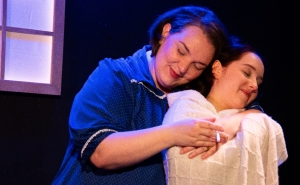
Perhaps surprisingly, Anatomy of a Suicide is not an overwhelmingly emotionally gripping play, nor is it horrifying. Instead, it vividly portrays the slow drip of suffering for Carol, a woman in the grip of depression, living always with suicidal tendencies. It also presents the impact of an intergenerational transference of Carol’s condition on her daughter and granddaughter. Written by British playwright Alice Birch and ably directed by Alex Mallory, it features Tatiana Pavela in the role of Carol, Taigé Lauren as her young adult daughter Anna, and Isabel Lee Roden as her granddaughter Bonnie.
Anatomy of a Suicide is hard to watch because of the design Birch has chosen for it. The central stories of these three women are performed simultaneously for two hours with one fifteen minute intermission. These focal storylines are in three different time frames, years apart. And some characters carry their roles between the timeframes. In other words, it is difficult to follow. A number of actors play multiple roles as numerous ancillary characters, adding to the challenge.
The program is helpful, but audience members are given just a barcode then told to silence their phones, so there is nothing to guide us as we watch. As a consequence, it is only by reading the program afterward, then studying the Wikipedia page for the play, that I could understand more of the details of what I witnessed.
Still, the broad lines of Anatomy of a Suicide on stage are clear enough to appreciate the heart of the story. All three actors are stunning in their roles. Pavela as Carol, whose life revealed, we are told spans the time frame of 1967-1985, registers the emotions that accompany what we now recognize as post-partum depression. We see every nuance of her internal strife as she struggles to meet societal expectations as homemaker and mother in that window of time when expectations of a woman’s place were unquestioned.
For those of us around then, it is an accurate portrayal of the menial roles women were expected to play in family life. And it puts in the spotlight how that period militated against women having an inner life, especially one that ran counter to the foreordained narrative line. Those who were depressed by childrearing or housekeeping bore the brunt of social opprobrium. And if their condition persisted, they might be subjected to brutal mental illness treatments, including shock therapy.
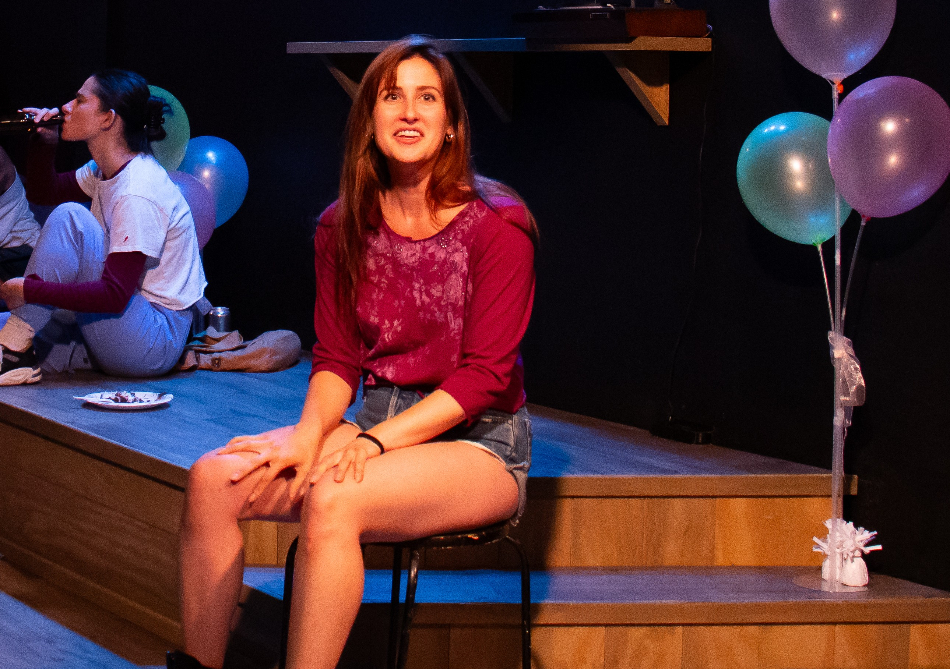
Isabel Lee Roden (left) as Bonnie and Taigé Lauren as Anna in Anatomy of a Suicide.
When we first see Anna, Carol’s daughter, portrayed in the window of 1994-1999 and in her twenties, she is being retrieved by her father, John (Josh Razavi) from a hospital where she was placed following a drug binge. The juxtaposition of these two characters, though in separate unconnected scenes, suggests a link between her mother Carol’s condition and Anna’s drug dependency. Anna emerges from her situation, finds her true love Jamie (Raúl Alonso) marries, and eventually bears a daughter, Bonnie.
We gather the pregnancy and birth are triggering emotionally for Anna. But most of her timeline on stage seems happy. She is a vibrant person. Her wedding day is full of joy; her father embraces her. Taigé Lauren's performance is full, rich and vibrant and it is a pleasure to see her on stage. Another actor, Laila Malak, plays a youthful version of Anna, and it seems that later, during Malak's tenure on stage, she and her father are nearby during a picnic at the moment of Carol’s suicide. This happens later in the play’s sequence, and explains retroactively why Carol was not at Anna’s wedding.
We meet Carol’s granddaughter, Bonnie, who seems to be on the spectrum of some neurodivergent condition. Isabel Lee Roden reflects an inertness in Bonnie, her lack of affect in engaging others. But in climactic moments, Roden leaps from reticence to full-throated dramatic presentation, a great performance that bides its time in deference to the character, but is always there.
To my mind, this is an actor’s play, one for theater professionals, but not something the average ticket buyer would want to see. The play is also burdened with a difficult to market title - Anatomy of a Murder or Anatomy of a Fall have worked, but Anatomy of a Suicide is an unlikely draw. With just 32 seats in the theater, I’m guessing co-producers JunkHeart and The Metal Shop Performance Lab do not have high expectations for revenue. Anatomy of a Suicide runs through August 30, 2026 at Redtwist Theatre in Chicago.




Latest Articles
-
 Robert Falls Directs a Sinfully Satisfying Don Giovanni at Lyric Opera of Chicago
Written by John AccroccoLet he without sin cast the first stone, Lyric’s “Don Giovanni” seemingly says when they bring up the house lights while the cast cheerfully sing about sinners being smote. Lyric Opera of Chicago kicks off the season with a thrilling…
Robert Falls Directs a Sinfully Satisfying Don Giovanni at Lyric Opera of Chicago
Written by John AccroccoLet he without sin cast the first stone, Lyric’s “Don Giovanni” seemingly says when they bring up the house lights while the cast cheerfully sing about sinners being smote. Lyric Opera of Chicago kicks off the season with a thrilling… -
 Inside Six Strange Worlds: Exquisite Corpse VI: LULLABIES
Written by Maddie BurroughsFor its sixth Halloween season, Rough House Theater Co. has transformed Steppenwolf’s Merle Reskin Garage into a spectacular puppet haunted house. Last year I visted House of the Exquisite Corpse V: BLOOD & PUPPETS, and this year’s installment feels familiar…
Inside Six Strange Worlds: Exquisite Corpse VI: LULLABIES
Written by Maddie BurroughsFor its sixth Halloween season, Rough House Theater Co. has transformed Steppenwolf’s Merle Reskin Garage into a spectacular puppet haunted house. Last year I visted House of the Exquisite Corpse V: BLOOD & PUPPETS, and this year’s installment feels familiar… -
 'Sanctuary Stories' Ventures Into Emotional Drama Behind the News on Immigration
Written by Bill EslerSanctuary Stories plumbs the line between theater and journalism, and the powerful human dramas both can depict. Funded by a Northwestern Medill School of Journalism grant to create a verbatim-based theatrical documentary, it is produced, directed and narrated by Craig Duff,…
'Sanctuary Stories' Ventures Into Emotional Drama Behind the News on Immigration
Written by Bill EslerSanctuary Stories plumbs the line between theater and journalism, and the powerful human dramas both can depict. Funded by a Northwestern Medill School of Journalism grant to create a verbatim-based theatrical documentary, it is produced, directed and narrated by Craig Duff,… -
 BrightSide’s Addams Family Musical Revives the Wonderfully Weird World of the Addams Clan
Written by Ken PayneThey're creepy and they're kooky, Mysterious and spooky, They're altogether ooky, The Addams Family. Yes, ooky. BrightSide Theatre’s production of The Addams Family Musical at the Theater at Meiley Swallow Hall feels like stepping back into the wonderfully odd world…
BrightSide’s Addams Family Musical Revives the Wonderfully Weird World of the Addams Clan
Written by Ken PayneThey're creepy and they're kooky, Mysterious and spooky, They're altogether ooky, The Addams Family. Yes, ooky. BrightSide Theatre’s production of The Addams Family Musical at the Theater at Meiley Swallow Hall feels like stepping back into the wonderfully odd world…
Does your theatre company want to connect with Buzz Center Stage or would you like to reach out and say "hello"? Message us through facebook or shoot us an email at This email address is being protected from spambots. You need JavaScript enabled to view it..
*This disclaimer informs readers that the views, thoughts, and opinions expressed in the text belong solely to the author, and not necessarily to Buzz Center Stage. Buzz Center Stage is a non-profit, volunteer-based platform that enables, and encourages, staff members to post their own honest thoughts on a particular production.