
Displaying items by tag: Derek Bertelsen
Astonrep Approaches Uncle Vanya’s Appeal from a Novel New Angle
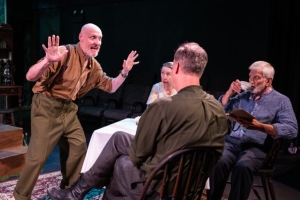
Anton Chekhov, a Russian playwright who was also a doctor, can claim a level of regard few writers achieve and maintain so long after their deaths. Born in 1860, the same year the Republican Party nominated Abraham Lincoln for President, his plays are routinely produced on stages in America and around the world because of what they reveal about who we are. That’s especially true for Chekhov’s Uncle Vanya, written in 1899, just a few years before the playwright died. Its popularity may be due to its mystery. Is it about resilience or is it about failure? Is it a comedy or a tragedy? It’s the kind of work that leaves you with questions about not only its two main characters, Sonya and her Uncle Vanya, but also about us.
A part of the city’s theater community since 2011, Astonrep Productions is a small Chicago company intent on “creating compelling and intimate experiences that challenge audiences”. Their interpretation of Uncle Vanya that opened over the weekend at The Edge Off Broadway succeeds in doing so with some reservations.
It’s the first American company to mount this commissioned 2024 Canadian adaptation of Chekhov’s classic. Liisa Repo-Martell’s revamp of the play dutifully adheres to the structure, plot themes and character composition of the original. But the play’s softer aspects, the features that define its essence and purpose, are less reliable and sure.
Displeasure with self is one of first things we get a sense of when the play opens. But even before that awareness sets in, there’s a curiosity the audience notices while they’re selecting their seats before the play begins. A man is slouched in an upholstered chair with one leg over its arm. He’s at the back of the stage and asleep. (We later learn he’s passed out drunk.) Soon after and closer to us, a man and woman are talking. They’re in the sprawling home of a rural Russian estate well over 100 years ago. He’s Mikhail Astrov (Robert Tobin), the local doctor and she’s Marina, a housekeeper very ably played by Liz Cloud, who clearly possesses a warm motherly instinct and a sharp wit. Astrov’s lamenting his fate as a country doctor. It’s all tedium. The people are gossip thirsty “savages”. His life has no fulfillment. He’s not married. He’s not in love with anybody and his youth is behind him. The demands of his work, a sour outlook and his liberties with vodka are catching up with him by slowly dismantling his good looks.
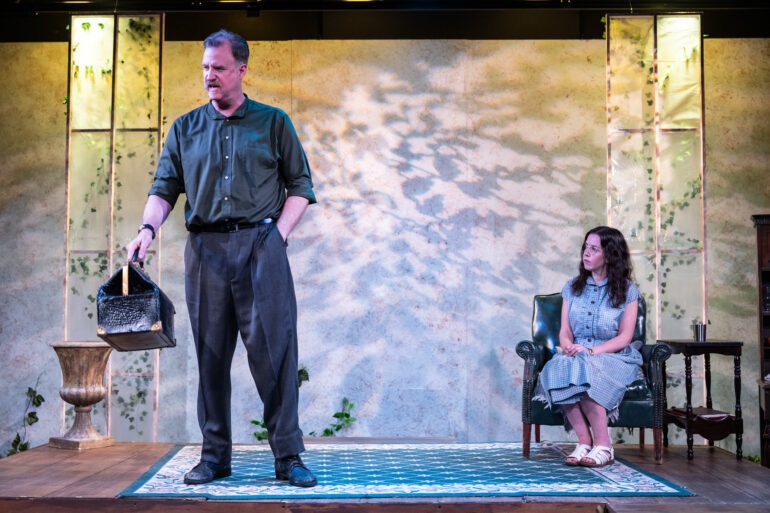
L-R: Robert Tobin, Natalie Hurdle. Photo by Paul Goyette.
By calling him a moron, the doctor’s antipathy for the sleeping man is made clear even before he wakes up.
As more people enter the story, we find ourselves in the middle of a family crisis. Vanya, the man who was sleeping in the chair, and his niece Sonya (Natalie Hurdle) have been the caretakers of the estate since her mother died. Sonya’s father, Alexandre (Geoff Isaac), is a professor in the city who’s been forced out of his university position and has now returned to the homestead. He’d been relying on income from the estate to support his lifestyle in town. He’s not returned alone. Joining him is his much younger and very beautiful second wife, Yelena, with Andi Muriel in the role. Things are tense. Alexandre’s pompous and obliviously demanding. And Vanya, played with visceral intensity by Rian Jairell, is demonstrably resentful.
An appeasing conflict avoider, Sonya’s loyalties are split between the natural draw a child has to her father and her uncle who’s labored with her to keep the estate viable at tremendous personal sacrifice to them both. Now a young woman, she seems to know it’s Vanya who’s been more the nurturing father presence for her and that other than each other, the estate is all that either of them have.
Additional strain is added with the presence of Yelena. Her beauty is like an intoxicant for both Vanya and the dissatisfied doctor, Astrov. They’re both brazen in their desire for her. Watching them shamelessly try to seduce her is equal parts comic and piteous.
With so much instability, friction and doubt in the air, you’d expect to feel the charge of that energy engulfing the air. Directed by Derek Bertelsen, it doesn’t arrive with any real intensity until the second act when Sonya’s father floats the idea of selling the estate. And that’s despite the considerable investments Jairell as Vanya had been contributing up to that point. Because It’s so transparent Alexandre wants the money from the sale to fund his return to the city and his refined form of living, Vanya’s resentment turns to rage. Finally filling the production with heat.
It dials up too when Sonya confesses her attraction, indeed love, for Astrov to Yelena. Unrequited never looked so vulnerable and fragile.
Part of Repo-Martell’s adaptation included revising the language to be more contemporary and ostensibly more approachable. It works in an essential way. Both Jeremiah Barr’s handsome set and Natalie Shoch’s costume designs are ambiguous enough to blur any specific time reference. But in the back of your mind you know this is all happening in a very distant time and place. One where duty and tradition held much more sway. That difference can often be found in the words used to express and explain obligations and choices. Here there’s a nagging sense that you may be missing important steppingstones.
In the end, things aren’t much different from where we found them in the beginning. Except everyone is much more depleted. Drained. But still tasked with shouldering their disappointments and continuing with their lives. In Chekhov’s original script, the word “rest” is used to represent that place of willful resignation that amounts to acceptance of one’s inevitable destiny. In this adaptation, the word “peace” is substituted. They say the same thing about something we’ve all experienced. When we’ve had to pull ourselves up out of the ashes and push forward. Uncle Vanya brings that feeling front and center and offers understanding through catharsis. That alone will keep it in heavy production for a few more centuries at least.
Uncle Vanya
Through July 5, 2026
Astonrep Productions
Venue: The Edge Off Broadway
1133 W. Catalpa Avenue
Chicago, IL 60640
For more information or tickets: https://www.astonrep.com
This review is proudly shared with our friends at www.TheatreInChicago.com.
Reservation Mayhem, One Man, Forty Voices: Mike Newquist Ignites 'Fully Committed' at The Den

Get ready - those phones are about to explode, and Sam is already spinning like a top trying to catch every single one. It’s a full‑blown ring‑storm, and he’s diving into it with the hectic energy of someone who knows the chaos is coming and still can’t outrun it.
A brisk, razor‑funny powder keg of a play, Fully Committed tracks a single frantic day in the life of Sam, the lone reservationist at one of Manhattan’s most elite - and most impossible - restaurant. Becky Mode’s script is a full‑tilt high‑wire act, and Mike Newquist tears across nearly forty characters with the kind of breakneck precision that makes your head spin. As Sam, he’s already a live wire - but then he’s also snapping into entitled celebrities, neurotic assistants, tyrannical chefs, and every flavor of fine‑dining madness that dares to ring his desk. It’s dazzling, anxious, and wildly fun to watch him juggle it all without ever dropping the thread. The comedy snaps because each character is so sharply etched, and Newquist seamlessly shifts among them with the kind of finesse that turns mayhem into art.
At its heart, the nearly 90-minute play gleefully skewers the rituals of status and the agitated, almost feral hunger for exclusivity, exposing just how ridiculous people become when a reservation turns into a badge of power. Sam becomes the unseen fulcrum of that world, and his day unravels from merely hectic to outright surreal as he absorbs tantrums, negotiates impossible demands, and fights to keep a grip on his own sense of worth. Watching Newquist as Sam behind that reservation desk in a constant tinderbox had me instantly aware that I wouldn’t survive two hours in his shoes. His frantic charm and barely contained panic sells the chaos and sparks a whole new respect for the people who actually thrive in that kind of daily combustion.
Fully Committed lands as hard as it does because it’s rooted in real industry absurdity. Mode shaped these characters straight out of real restaurant‑world encounters, giving the show a mix of satirical whirlwind and a bite of truth that feels both sharply recognizable and wickedly real.
Throughout the play, I loved how Sam’s dad kept slipping into the heavy commotion with that gentle, grounding voice - just long enough to let the whole room exhale. Each time he called, Sam’s entire demeanor flipped in an instant; you could watch him go from frazzled to peaceful like someone had hit a reset switch. Those brief check-ins made it clear how a few steady words from a gentle, supportive father (or friend/family member) can cut straight through the noise, offering a tiny pocket of calm even when everything else is burning down around him.
Mike Newquist is pure kinetic joy onstage, delivering a commanding turn in Fully Committed. The Chicago‑based actor and improviser thrives in the city’s storefront trenches, bouncing between sharp‑edged comedy, character chameleon work, and the kind of ensemble disorder where anything can - and usually does - happen. He’s popped up with PrideArts, AstonRep, and The Comrades, tackling everything from contemporary drama to high-velocity comic mayhem. In Fully Committed, it’s his quick‑switch agility that makes him a blast to watch.
Directed by Derek Bertelsen, this Chicago staging arrives with a jolt of fresh energy and real immediacy. Newquist’s performance becomes the engine that drives the whole night, while Bertelsen keeps the momentum razor‑sharp, the pacing tight, and every character shift snapping cleanly into place.
The Den Theatre hosts the run March 13–28, 2026, with performances on Friday and Saturday nights at 7:30 p.m. Tickets for Fully Committed at The Den Theatre are just $26. For tickets and/or any more show information, click here.
Recommended.
This review is proudly shared with our friends at www.TheatreInChicago.com.
Peter Shaffer's Equus Receives a Vivid Production By AstonRep, But Is a Tad Rushed

The late British playwright Peter Shaffer broke into new and radical territory with Equus. First produced in 1974 (and based loosely on a true event), the play tells of a grotesque crime by a teenaged boy, Alan Strang (Sean William Kelley is excellent) who put out the eyes of six horses in a stable. Strang is given a purposeful but extended nude scene, and presents us with his religio-erotic (though not sexual) relationship with horses. It tends to sell a lot of tickets.
Shaffer, who rose to even greater fame for his 1979 Amadeus – both a hit play and movie - was masterful in crafting “thinking” works. In Equus, he gives us the character of Alan's therapist Martin Dysart (Rian Jairell brings an understanding of the role), a figure struggling through his own dark night of the soul. Dysart feels he is on a treadmill, only healing young people who, as they "normalize," lose some of the magical and imaginative qualities that also drive their aberrant behaviors.

That is particularly the case with Alan, who has developed an emotional fetish for horses in a Dionysian merger of the sexual and spiritual. But following the horrifying incident (it is shown as a recalled memory only at the end of the play), Alan is withdrawn, nearly catatonic, staring at the television, babbling advertising jingles, with difficulty relating or, understandably, recounting the event. A court magistrate, Hesther Salomon (Alexandra Bennett), brings the bizarre case to child psychologist Dysart, who must unravel what led the boy to his heinous act, and try to heal him.
But as he unwraps Alan's psyche, Dysart increasingly regrets his own station in life. “This is more than professional menopause,” Dysart complains to Hesther. "I'm jealous of Alan Strang. Such a fantastic surrender to the primitive!"

Hesther's character as a fellow professional allows the two to comment for the audience’s benefit on the progress of the case. Dysart also looks for clues in the tensions between Alan’s parents, the excessively religious mother Dora Strang (Julie Partyka) and his austere atheist father Frank Strang (Robert Tobin).
AstonRep has given this production of Equus at The Edge Theatre much of the power that must have made the original so notable – using choreography and stylized puppetry (Jeremiah Barr) - with imposing horse masks on six players. As Dysart painstakingly works to get Alan Strang to open up, we learn of the boy's history working with horses, his love for them, and Alan re-enacts scenes with his favorite horse - Nugget – very well played by Jordan Pokorney who doubles as the stablemaster, Horseman.
In a notable scene, Alan mounts Nugget for a midnight ride on his beloved animal. And gradually, using hypnois and other therapeutic techniques, Dysart reveals Alan's skewed and rather sexualized worship of Nugget, who in Alan’s mind transforms to a horse god, Equus. Some of the therapeutic descriptions Dysart gives to Hesther sound a little dated, or even a bit offhand. Dysart uses the term "abreaction," something that dates back to Freudian psycholanalysis and is less current today. In describing his plans to trick Alan into deeper revelations, he sounds almost unprofessional by today's standards.
There is an intensity and earnestness in the performances in this Equus – but director Derek Bertelsen needs to help the actors play off one another a little more, Instead, each actor plays for himself – though sometimes to good effect. Sean William Kelly as Alan Strang is a protrait of youthful estrangment, so his lack of chemistry with Dysart almmost makes sense - but seems unlikely in therapy. Alan's young love interest Jill Mason (Malia Hu) makes a good match with a nice frisson. By contrast, in scenes with Dysart it is as though the actors are in two different plays.
Julie Partyka is compelling as Alan's mother Dora. “I’m a parent. We gave him the best we could. Whatever has happened has happened because Allen is ’him.’ He is not just the sum of us added up. The devil isn’t what mommy said or daddy said."
Where this Equus stumbles – and perhaps it was just the performance I saw - was in hearing and understanding the power of Martin Dysart’s internal struggle. Jairell gave us a rushed, and consequently somewhat monochromatic delivery. Even more so for Hesther Salomon – Bennett sometimes talked over the ends of Jairell’s sentences.
Because Dysart is so essential, I would love to see the language slowed down just a bit. Regardless, Equus is highly recommended for the quality of this production, and for a chance to see this ineffable work by a dramatic master. Equus runs through October 27 at The Edge Theatre, 5451 N. Broadway in Chicago.




Latest Articles
-
 Goodman's Dead Girl’s Quinceañera: When Fifteen Meets the Adult World
Written by Wesley DavidAt fifteen, the world can feel like a television show you haven't quite figured out how to turn off. For Salma (Jacqueline Guillen), it may be even more difficult. She watches too much television—especially detective shows—and has begun to see…
Goodman's Dead Girl’s Quinceañera: When Fifteen Meets the Adult World
Written by Wesley DavidAt fifteen, the world can feel like a television show you haven't quite figured out how to turn off. For Salma (Jacqueline Guillen), it may be even more difficult. She watches too much television—especially detective shows—and has begun to see… -
 Chicago City Opera Delivers a Rare Operatic Haunting with Der Vampyr
Written by Ken PayneWith Halloween creeping closer, there’s something fitting about revisiting one of opera’s earliest flirtations with macabre horror - especially in a production presented and performed by Chicago City Opera (COT). Der Vampyr may not enjoy the mainstream familiarity of later…
Chicago City Opera Delivers a Rare Operatic Haunting with Der Vampyr
Written by Ken PayneWith Halloween creeping closer, there’s something fitting about revisiting one of opera’s earliest flirtations with macabre horror - especially in a production presented and performed by Chicago City Opera (COT). Der Vampyr may not enjoy the mainstream familiarity of later… -
 Collaboraction to premiere Mud Life, drawn from Willie Round’s experience as a writer and rapper on Chicago’s west side, October 21-November 15
Written by Buzz Center StageMud Life, a world premiere drama by Chicago writing duo G. Riley Mills and Willie Round, drawn from Round’s life experiences as an emerging writer, rapper and producer, opens Collaboraction Theatre’s 2026-27 season, October 21 - November 15.Round and Mills…
Collaboraction to premiere Mud Life, drawn from Willie Round’s experience as a writer and rapper on Chicago’s west side, October 21-November 15
Written by Buzz Center StageMud Life, a world premiere drama by Chicago writing duo G. Riley Mills and Willie Round, drawn from Round’s life experiences as an emerging writer, rapper and producer, opens Collaboraction Theatre’s 2026-27 season, October 21 - November 15.Round and Mills… -
Steppenwolf Theatre's ADIRONDACK CHAIR CIRCLE In Rehearsal – Playing October 22 – December 6, 2026 – World Premiere!
Written by Buzz Center StageSteppenwolf Theatre Company, the nation's premier ensemble theater company, is pleased to launch its 51st Season with the world premiere of Chicago playwright Stephanie Alison Walker's biting satire Adirondack Chair Circle, directed by Tony Award winner Pam MacKinnon (Downstate, Edward Albee's Who's Afraid of Virginia…
Does your theatre company want to connect with Buzz Center Stage or would you like to reach out and say "hello"? Message us through facebook or shoot us an email at This email address is being protected from spambots. You need JavaScript enabled to view it..
*This disclaimer informs readers that the views, thoughts, and opinions expressed in the text belong solely to the author, and not necessarily to Buzz Center Stage. Buzz Center Stage is a non-profit, volunteer-based platform that enables, and encourages, staff members to post their own honest thoughts on a particular production.