
Displaying items by tag: Teressa LaGamba
Pure Vocal Magic: Goodman’s Octet Redefines Musical Innovation
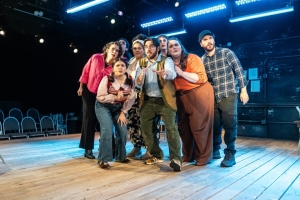
Dave Malloy’s Octet is a musical with daring aspirations, currently gracing the stage in a powerhouse co-production between the Raven Theatre and the Goodman Theatre. This staging, directed by Keira Fromm, first debuted at the intimate Raven Theatre, where it enjoyed a highly successful run before its move to the Goodman - a transition that proves the project is as robust as it is ambitious. Octet stands apart as a completely a cappella experience, relying entirely on the human voice to build its intricate, immersive, and haunting soundscape.
Malloy’s imprint is everywhere in this piece. He wrote the music, lyrics, book, and even the intricate vocal arrangements, crafting a score constructed without a single instrument to generate its tension, beauty, and emotional architecture.
Set in a sparse, church-basement style meeting room, the play introduces us to the “Friends of Saul,” a support group for people struggling with internet addiction. Their relationship to the online world is so fraught that they refuse to say its name, calling it only “the monster” to avoid giving it more power. Throughout their time together, the eight participants take turns sharing fears of being canceled, pornography, gaming, the pull of incel communities, and the inability to connect with others. Their discussions are brutally honest, darkly comedic, laced with expletives, and at one point offer an especially disturbing illustration of just how grotesque the monster can be. It’s unlike anything before.
The show threads each character’s intimate, emotionally charged account into sweeping ensemble passages that rise like contemporary hymns, the group joining voices to confront and grieve the “monster” that binds them. The interplay creates a pulse that feels communal and ritualistic, as though every personal admission is carried forward and reshaped by the collective.
The performances are nothing short of a whirlwind. The talent onstage is beyond belief. The ensemble showcases astonishing vocal mastery, blending with precision to create rich, enveloping music.
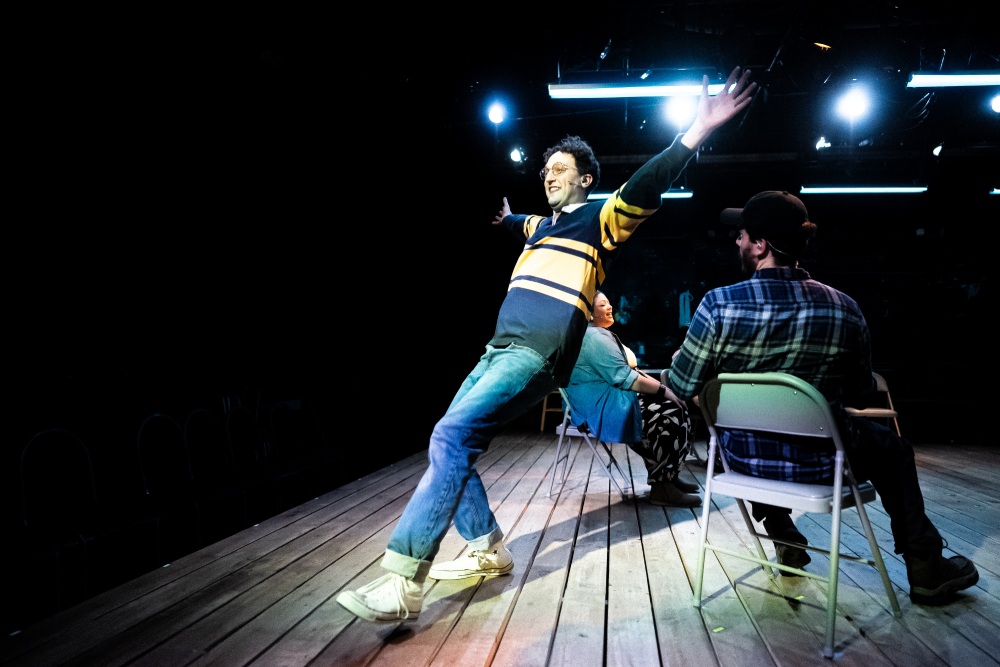
Sam Shankman in Dave Malloy's Octet at Goodman THeatre in collaboration with Raven Theatre. Photo by Joe Mazza.
Neala Barron, as Jessica, is phenomenal with powerhouse vocals and a dynamic stage presence. Her rendition of “Refresh” is delivered with the intensity of a tiger trapped in a cage, perfectly capturing the visceral feeling of being humiliated online and the subsequent rage against the world. Along with dramatic chops, she makes her comedic lines sizzle.
Sam Shankman plays the comedy perfectly as Henry. His portrayal of a tone-deaf, slightly dorky addict is both identifiable and deeply empathetic. His song “Candy” is a standout that demonstrates how this ensemble can craft story using only a cappella sound and how their movement reinforces the narrative.
Teressa La Gamba, as Paula, the group’s moderator, brings a gentle strength and compassion that helps root the show. But when she sings, it feels as if the roof will fly off. She commands the stage with perfect vocal precision, whether in a solo or complex ensemble passages.
The set is intentionally sparse and open, which functions perfectly for the show’s focused format, a choice scenic designer Milo Bue shapes with thoughtful restraint. The lighting design, crafted by Maximo Grano de Oro, is similarly impressive. Overhead lights shift deftly from the feel of a bland meeting room to the vibrant, chaotic interior of a Candy Crush interface or the dark corners of a character’s mind. In an instant, you can be transported to an entirely different plane and lost in its overwhelming atmosphere.
As the plot unravels, the staging seems intent on exploring where hope can or cannot be found, and it makes clear that faith-based religion is not where it looks. The script often approaches Christian belief with a skeptical edge, sketching certain “believer” archetypes in broad, unflattering strokes. The structure of “Friends of Saul” reinforces this orientation, lightly echoing the format of Alcoholics Anonymous. AA, one of the most widely recognized recovery communities, is often described as spiritual in nature, while many participants experience it as rooted in a faith-guided model, as it was originally intended. “Friends of Saul,” by contrast, operates with a more nonreligious bent, occasionally running out of pamphlets for “Steps for Agnostics and Atheists,” a detail made all the more ironic given that their meetings take place in a church basement - a space that pointedly distances itself from the faith‑oriented tradition AA is often associated with.
That contrast deepens in “Little God,” one of the staging’s more unusual songs. Here, Marvin (Jordan Golding), a committed atheist, describes an encounter with an all-powerful being represented onstage by a small girl and reflects on his compulsion to debate creationists about evolution. The moment is very much Malloy’s choice, framing Marvin’s fixation as a kind of intellectual loop: the irresistible pull of trying to reason through the idea that something as vast as existence might emerge from nothing at all, a purposeful artistic angle that shapes the show’s worldview.
Given these choices, the staging’s perspective may not resonate as strongly with audiences who hold traditional Christian views, which seems intentional, reflecting a deliberate direction in Malloy’s overall vision. In contrast, the show places greater emphasis on new age spirituality and tarot, treating these elements with notable sincerity. Each character has direct parallels to tarot cards, and Velma (Joryhebel Ginorio) finds her spiritual awakening through them. In fact, she is the only member of the group who speaks the monster’s true name, “internet,” throughout the night. Ultimately, the musical suggests that a blend of new age spirituality and human connection is the most viable path to inner peace.
Although these elements may pose challenges for certain audiences, Octet remains a triumph of vocal performance. These actors represent the highest caliber of Chicago talent, and when their voices come together, the result is breathtaking and inspiring. If you are looking for choral artistry, Octet delivers. For some audiences, Octet’s philosophical stance may feel more contemplative than corrective, raising more questions than answers about our relationship to the online world - but its musical brilliance makes the journey more than worthwhile.
Recommended.
Venue: The Goodman Theatre – The Owen 170 N. Dearborn Street, Chicago
Run Dates: Through August 2
Performance Schedule:
- Wednesdays: 7:30 p.m.
- Thursdays: 2:00 p.m. & 7:30 p.m. (No evening performance on July 30)
- Fridays: 7:30 p.m.
- Saturdays: 1:00 p.m. & 7:30 p.m.
- Sundays: 2:00 p.m. (Additional 7:30 p.m. performance on August 2)
Running Time: 1 hour, 35 minutes (no intermission)
Box Office: 312-443-3800
Tickets: https://www.goodmantheatre.org
Raven Theatre Delivers a Revelatory, Unmissable Octet

There’s a rare kind of theatrical experience that transcends personal taste. Even if a genre is not typically your first choice, the sheer level of artistry on display is impossible to deny. That is exactly what director Keira Fromm’s production of Octet accomplishes: a vocally astonishing, emotionally resonant, and meticulously staged production that leaves you in complete awe of the performers.
Centered around a support group for people struggling with various forms of internet and technology addiction, Dave Malloy’s 2019 chamber choir musical somehow feels even more relevant now. Octet explores the strange, funny, isolating, and deeply human ways people use the internet to cope, connect, and self-destruct. Each member of the eight-person ensemble embodies a different facet of online dependency, from social media obsession to gaming to pornography to niche internet rabbit holes.
While the characters are intentionally heightened at times, what makes the show so effective – and a little scary – is how recognizable they still feel. The humor comes easily, but it is the moments of uncomfortable self-recognition you experience with each and every character that linger long after the show ends.
The production is, above all else, a staggering vocal achievement – made even more impressive by this marking Raven Theatre’s first musical production. Performed almost entirely through a cappella and chamber-style music, Octet demands an unbelievable level of precision, memorization, and endurance from its cast. The eight performers remain onstage for the full show, seamlessly moving between emotionally vulnerable monologues, intricate harmonies, comedic ensemble numbers, and soaring solo ballads without ever losing momentum. The result is one of the most impressive live vocal performances I have seen in quite some time.
What makes the cast especially remarkable is not just the technical perfection of the singing – though there genuinely was not a single noticeable missed cue, stumble, or musical lapse throughout the performance – but the way every performer remains completely locked into their character while executing extraordinarily difficult material. The ensemble operates like a perfectly synchronized machine, yet never sacrifices emotional authenticity for precision.
Two particular standouts were Teressa LaGamba (Paula), whose warmth and compassion radiated through every interaction and whose vocals carried extraordinary emotional clarity, and Sam Shankman (Henry), whose flamboyant humor and painfully relatable awkwardness made him both hilarious and unexpectedly touching. Shankman’s chemistry with the rest of the ensemble elevated nearly every scene he was part of, reinforcing the deeply interconnected energy that makes the show work so well.
Technically, Octet is relatively minimalist, but Raven Theatre’s production proves how impactful thoughtful simplicity can be. Utilizing the backstage area of the company’s black box theatre to create the atmosphere of a sparse church basement, scenic designers Milo Bue and Wynn Lee embrace an intentionally unpolished environment that perfectly suits the material. Every design choice feels purposeful.
The true technical standout, however, is Maximo Grano De Oro’s lighting design (with Ruby Lowe and Emmitt Socey as Master Electricians). Great lighting often goes unnoticed because of how seamlessly it integrates into a production, but the work here is impossible not to appreciate once you begin paying attention. Countless meticulously timed lighting cues transform otherwise ordinary fluorescent fixtures into an incredibly dynamic storytelling device, adding depth, tension, warmth, and unease in ways that subtly shape every moment of the show. The precision of the programming and cue choreography demonstrates an extraordinary level of care and intentionality, elevating the entire production without ever distracting from it.
With a newly announced film adaptation directed by Lin-Manuel Miranda and featuring an all-star cast already generating major excitement, Raven Theatre could not have picked a better time to stage Octet. Their production captures everything that makes the musical so singular: its humor, its humanity, its discomfort, and its breathtaking musicality. It is a deeply modern show presented with extraordinary care, and it sets an incredibly high bar for any future stagings.
Octet is running at Raven Theatre through June 7th. Tickets are available at https://www.raventheatre.com/stage/octet/.
This review is proudly shared with our friends at www.TheatreInChicago.com.




Latest Articles
-
 The Attic at Goodman Theatre Redefines Memoir Through Breathtaking Physical Storytelling
Written by Maddie BurroughsAt intermission, I sent Ken, Buzz Center Stage’s managing editor, a text: “So thankful I made it!! It’s intermission, and if there’s one show anyone sees it should be this.” By the time the lights came up at the end…
The Attic at Goodman Theatre Redefines Memoir Through Breathtaking Physical Storytelling
Written by Maddie BurroughsAt intermission, I sent Ken, Buzz Center Stage’s managing editor, a text: “So thankful I made it!! It’s intermission, and if there’s one show anyone sees it should be this.” By the time the lights came up at the end… -
 Babes With Blades's Announces William Shakespeare's KING LEAR, playing October 22 - November 21
Written by Buzz Center StageBabes With Blades Theatre Company’s (BWBTC) announced today new production dates for the final production in its 2026 season, William Shakespeare’s King Lear, directed by Alison Dornheggen and fight choreography by Jess Pennachio, the new dates are now October 22 - November 21 in Theatre 3 at Theater Wit,…
Babes With Blades's Announces William Shakespeare's KING LEAR, playing October 22 - November 21
Written by Buzz Center StageBabes With Blades Theatre Company’s (BWBTC) announced today new production dates for the final production in its 2026 season, William Shakespeare’s King Lear, directed by Alison Dornheggen and fight choreography by Jess Pennachio, the new dates are now October 22 - November 21 in Theatre 3 at Theater Wit,… -
Open Space Arts Presents BEFORE WE ARE HISTORY October 23 – November 8
Written by Buzz Center StageOpen Space Arts presents BEFORE WE ARE HISTORY, a three-week theatrical exploration of LGBTQ+ theater created during and in response to the AIDS crisis, running October 23 through November 8, 2026, at Open Space Arts, 1411 W. Wilson Ave. in Chicago.The project…
-
The Jinkx & DeLa Holiday Show - December 6th at Auditorium Theatre
Written by Buzz Center StageThe greatest holiday show south of the North Pole returns for its 9th year with another brand spankin' new wintertide wonder! Award-winning comedy icons, writers, actors, and drag queen powerhouses BenDeLaCreme & Jinkx Monsoon are coming back to town with…
Does your theatre company want to connect with Buzz Center Stage or would you like to reach out and say "hello"? Message us through facebook or shoot us an email at This email address is being protected from spambots. You need JavaScript enabled to view it..
*This disclaimer informs readers that the views, thoughts, and opinions expressed in the text belong solely to the author, and not necessarily to Buzz Center Stage. Buzz Center Stage is a non-profit, volunteer-based platform that enables, and encourages, staff members to post their own honest thoughts on a particular production.